building a side project
2013
- Get an idea
- Open laptop
- Start coding
- Deploy
- Done
2026
- Get an idea
- Ask ChatGPT if idea is good
- Ask Claude for validation
- Ask X for feedback
- Buy domain
- Change domain
- Pick tech stack
- Change tech stack
- Pick database
- Setup auth
- Setup analytics
- Setup payments
- Watch productivity videos
- Forget original idea
The programming space absolutely sucks these days. The algorithm heavily rewards AI content over actual coding content. Don't let all this noise and fear paralyze you. Believe in the path of traditional handwritten coding, develop the skills you need to clear interviews and don't forget to take care of yourself.
Top resources for backend/systems learning:
- OS Dev Wiki
- Beej's Guides
- Julia Evans' Blog
- Low Level Programming University
- Computer Science from the Bottom Up
- Crafting Interpreters
- The Linux Documentation Project
- Writing an OS in Rust
- Destroy All Software
- Casey Muratori's courses
- MIT OpenCourseWare
- Compiler Explorer
- Computer Systems: A Programmer's Perspective
- Hacker News
- Lobsters
- /r/systems
- ByteByteGo
- High Scalability
- Martin Kleppmann's Blog
- Architecture Notes
- The Morning Paper
- Brendan Gregg's Blog
- Dan Luu's Blog
- Phil Eaton's Blog
- Database Internals (book)
- Designing Data-Intensive Applications
- Systems We Love talks
- Strange Loop conference videos
- Papers We Love
- CMU Database Group
Top resources for backend/systems learning:
- OS Dev Wiki
- Beej's Guides
- Julia Evans' Blog
- Low Level Programming University
- Computer Science from the Bottom Up
- Crafting Interpreters
- The Linux Documentation Project
- Writing an OS in Rust
- Destroy All Software
- Casey Muratori's courses
- MIT OpenCourseWare
- Compiler Explorer
- Computer Systems: A Programmer's Perspective
- Hacker News
- Lobsters
- /r/systems
- ByteByteGo
- High Scalability
- Martin Kleppmann's Blog
- Architecture Notes
- The Morning Paper
- Brendan Gregg's Blog
- Dan Luu's Blog
- Phil Eaton's Blog
- Database Internals (book)
- Designing Data-Intensive Applications
- Systems We Love talks
- Strange Loop conference videos
- Papers We Love
- CMU Database Group
Anthropic's own study proves Vibe-Coding and AI coding assistants harm skill building.
"AI use impairs conceptual understanding, code reading, and debugging abilities, without delivering significant efficiency gains on average"
Developers learning 1 new Python library scored 17% lower on tests when using AI.
Delegating code generation to AI stops you from actually understanding the software.
Using AI did not make the programmers statistically faster at completing tasks.
Participants wasted time writing prompts instead of actually coding.
Scores crashed below 40% when developers let AI write everything.
Developers who only asked AI for simple concepts scored above 65%.
Managers should not pressure engineers to use AI for endless productivity.
Forcing top speed means workers lose the ability to debug systems later.
----
Paper Link – arxiv. org/abs/2601.20245
Paper Title: "How AI Impacts Skill Formation"
indian clients are a different breed.
worked with a founder once. delivered the mvp and full handover docs. also did a lot of extra work out of goodwill.
one of the lowest paid gigs i’ve taken too, only because they were from my hometown. (currently in sf, btw)
then the mvp “died” because their openai quota/subscription ran out. suddenly it became “how is this dead?”, “this is your job”.
so i confronted them. told them to sit down for a second. first, i had already lowered my rates when they pleaded saying they didn’t have much money right now. second, everything was properly documented in the handover.
told them - keep your tone requesting, not authoritative. i'm the one here going extra mile.
and even after that i still hand-held them through fixing the envs and setup.
once it was working again, they said “we can still work long term if you want”.
i told them they can go kick rocks. never again.
The guy who wakes up at 10am and goes straight to his laptop
Will go further than the guy who wakes up at 6am, journals, meditates, and does everything except the actual WORK
Don't get caught in the self improvement trap without actually moving the needle
Kids born 2000–2004:
- Corona fucked up everything
- After corona, students forgot how to write on paper
- Worst college life
- No real friends
- Unemployment arc
- War and missiles
- AI taking real jobs
- Mental health issues and depression
- Anyone can write code, real devs not needed
- No healthy life
THE FIRST CLOUD INFRASTRUCTURE CASUALTY OF WAR
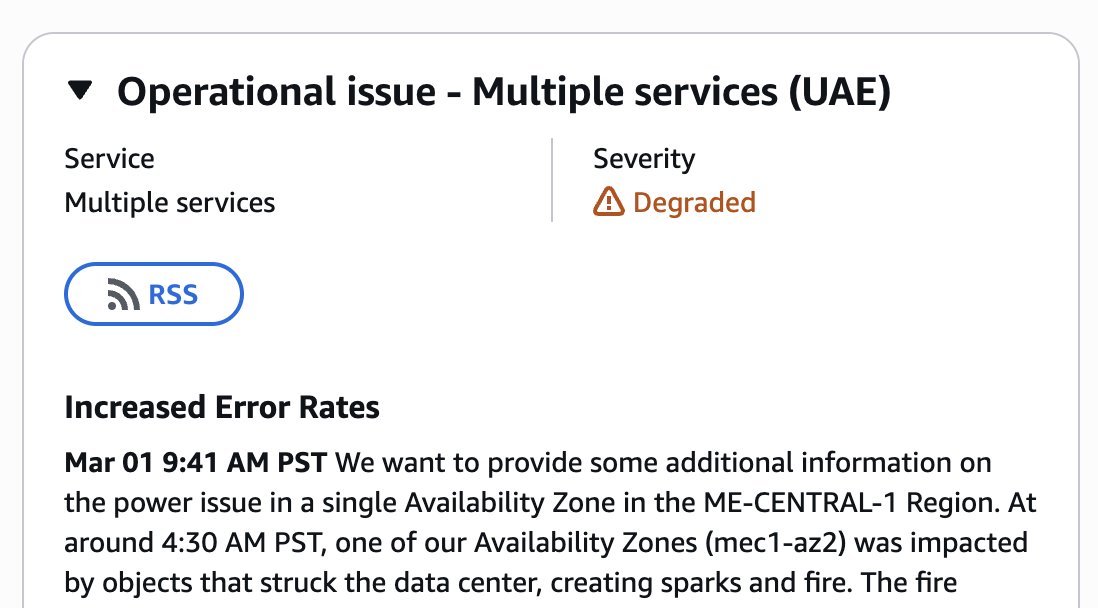
An Amazon Web Services data center in the UAE just got hit.
AWS confirmed that at approximately 4:30 AM PST on March 1, “objects struck” the facility in availability zone mec1-az2, creating sparks and igniting a fire. The UAE fire department cut power to the building. The zone went dark. AWS says other zones remain operational and restoration will take several hours.
Read that sentence again. “Objects struck.”
The most valuable corporate infrastructure on earth is now absorbing kinetic damage from a state-level military conflict, and the world’s largest cloud provider is describing missile or drone debris as “objects” because no corporate communications playbook exists for this scenario.
This is the first time in history that a major hyperscaler data center has been physically struck during a war.
Every cloud architecture slide deck in every boardroom on earth assumes physical security means perimeter fences and biometric locks. Not ballistic missile defense. Not drone intercept capability. Not wartime fire suppression while the building next door absorbs ordnance.
The Jerusalem Post reported the facility was used by Israel’s military. If confirmed, Iranian targeting of dual-use cloud infrastructure transforms every data center in a conflict-adjacent geography from civilian asset to military target. The distinction between cloud infrastructure and defense infrastructure just collapsed.
And the geography matters enormously. AWS chose the UAE for its Middle East region precisely because Dubai and Abu Dhabi offered stability, connectivity, and proximity to enterprise clients across the Gulf. That thesis died on a Saturday morning when Iranian drones struck the Burj Al Arab, hit Jebel Ali port, and set fire to a data center running workloads for governments, banks, and military operations simultaneously.
The concentration risk is staggering. AWS, Microsoft Azure, and Google Cloud all operate Middle East regions clustered in the same geographic corridor that just became an active theater of war. Oracle has infrastructure in Dubai. Every enterprise running production workloads in these regions is now calculating disaster recovery scenarios that were categorized as “theoretical” 72 hours ago.
The insurance implications alone will restructure cloud pricing for a decade. Lloyd’s of London was already reassessing war-risk exclusions after Ukraine. Now a drone has physically damaged a data center belonging to a $2 trillion company in a country that markets itself as the safest business hub in the region.
AWS built multi-availability-zone redundancy for earthquakes, power failures, and network partitions. Not for Iranian retaliation against a joint US-Israeli military campaign. The architecture held because one zone went down while others stayed up. But the premise broke: that geography selection for cloud regions is a business decision, not a wartime calculation.
Cybersecurity expert Lukasz Olejnik flagged the euphemistic language immediately. AWS did not say “bombed.” AWS said “objects struck.” That linguistic gap is the entire story. The world’s cloud infrastructure just entered the theater of war and the industry has no vocabulary for it yet.
The vocabulary will be priced in by Monday.
https://t.co/BrzGRrU3VW