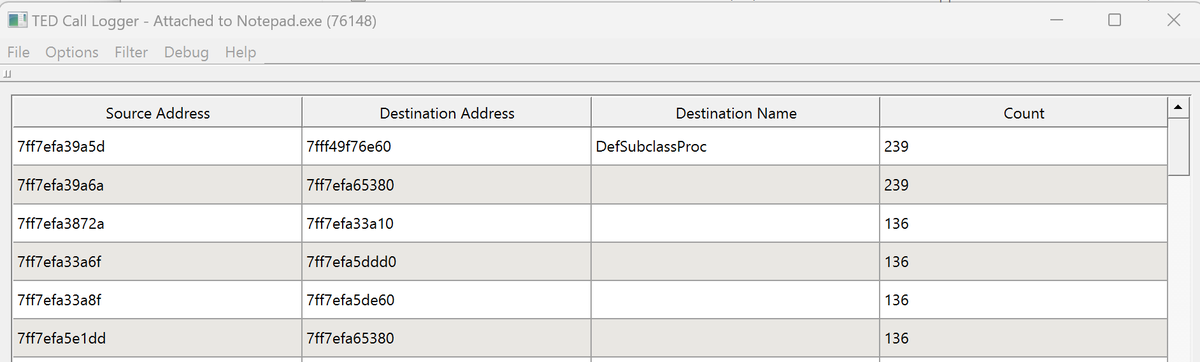
Releasing TED (Tiny Exfiltrating Debugger): A general purpose reverse engineering API, combined with a Call Logger application to log, filter, and display all calls in a target process.
Wrote up another four part series on creating extra-sensory perception (ESP) hacks for FPS games: https://t.co/iTcXaL9Upn As always, full source is available on GitHub.
Finished up the 12-part series on reversing REST APIs/network communication: https://t.co/8npqV9vtEV Starts simple, but dives into assembly, dynamic analysis, and function hooking to get plaintext network traffic from a process.
Continuing on with the reverse engineering REST API series: https://t.co/MPV42VJ3H1 Latest posts cover Winsock hooking and reverse engineering internal functions to get plaintext request data
Continuing the reversing REST APIs series: https://t.co/Gc6l3FFrS4 Post covers basic debugging and usage of the SSLKEYLOGFILE to see decrypted data. Future posts will continue with application reversing to get raw network data (to be posted soon)
Wrote up a quick post regarding reversing REST APIs: https://t.co/y8nwHPfb01 Example covers decrypting TLS traffic from within a game. Part of a larger series (to be posted soon).
Its been a while since I've posted on my blog, but decided to do a write-up of a fun side project that I did recently: a multi-language compiler system. 11 part series here: https://t.co/inZdnt01pn
Rethinking floating point for deep learning - Jeff Johnson at FAIR
- proposes non-linear floating point math -- more energy efficient, accurate
- no retraining or quantization before deployment
- Verilog, C++, PyTorch implementations available
https://t.co/0w3IqE1HUZ