AirTrunk is putting $30 billion behind a massive AI data center buildout in India.
The Australian operator says the plan covers 5GW of planned capacity, making it one of the largest infrastructure bets in the region. For developers and AI builders, this signals more compute supply, better regional hosting options, and a stronger foundation for scaling AI workloads closer to Indian users and enterprises.
It also underscores how quickly demand for power, cooling, and large-scale GPU infrastructure is reshaping cloud and data center strategy across Asia.
#AI #DataCenters #CloudComputing #India #Infrastructure https://t.co/YVwNS7us4n
Google is set to pay SpaceX $920 million a month for compute in a deal announced Friday, landing just a week before SpaceX’s planned IPO.
The scale of the contract signals how aggressively hyperscale buyers are chasing compute capacity, and how valuable large, reliable infrastructure has become in the AI era. For developers and builders, it’s another sign that access to compute is tightening, pricing power is shifting, and major platform deals can reshape the economics of cloud and AI workloads.
#AI #CloudComputing #SpaceX #Google #TechInfrastructure https://t.co/80v1sip7JY
Clone Mistral’s New Vibe Sandbox in Your App: The 7 Tricks Most Devs Will Miss
Mistral’s new Code Mode makes one thing clear: the winning AI dev workflow isn’t “let the model loose on production,” it’s “trap it in a disposable sandbox and review everything.”
- The biggest shift is architectural, not just UX: AI should work in an isolated, single-tenant environment that clones your repo, completes a task, and gets destroyed when the session ends. That model protects your app, your local machine, and your sanity.
- The first rule of safe vibe coding is simple: no direct production access. Your agent should never write straight into `main` or roam around your live app unsupervised. Every task should start in a dedicated feature branch so the AI’s edits stay fully contained and reversible.
- Ephemeral cloud workspaces are the real unlock. Running agents locally sounds convenient until they break dependencies, touch the wrong files, or pollute your environment. A fresh cloud container per task means every mistake is isolated, disposable, and easy to reset in seconds.
- Speed only works if review is built into the loop. The right pattern is Spec→Diff→Deploy: give the AI a clear spec, let it generate code, then review the git diff before anything merges. Some teams are even using secondary AI reviewers, but the core principle stays the same: no unchecked code ships.
- Safe deploy gates are what turn sandbox coding into a production-ready system. Once the AI finishes on its branch, deploy that exact branch to a preview environment and test it like a real user would. You get confidence in the UI, backend logic, and behavior before anything reaches customers.
This is the broader signal behind Mistral’s release: the future of AI coding is contained, reviewable, and branch-based by default. If you want the speed of vibe coding without the chaos of AI-generated technical debt, this workflow is worth understanding now.
#AI #VibeCoding #WebDev #DevTools #GitHub #Developers
https://t.co/5ScOk1q17N
Suno just doubled its valuation to $5.4 billion even as it battles major record labels in court.
The AI music startup raised $400 million in fresh funding, signaling strong investor confidence in generative audio despite legal uncertainty. For developers and builders, this is a reminder that AI media products can scale fast, but copyright risk remains a core product and business challenge. The outcome of Suno’s disputes could shape how future AI tools are trained, distributed, and monetized.
#AI #MusicTech #Startups #GenerativeAI #Copyright https://t.co/Ti03G5vnA3
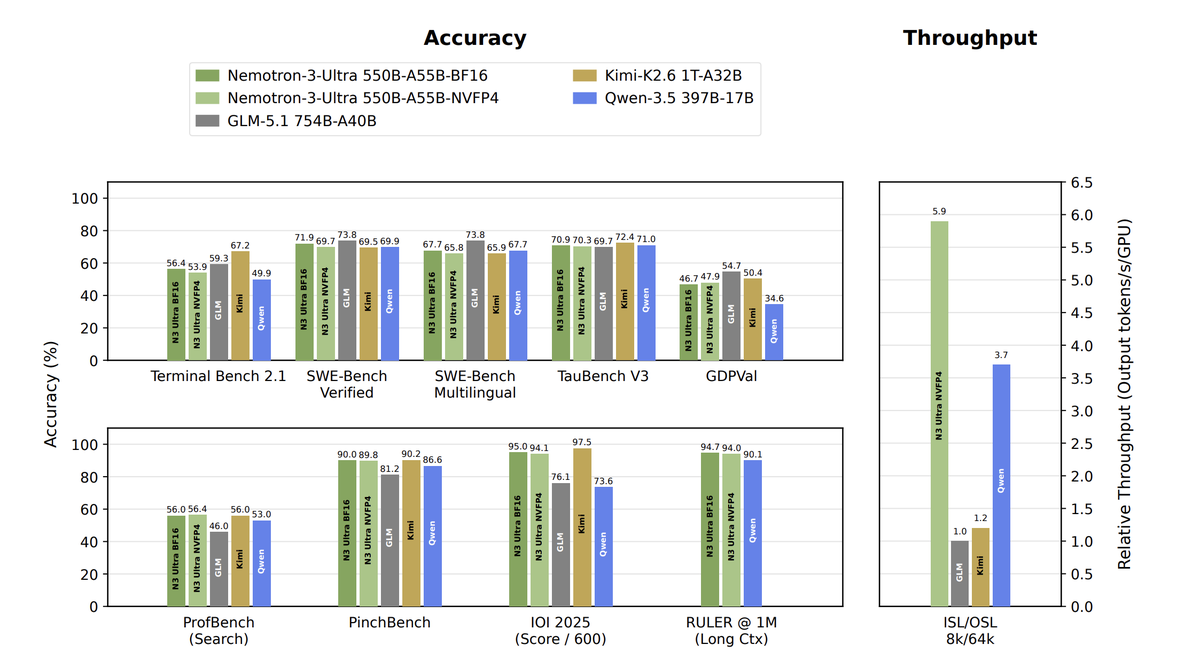
NVIDIA has released Nemotron 3 Ultra, an open 550B-parameter hybrid Mamba-Transformer built for long-running AI agents.
With 55B active parameters and support for up to 1M-token context, the model is aimed at workflows that need sustained memory, large document handling, and multi-step reasoning over long sessions. NVIDIA says it can deliver up to about 6x higher inference throughput than comparable open LLMs at similar accuracy, which could make agentic apps more practical to deploy at scale.
For developers, this is a notable step toward faster, more cost-efficient long-context systems without giving up open access.
#AI #NVIDIA #LLM #MachineLearning #OpenSource https://t.co/x5yH8EWmuh
How Smart AI Routing Cut a $1,500 Bill to Near Zero Without Downgrading Results
If billion-dollar companies are putting hard caps on AI spend, startups routing every task through a premium model are quietly setting fire to runway.
- The biggest cost mistake in AI apps today is treating one frontier model like a universal solution. Using a top-tier model for classification, formatting, summaries, and simple drafting is like paying a senior architect to paint a fence: technically possible, financially irrational.
- The pricing gap is not small. Premium models can cost 30-50x more than lightweight options for the same token volume, which means a workflow that feels fine in week one can become a four-figure monthly bill long before you reach product-market fit.
- The fix is a three-tier routing workflow. Use cheap, fast models for drafts, triage, extraction, and intent detection. Reserve premium models for the work that actually needs deep reasoning: architecture decisions, tricky debugging, and code review. Then move implementation into a structured environment instead of wasting tokens on repetitive prompt-repair loops.
- This is where many teams still leak money: they get a strong spec from an expensive model, then burn even more budget trying to force the model to execute blindly across a messy dev setup. A better pattern is Spec → Diff → Deploy inside CoderVibe, where clean specs turn into faster implementation with less AI drift.
- Smart routing should also exist inside the products you ship. If you're building internal tools or customer-facing AI features, add a routing layer so simple OCR, tagging, or summarization goes to cheaper models, while anomaly detection, multi-step reasoning, or high-stakes decisions go to premium ones. Better margins are often an architecture choice, not just a pricing one.
AI leverage is real, but so is token burnout. The teams that win won't be the ones spending the most on models; they'll be the ones designing workflows that spend intelligently. If you're building with AI right now, this is the moment to fix your routing before your costs lock in.
#AI #Startups #VibeCoding #WebDev #Developers #SaaS
https://t.co/lCAZszmJ1i
Ship a real app today, not “someday.”
CoderVibe gives you 46 step-by-step build guides to go from plain English to production-ready web apps: CRM, invoice app, booking system, AI chatbot, SaaS, and AI agents. Add login, database, payments, and core workflows without starting from scratch.
Pick one guide, build it fast, and launch today.
#VibeCoding #AIBuilder #WebDev #SaaS #NoCode | Code: TECHWITHTIM20 (20% off) https://t.co/bgY0Wicqie
Alphabet just pulled off a record-setting $85 billion stock raise tied to Google’s AI business, and investors clearly wanted in.
The deal is being read as a strong vote of confidence in Google’s AI strategy, even as the company ramps up spending on infrastructure, models, and product integration. For developers and builders, that means more capital behind cloud capacity, AI tooling, and the long-term competition to ship AI features at scale.
It also signals that public markets still see AI as a major growth engine, not just a hype cycle. That can translate into faster platform investment, more enterprise AI products, and heavier pressure on rivals to keep up.
#AI #Google #Alphabet #MachineLearning #TechInvestment https://t.co/yW8XMU8mrj
SpaceX is reportedly lining up the biggest stock market debut ever, with a potential $75bn raise and a $1.77tn valuation.
If it happens, the IPO would dwarf existing records and could push Elon Musk much closer to trillionaire status. For developers and builders, a listing of this scale would signal even more capital behind SpaceX’s launch, satellite, and infrastructure ambitions, with ripple effects across aerospace, telecom, and defense tech. It also adds another benchmark for how private AI-era megacompanies can reshape public markets when they finally go public.
#SpaceX #ElonMusk #IPO #Aerospace #TechMarket https://t.co/zfPAI6Ncff
Trump has signed a narrower AI oversight executive order after pushback from industry, shifting to voluntary prerelease government reviews for advanced models.
The revised approach backs away from mandatory review requirements, signaling a lighter-touch federal stance on frontier AI. For developers and startups, that could mean fewer compliance hurdles and faster model launches, but also more uncertainty around what voluntary oversight will look like in practice. It also suggests the government is still trying to balance AI safety concerns with pressure to avoid slowing innovation.
#AI #MachineLearning #Policy #Startups #Tech https://t.co/SsWM7cFD48
Stop settling for AI app builders that leave you boxed in. CoderVibe’s Pro plan gives you full source code download and custom domain publishing, so you can own the app and launch it like a real product.
Build faster, ship under your brand, and keep the freedom to move, edit, or scale whenever you want.
Try CoderVibe Pro and launch with control.
#AIAppBuilder #VibeCoding #WebDev #StartupTools #NoCode https://t.co/pdVe224Ze0
Warren Buffett’s Berkshire Hathaway is putting $10 billion into Alphabet as the company ramps up a massive AI infrastructure push.
Alphabet is raising $80 billion to expand the compute, networking, and data center capacity needed to train and serve AI models, with capital spending projected to hit $190 billion in 2026 and climb further after that. For developers and builders, this signals that AI competition is increasingly being won on infrastructure: more GPUs, more cloud capacity, and higher costs to operate at scale. It also shows that even traditional value investors see long-term demand for the systems powering AI apps and services.
#AI #Alphabet #BerkshireHathaway #CloudComputing #Infrastructure https://t.co/39AEY4hzfW
AI Traffic Can Spike 100x Overnight—Preview Deploys Let You Find the Breaking Point First
AI traffic doesn’t fail like human traffic fails—it spikes faster, burns more compute, and can turn one careless deployment into downtime plus a massive cloud bill.
- AI agent traffic is no longer a niche edge case; it’s becoming a core production reality. With explosive growth in automated traffic and AI agents already driving major transaction volume, your app isn’t just serving people clicking around slowly anymore. It’s serving bots and agents that hit endpoints relentlessly, concurrently, and unpredictably.
- For AI-powered MVPs, “deploy and pray” is especially dangerous. A small mistake—an infinite loop in an agent, a prompt bug that inflates token usage, a queue backlog, or a vector search bottleneck—doesn’t just create a minor UX issue. It can cascade into latency spikes, API throttling, database locks, and runaway infrastructure costs.
- Preview deploys are one of the most practical ways to de-risk this. Instead of testing scaling behavior in production, every PR gets its own isolated environment where you can validate the exact branch before merge. That means you can test malformed inputs, third-party API failures, async workloads, and high-traffic scenarios without touching live users or data.
- The real advantage comes when preview environments are paired with load testing. Don’t guess whether a new model integration, agent workflow, or retrieval pipeline is “probably fine.” Measure latency, error rates, queue depth, and resource consumption before code lands in main. Reactive monitoring tells you what already broke; preview testing helps stop breakage from shipping in the first place.
- Preview deploys alone aren’t enough if anything can still merge. Production gating matters. AI apps need staging checks that verify not just syntax and unit tests, but actual model behavior, tool-calling reliability, latency thresholds, and failure handling. If a build can’t prove it’s resilient, it shouldn’t reach production.
The shift is simple: stop treating production like your load test environment. If your AI app gets real traffic tomorrow, the difference between confidence and chaos will come down to whether you tested scale before the spike hit.
#AI #VibeCoding #WebDev #DevOps #LLMOps #Developers
https://t.co/AkqPQmjTof
Before You Ship an AI Therapist, Test These 3 Safer MVPs First
The fastest way to kill an AI health startup is to ship a “therapist” before you’ve proven users even want the safer workflows around it.
- In mental health, the default AI MVP is often dangerously over-scoped: a blank chat box plus an empathetic model. That may look impressive in a demo, but in production it creates legal, ethical, and safety exposure the moment a real user enters a crisis, receives misleading guidance, or mistakes simulation for care.
- The better path is to validate workflows, not companions. Instead of trying to replace licensed professionals, build narrow tools that support them: intake and triage forms, structured daily check-ins, summaries for clinicians, and clear escalation paths to humans when risk signals appear.
- Scope is not just a product decision; it’s a liability decision. A bounded system that categorizes urgency or organizes patient-reported data is fundamentally different from a system that appears to diagnose, counsel, or emotionally intervene. One helps operationally. The other can pull you into medical-provider expectations without the safeguards to match.
- This is also the smartest way to test market demand. Many founders assume clinics want “AI therapy,” but what they often actually want is reduced admin burden, better documentation, faster triage, and safer handoff systems. If you validate those needs first, you can build something useful without taking existential risk.
- The same lesson shows up across regulated industries: don’t start with the robot expert. In legal tech, the bad idea is the autonomous AI lawyer; in health tech, it’s the autonomous AI therapist. The winning products usually begin with constrained, high-value infrastructure around intake, routing, summarization, and operations.
If you’re building in mental health or wellness, this is the fork in the road: chase the flashy demo, or ship the safer MVP that can actually survive contact with reality. The founders who win here won’t be the ones with the most human-sounding bot, but the ones who validate demand while protecting users from day one.
#AI #HealthTech #MentalHealth #Startups #SaaS #Developers
https://t.co/it7ks8lujY
Anthropic has filed for an IPO, signaling its move from fast-growing AI challenger to public-market contender.
The company’s filing comes after its valuation climbed above OpenAI’s, putting pressure on the broader AI race and on investors watching which model makers can turn momentum into durable revenue. For developers and builders, a public Anthropic means more scrutiny on product strategy, model performance, pricing, and enterprise adoption as the company pushes to prove it can scale beyond hype.
If successful, the IPO could also reshape the competitive landscape for foundation model providers and accelerate the push for safer, more enterprise-ready AI platforms.
#AI #Anthropic #IPO #MachineLearning #Startups https://t.co/9Inwkec6KY
Anthropic has confidentially filed for an IPO with the SEC, moving the Claude maker a step closer to becoming a public company. The filing follows a funding round valuing the startup at just under $1 trillion, underscoring how aggressively the AI race is being capitalized.
For developers and builders, this signals another major AI platform heading toward public-market scrutiny, with pressure on growth, reliability, and enterprise readiness likely to intensify. It also raises the stakes for model access, pricing, and ecosystem strategy as Anthropic and rivals like OpenAI prepare for the next phase of competition.
#AI #Anthropic #Claude #IPO #Startups https://t.co/I2kSmEeDrd
Anthropic has confidentially filed for a US IPO, marking a major step toward going public after a year of rapid expansion.
The Claude maker’s move comes on the heels of a $65bn funding round that reportedly valued the company at $965bn, underscoring how quickly top-tier AI firms are scaling in both capital and market expectations. For developers and builders, this signals a new phase for one of OpenAI’s biggest rivals: more pressure to ship, monetize, and prove durable enterprise demand. It also adds fresh momentum to the broader AI infrastructure race, where model quality, safety, and developer adoption are becoming the key differentiators.
#AI #Anthropic #IPO #Claude #Startups https://t.co/sr3rTQU1qr
Turn your idea into a deployed app faster than any dev stack ever could.
With CoderVibe, you describe what you want in plain English, iterate in chat, and publish when it’s ready. No local setup. No environment configs. No deployment headaches. Just real apps with logins, databases, and payments—built and launched from one conversation.
If you’ve got the idea, you’ve got the build path. Start now.
#VibeCoding #AIBuilder #WebDev #StartupTools #NoCode https://t.co/TIz0Omxrv4
Anthropic has confidentially filed for an IPO that could become one of the largest public offerings ever.
The company behind Claude is moving toward public markets at a time when investors are still betting heavily on frontier AI infrastructure, model competition, and enterprise adoption. A deal of this scale would be a major signal for the broader AI sector, shaping how startups, developers, and cloud partners think about funding, valuation, and long-term platform bets.
For builders, this matters because Anthropic’s growth will influence API pricing, model access, enterprise roadmaps, and the pace of competition with OpenAI, Google, and others. It also adds pressure on AI startups to show durable revenue and clearer paths to profitability.
#AI #Anthropic #IPO #Startups #MachineLearning https://t.co/Tk3TdpAPZ8
Alphabet is raising up to $80bn in equity, including a $10bn sale to Berkshire Hathaway, to bankroll its AI infrastructure push. This massive capital injection underscores the escalating arms race in generative AI, with implications for compute costs, cloud pricing, and competitive dynamics. Developers should brace for accelerated model releases, expanded tooling, and potential shifts in the AI platform landscape as Google seeks to cement its lead.
#AI #Alphabet #Tech #CloudComputing #MachineLearning https://t.co/dvOsOxSMh6