There is an old laptop in your closet.
Gathering dust. Dead battery. Slow processor. You keep it because you feel guilty throwing it away.
That laptop can replace every cloud subscription you pay for.
- Netflix
- Google
- Dropbox
- 1Password
That is $42 a month. $504 a year. To rent things you used to own.
The old laptop in your closet could do all of it.
Now meet CasaOS.
A free and open source system that turns any old laptop, Raspberry Pi, or mini PC into your own personal cloud.
You run one command. In 30 minutes, the laptop becomes a server. You open it from your phone, your TV, your work computer, anywhere in the world.
Then you pick the apps you want from a built-in store. One click each.
- Jellyfin to replace Netflix. Stream every movie and show you own.
- Immich to replace Google Photos. Faces and search included.
- Nextcloud to replace Dropbox. Sync every file across every device.
- Vaultwarden to replace 1Password. All your passwords, your keys.
- Syncthing to keep files in sync across every device, no cloud.
- Home Assistant to control every smart device in your home.
- AdGuard to block ads on every device on your wifi.
Setting up a home server the old way took an entire weekend. Install Linux. Learn Docker. Write config files. Set up storage. Fix errors. Look up every app one by one.
CasaOS does all of that for you. No code. No config files. No Linux skills. You see icons on a screen. You click them.
34,116 stars on GitHub. Apache 2.0. Free forever.
Built by a small team starting September 2021. Runs on Raspberry Pi, Intel NUC, old laptops, and most home servers. Over 100,000 Docker apps can be installed.
A new Raspberry Pi costs $50. The old laptop in your closet costs $0. It already works. It is already in your house.
Netflix charges every month. CasaOS doesn't.
Google charges every month. CasaOS doesn't.
Dropbox charges every month. CasaOS doesn't.
1Password charges every month. CasaOS doesn't.
Here is the wild part.
The laptop you forgot about is more powerful than the web server that ran most websites in 2008.
It is sitting in a drawer. It costs you nothing. It already works.
One command. Thirty minutes. Five hundred dollars a year back in your pocket.
Your files. Your photos. Your movies. Your home.
Your closet just became a data center.
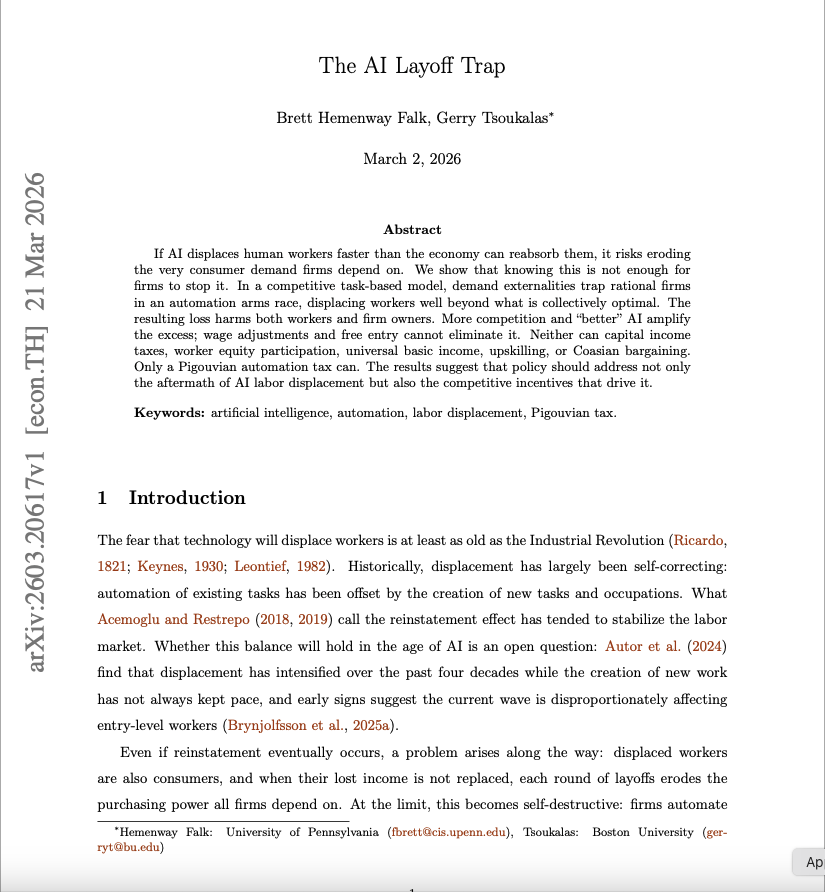
Two economists just published a mathematical proof that AI will destroy the economy.
Not might. Not could. Will — if nothing changes.
The paper is called "The AI Layoff Trap." Published March 2, 2026. Wharton School, University of Pennsylvania. Boston University. Peer reviewed. Mathematically modeled.
The conclusion is one sentence.
"At the limit, firms automate their way to boundless productivity and zero demand."
An economy that produces everything. And sells it to nobody.
Here is how you get there.
A company fires 500 workers and replaces them with AI. A competitor fires 700 to keep up. Another fires 1,000. Every company is behaving rationally. Every company is following the incentives correctly. And every company is building a trap for itself.
Because the workers who were fired were also customers.
When they lose their jobs faster than the economy can absorb them, they stop spending. Consumer demand falls. Companies respond by cutting costs — which means automating more workers — which means less spending — which means more falling demand — which means more automation.
The loop has no natural exit.
The researchers tested every proposed solution. Universal basic income. Capital income taxes. Worker equity participation. Upskilling programs. Corporate coordination agreements.
Every single one failed in the model.
The only intervention that worked: a Pigouvian automation tax — a per-task levy charged every time a company replaces a human with AI, forcing them to price in the demand they are destroying before they pull the trigger.
No government has implemented this. No major economy is seriously discussing it.
Meanwhile the numbers are already tracking the curve. 100,000 tech workers laid off in 2025. 92,000 more in the first months of 2026. Jack Dorsey fired half of Block's workforce and said publicly: "Within the next year, the majority of companies will reach the same conclusion."
Nobody is doing anything wrong. Companies are following their incentives perfectly. That is exactly the problem.
Rational behavior. At scale. Simultaneously. With no mechanism to stop it.
Two economists built the math. The math leads to one place.
Source: Falk & Tsoukalas · Wharton School + Boston University ·
https://t.co/4m8E9jQNYm
En la marcha de los alérgicos al trabajo que buscan la revocatoria de Noboa organizada por Washington Andrade se coló la loca de Pabel Muñoz.
Mmvg nada haces para Quito, aún así te atreves a asistir y abandonar a tu pueblo.
Reelección que te manden a la v vas a tener.
El Correismo como cada día son menos y no les da para llenar media plaza, se van de metidos a una marcha de los trabajadores
Y con eso grabar y hacer creer al país que son millones aún, más ridículos imposible.
Unbelievable scenes in El Salvador today. Hundreds have gathered demanding a total ban on Bad Bunny music. The protesters are literally claiming the music 'lowers IQ' and turns people gay. 🇸🇻
Un trabajador enganchó justo a un chorro de mierda queriéndole robar la bici y lo impidió literalmente PEGÁNDOLE UNA PATADA EN EL ORTO JAJAJAJAJ
El chad se preparó toda la vida para cagar a patadas a un negro. Toca bancar.
Having been part of the industry for 50 years, I can confidently report that none of this is true.
Sure, writing code has a non-zero cost; this is true of any artifact.
But you know what costs even more, Jonathan?
Writing bad code; writing unnecessary code; writing more code than you really need simply because you think you might need it someday or you are too lazy or sloppy to clean up after yourself.
Anything that costs nothing is often worth nothing as well, and results in significant unintended consequences.
@SokeyeA@clairevo The best product managers did what you say since the dawn of computing. Tools come and go, the only permanent thing is to embrace change.
“I’ll kill it before you do”
This is so real
I think the Product role is shifting to talking to users more, getting the right feedback, deciding which product bets to take, validating solutions through prototypes, experiments and MLPs iteratively and capturing long term value for the business & customers
And less of writing long documentation, roadmaps, ticket handoffs and more
The iteration loops have become much shorter for PMs
PR >> PRD. The handoff era is over.
→ When opening a PR is faster than writing a PRD, AI changes how product gets built. The old roles start to collapse.
"PR >> PRD"
Yep. the handoff era is over. but it's not just the roles collapsing. it's the tools.
Every PM tool was built for a world where humans did the coordination.
tickets
docs
roadmaps
presentations
all of that was scaffolding for work AI now does faster and cheaper. slapping AI on top doesn't fix it. The foundation is already out of date.
I build @chatprd every day knowing i have to replace its core before something else does: claude code, another startup, something i haven't imagined yet.
Radical humility and endless paranoia are the only product strategies that make sense right now.
So sure. the PRD is dead.
But I'll kill it before you do.
We are in the age of "redo".
The days of software prophets jealously guarding their architecture and obsessing over every detail are over. By the time you get it right, the goals have shifted, probably even transformed.
I say this as someone who’s as guilty of software perfectionism as anybody.
Everything moves too fast. You can’t be emotionally attached to your software. A new approach blows past what you've been building by hand? You just have to say who cares, I’m moving on. That’s just the way the world is now.
Constant reevaluation is really all that you can do to keep up in this environment.
Software egos used to make sense. The products that stood the test of time and didn't collapse under their own weight were carefully grown over time by a visionary architect.
Is clean code dead? not exactly. But building something exactly how you want it AND keeping up? You can only pick one. Don't get anchored to the moment you tried something revolutionary.
We might not get it right, but we can redo it fast. With more experience and better methods.
> "Radical humility and endless paranoia are the only product strategies that make sense right now"
- @clairevo
@nicolekcha Production code is not cheap to replace, just imagine critical applications in finance and health where failures not only cost money but lives.
Vibe coding has a place but doesn’t make it trivial to get into production, as changing code is not a game but a serious task.
Hard disagree.
The same "Yes Engineers" didn't suddenly gain taste and system design intuition just because things got easier to build. Without these traits, they are going to be the slop cannons that produce unsustainable messes that work for 1-3 weeks and then break and are forgotten.
Debt will still accumulate, it will just take a different shape, less in hard code and more in product decisions and system-wide connectivity.
Experienced No Engineers are sensing this accumulation right now and the good ones will shift their restraint from code rationing to something new.
If they don't, they'll remain No Engineers 1.0 and you're right.
Yes, redo is cheap now (https://t.co/4TCxCSptLG), but restraint is still about when and what to redo. With an abundance of code, product sanity will require careful coordination more than ever.