@PatricioOnCode What's on your list so far? It would be cool if the components received the snapshot data as props and re-rendered when the snapshot updated!
Imagine gpt-4o multi-modal combined with gpt-o1. You verbally give it a task, and it starts thinking out loud. You can interrupt at any time, provide more information, make corrections. We are so close to talking with AI that thinks and has agency. A worthy gpt-5.
Ideas as possessions has been a source of considerable pain. It's about perception not possession. Behind every idea is a story; the story is the spring. Stories connect. Ideas are islands. Record the story, free the idea.
@SterlingCooley I thought Godel's incompleteness theorems only apply to formal axiomatic systems, like the logic based AI of the 70s. Since neural network models are probabilistic Godel's incompleteness does not apply.
@gitbutler looking forward to daily driving gitbutler, but a few bugs forced be to put it back on the shelf. I wish to follow your progress though. I've tried a few times but I cannot find a changelog? Blog does not have high enough fidelity.
Benchmarks don't demonstrate the full power LLMs. Benchmarks use simplistic prompts. Prompts naive of the models unique latent space.
Model developers themselves modify benchmark prompts to improve performance.
HELM LLMU use simple standardized prompts for "reproducible comparison". But standardized prompts are biased towards specific models and architectures.
My hunch is that decent model + good prompting can beat all other models on a given benchmark.
Oh I thought they were using online training to update them, since they provide them as an API and mentioned fine tuning.
> Our LLMs, pplx-7b-online and pplx-70b-online, are online LLMs because they can use knowledge from the internet, and thus can leverage the most up-to-date information when forming a response. By providing our LLMs with knowledge from the web, our models accurately respond to time sensitive queries,
> Fine-tuning: our PPLX models have been fine-tuned to effectively use snippets to inform their responses. Using our in-house data contractors, we carefully curate high quality, diverse, and large training sets in order to achieve high performance on various axes like helpfulness, factuality, and freshness. Our models are regularly fine-tuned to continually improve performance.
But I see mention of fine tuning on snippet use, not on knowledge.
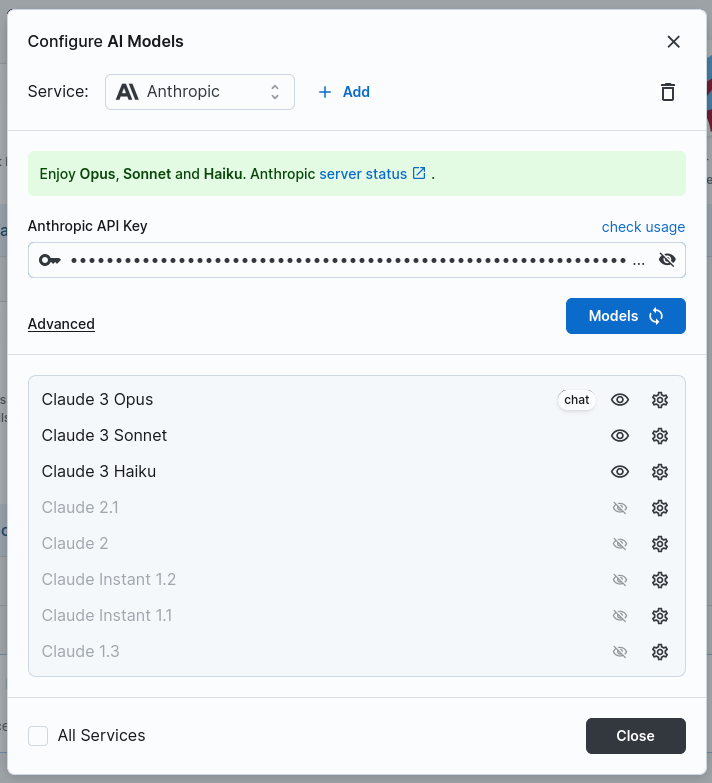
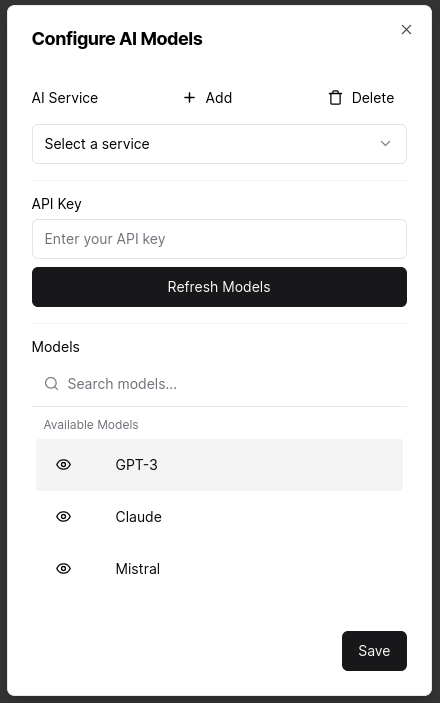
Inspired by big-AGI's interface for configuring AI model services. Tried to loosely recreate it using @v0 I think you can guess which is the original, but bad tho.
Here's the prompt:
Create a dialog for configuring AI model services and keys. The dialog trigger is "Configure". This dialog should have the title "Configure AI Models". The dialog is divided into three (3) vertical sections with a horizontal divider between each.
## Section 1
Add a select drop down for selecting an AI service. For example OpenAI, Anthropic, Mistral etc. Next to the drop down there should be an add button, to add another service and a trash button to delete the currently selected service.
## Section 2
Add a full width input for API Key. Under the API key input there should be a button to refresh the model list.
## Section 3
Add a list box that lists each model provided by the service. For each model in the list add visibility toggle button on the left. The toggle is for the user to set which models they want visible after configuration.