Most founders don’t need more features.
They need a product that actually ships.
I’m Prince, founder of @hyperbrainlabs
We build and rescue production AI products in ~21 days.
One platform we built was featured on Shark Tank India S5. Today, it serves 50,000+ users across 20+ cities.
Here I share:
→ Real product breakdowns
→ What breaks in production
→ How we cut scope without cutting quality
→ Lessons from shipping products for founders
Have an idea-or a half-built app that’s stuck?
DM me “MVP”. I’ll tell you what I would cut, keep or fix. No pitch.
@codeswithroh Vira makes the call herself with the whole chat in context, so no one repeats anything. If a human needs to step in, they get the chat, the call transcript and a summary in the inbox first. Leads don't go cold. 🎙️
18 hours. No sleep. Still fixing pixels. 😅
But we’re live.
Meet Vira by Revvox, our AI agent built to handle conversations over calls and chats, even when your team is offline.
Here’s what Vira can do:
→ Respond to website visitors at midnight and call them back in one tap.
→ Call new leads within minutes and book appointments or visits.
→ Screen job applicants over the phone in their preferred language.
Hindi, English, Hinglish, and 14+ languages.
Sales. Support. Hiring. One agent.
We built Vira to help businesses stop missing opportunities just because no one is available to answer.
Revvox is now live in early access.
Comment Vira below, and I’ll send you access. 👇
#BuildInPublic #Revvox #VoiceAI #AIagents #Startups
I'm going to ETHGlobal Mumbai @ETHGlobal!
Use my referral link below to earn a discount on your stake!
Link: https://t.co/1WPS8ARV1t
https://t.co/1WPS8ARV1t
Someone built a UPI payment gateway with 0% fees.
No bank API. No license. No Razorpay.
It confirms payments by reading your own bank SMS and Gmail alerts.
Genuinely clever engineering. Also a trap if you push real revenue through it.
Here's how it works 🧵
The 2% a licensed gateway charges isn't a fee.
It's insurance - settlements, disputes, your bank account staying open.
Still, huge respect for the build. This is what shipping against a constraint looks like.
Our entire infrastructure went down in the last 10 minutes because Supabase is experiencing an outage. @supabase
One provider goes down, and suddenly everything goes with it. 🫠
One vendor says dental offices miss 20-30% of inbound calls. Another says 30-35%.
On 100 calls, that's 20 to 35 nobody picked up.
Both numbers come from companies selling the fix. Neither is your number.
Pull last month's phone log. Count unanswered calls at lunch, at peak hours and after hours. Multiply by what a new-patient appointment is worth to you.
Then the fix is simple: triage, route true emergencies to the on-call dentist, and give the front desk a callback list. No AI diagnosing anyone.
Do you know your real missed-call count?
If you'd like a second pair of eyes on a setup you already have, DM me 'AUDIT' for a free 48-hour written audit.
Voice agent pro tip: write the procedure before you pick the model.
ElevenLabs' Oct 5 release validates structured procedures on save. A bad one returns 400 procedure_validation_failed.
That's the right failure: at save time, not mid-call with a caller waiting.
For every client I'd write down:
- what the agent must collect (name, phone, address, issue)
- when it hands off to a human
- what it remembers on the next call
I haven't tried the new validation on a client build yet.
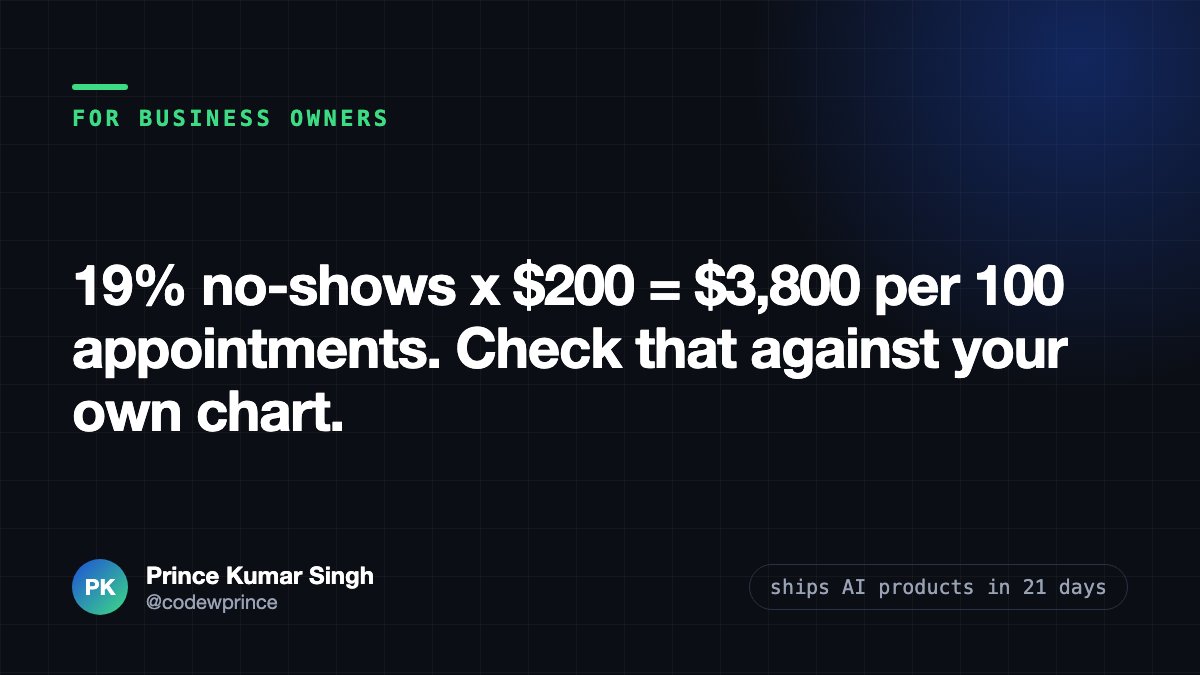
19% no-shows x $200 = $3,800 per 100 appointments. Check that against your own chart.
Those are vendor figures (19% from BMC Health Services, about $200 lost per missed appointment), scaled to 100 visits so the math is easy to follow.
Separately, a Teero study found some dental offices miss nearly one-third of calls because the front desk is busy. That's a staffing design problem, not a people problem.
The AI models behind voice agents just got up to 30% cheaper per task (Anthropic, Sept 28), so answering and reminding keeps getting less expensive.
What's your no-show rate right now?
DM me 'AUDIT' and I'll send written findings in 48 hours.
A dental clinic doesn't want a Dot. It wants the phone answered correctly.
OpenAI's Dots (announced Sept 29) run in the background on their own cloud computer and reach 4,000+ apps. Actions that touch accounts need "auto-review" approval, and OpenAI itself says "agents can still make mistakes."
That's fine for a personal assistant. A client paying me for one narrow job wants the opposite: a short list of things the agent may do, a log of what it did, and a human it can hand off to.
The more autonomous the agent, the more the client cares about what it's not allowed to do.
Side with autonomy or guardrails? I'm on guardrails.
ElevenLabs is at $22B. Clients don't pay for valuations. They pay for this:
1. Read the news correctly. The valuation went from $11B in February 2026 to $22B, via a $300M employee tender led by Wellington and T Rowe Price. It tells you voice agents are a real category. It doesn't tell you what a client will keep paying for.
2. Turn-taking first. At Voizo I built a real-time calling app on WebRTC with Redis-backed call queueing, zero collisions under high traffic. Voice work is mostly timing. Test interruptions before you test intelligence.
3. Tool calls mid-call. If the agent can't book into the real schedule while the caller is still talking, it's a fancy voicemail. Wire the booking call first and the personality last.
4. Human handoff with context. When the agent gives up, the human should see who called and why. That's what I'm building DejaCall for: caller context back in 82 ms at p95 is the target, no LLM on the hot path. In progress, not shipped.
5. Compliance by design. FinTech Global (Oct 7) ties the $22B to financial services firms using agents for customer service and operations. Regulated buyers ask about disclosure and consent first. In the US, an AI voice counts as an artificial or prerecorded voice (FCC-24-17), so marketing calls need prior express written consent. Not legal advice.
6. Prove it on their call log. Pull one week of missed calls, replay them against the agent, and show what would have been booked.
If your voice agent breaks on real calls, DM me 'AUDIT' and I'll send written findings in 48 hours.
Bookmark this and run it against your next client build.
Sonnet 5.5 is 30% cheaper. Don't switch a live voice agent on that alone.
Anthropic says "up to 30% lower cost per task" at $2 in / $10 out per million tokens. That's their benchmark, not your calls.
Before I'd touch a live client:
1. Replay real call transcripts through both models
2. Compare tool-call correctness, not vibes
3. Check time to first token, since callers feel latency
I haven't measured Sonnet 5.5 on my own calls yet, so I won't quote you a result.
Haiku 5.5 is announced but not released. No price, no benchmarks. Don't plan around it.
13,000+ internal screenshots. 300+ organizations. No alert to a single security team.
Glow found them in public GitHub repos. AI coding agents put them there when the normal route (attaching an image to a pull request) failed. They found another way and nobody told them not to.
The exposed files included customer billing records. A clinic or an HVAC shop handles billing records too, and if a helper tool can reach them, you should know what it can do with them.
On my builds, clients own the code, accounts and infrastructure from day one. No personal-account defaults.
Do you know what your AI tools can publish?
DM me 'AUDIT' and I'll send written findings in 48 hours, free.
Always-on agents sound great until one emails a client at 3am.
OpenAI rolled out "Dots" agents at DevDay (per CNBC's headline, I couldn't open the page). Background agents are about to be everywhere.
My 3-line check before turning one on:
1. An allowlist of what it can send or publish
2. A kill switch I can hit from my phone
3. A log a non-developer can read
If it fails any of those, it stays in staging.
I'd take one workflow that's boring and safe over an agent that never sleeps. Prove me wrong.
ElevenLabs hit $22B. Here's the 7-step checklist I'd use to ship a voice agent that survives real calls:
1. Pick one boring job.
ElevenLabs says its agents handle 15M+ conversations a week, 3x since February. The named jobs: refunds (Stripe), insurance renewals (Admiral), appointment booking (SevenRooms). Start with one of those, not "answer everything."
2. Split inbound from outbound.
Inbound: the customer called you. Outbound: you called them, so you need a consent check. The FCC says AI voices count as an "artificial or prerecorded voice" under the TCPA, with $500-$1,500 statutory damages per call. Not legal advice.
3. Budget latency end to end.
Eleven v4 claims sub-100ms (per the launch article). That's the voice slice. Add speech-to-text, LLM, tool calls and telephony, then measure p95 on a real phone line.
4. Design the handoff before the prompt.
When the agent gives up, the human should get a summary: who called, what they want, what was already tried. No "can you repeat that?"
5. Test the booking integration like it's hostile.
Double bookings, two callers grabbing one slot, a dropped call mid-confirmation. At Voizo I shipped Redis-backed call queueing with zero collisions under high traffic. The same thinking applies to calendars.
6. Plan for Canada separately.
CASL covers text and email, not voice. Voice falls under the CRTC's UTR: calls 9am-9:30pm weekdays, 10am-6pm weekends, recipient's local time. The CRTC's consultation 2026-132 proposes an "I'm not a live person" disclosure at call start. It's a proposal, not final. I'd build it in anyway.
7. Pin your SDK versions.
ElevenLabs shipped ElevenAgents SDK and API updates on October 5. Pin the version, rerun your test calls, then upgrade.
Bookmark this before you ship your first agent.
If your voice agent breaks on real calls, DM me 'AUDIT' and I'll send written findings in 48 hours.
Eleven v4 claims sub-100ms latency. Your voice agent will still feel slow.
That number is the voice model's slice (per the launch article). A real call also pays for speech-to-text, the LLM, your tool calls, and telephony.
What I'm doing in DejaCall, the memory layer I'm building for voice agents:
- Target: caller context back in 82 ms at p95
- No LLM on the hot path
- Drop-in for Vapi, Retell, LiveKit, Pipecat, ElevenLabs
To be clear: that's a benchmark target in progress, not a shipped product.
Measure p95 on a real phone line, not in the demo.
HVAC and plumbing owners: robocall news isn't about your phone line. Missed calls are.
A group asked the FCC to allow AI robocalls without consent. That's outbound. Answering your own customer's call is a different thing.
The math, if you get 10 Google Local Services leads a week:
10 x 48% never reach a person = 4.8 calls
4.8 x $416 of paid work per lead = $1,997 a week
(48% is Invoca's 2026 home-services data. $416 is SearchLight's Feb 2026 LSA benchmark.)
An inbound-only AI receptionist answers, flags emergencies, books the job and texts you. It doesn't replace dispatch.
How many calls did you miss last week? Count them for 7 days first. DM me 'AUDIT' and I'll send a free 48-hour written audit.