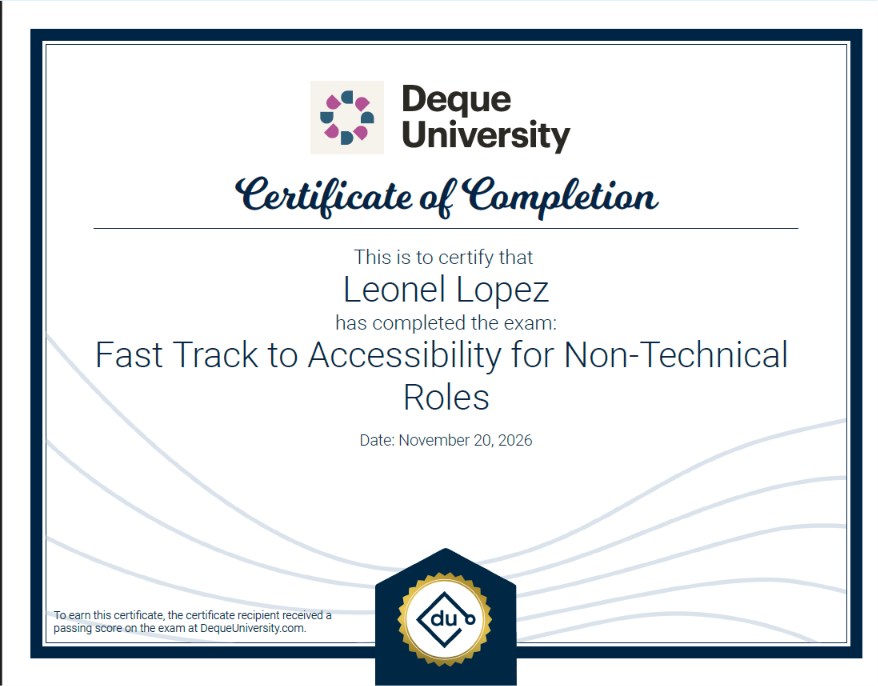
🎉 I passed the Fast Track to Accessibility for Non-Technical Roles exam at Deque University!
I didn't pass on my first attempt, but I learned from my mistakes and succeeded the second time.
I'll keep learning to help make the web accessible to everyone! 💪
#WebAccessibility #a11y
We must use artificial intelligence with great caution when it comes to digital accessibility.
AI can make mistakes and fail to detect certain accessibility barriers because it lacks the necessary context.
Accessibility is not just about AI. It requires real-world testing, human review, and the involvement of people with disabilities.
#DigitalAccessibility #AI #Inclusion
Which AI coding tools are you actually using for Laravel in 2026, and why?
I'm a web developer working mainly with Laravel, and I'm currently paying for Claude, ChatGPT and GitHub Copilot. I want to cut down to what really adds value.
I'd love to hear from people using these tools daily:
1. Which tool(s) do you use most for Laravel work (Claude Code, Cursor, Copilot, Codex, PhpStorm + Junie, other)?
2. Why that one? Code quality, speed, price, editor integration?
3. Are you using Laravel Boost? Has it made a noticeable difference?
4. If you had to keep only ONE subscription, which would it be?
Thanks in advance, any real-world experience helps!
Thank you so much for your willingness to help! 🤟 We received an estimate of INR 130,000–150,000 (approximately USD 1,350–1,550) for two Indian Sign Language (ISL) interpreters over two days. We are currently coordinating with the Laracon India organizers, so I think the best approach would be to contact them directly for more details about the interpreter costs and potential sponsorship opportunities. Your support would mean a lot to Deaf developers attending Laracon India 2027!
Hi!
Could you recommend someone in the Laravel community whom I could contact regarding potential sponsorship?
We are working hard to secure funding for Indian Sign Language (ISL) interpreters at Laracon India 2027, so Deaf developers can fully participate in the conference.
Any recommendations or connections would be greatly appreciated!
Thank you for your support! 🤟
Thank you so much for your willingness to help! 🤟
We received an estimate of INR 130,000–150,000 (approximately USD 1,350–1,550) for two Indian Sign Language (ISL) interpreters.
We are currently coordinating with the Laracon India organizers, so I think the best approach would be to contact them directly for more details about the interpreter costs and potential sponsorship opportunities.
Your support would mean a lot to Deaf developers attending Laracon India 2027!
💻 Web developers!
What do you use for your local development environment?
I'm curious to see what the developer community prefers!
Using something else? Let me know in the comments!
🎉 I’ve been accepted as a Deque University scholarship recipient!
I’ll have a full year of access to their digital accessibility training. My goal: to become a digital accessibility expert and help build a web that works for everyone.
Thank you, Deque! 🙌
#Accessibility#A11y #DequeUniversity
I agree with you. My point is that when several people speak without taking turns in a live Twitter/X Space, captions fall behind. Even though the platform offers some accessibility features, it's still difficult for deaf people to follow the conversation and participate equally. Accessibility is not just about understanding, but also about having the opportunity to participate.
My Accessibility Experience on X (Twitter) as a Deaf Person
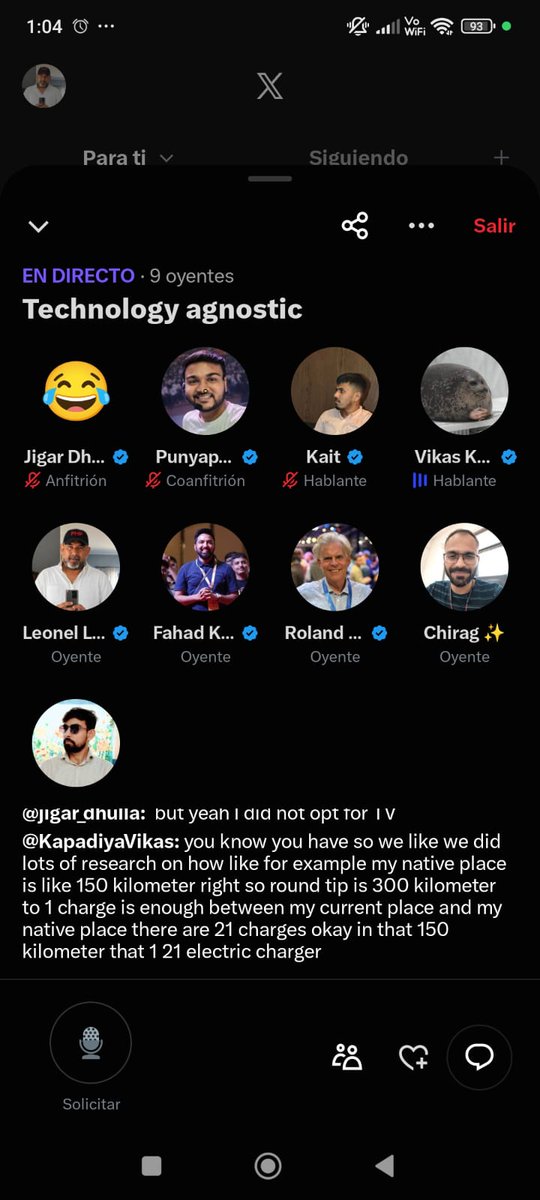
Today, I joined a live audio Space on X (formerly Twitter) to see how accessible it was for me as a Deaf person.
I enabled automatic live captions and noticed some positive features, as well as several areas that need improvement.
What worked well
I was able to read captions while people were speaking.
I could scroll up to review previous captions. This helped me catch information I had missed.
What needs improvement
1. Caption delays
The captions appeared more than 3 seconds after people spoke. This made it difficult to follow the conversation in real time.
2. Identifying speakers
The captions appeared in white text, making it difficult to distinguish who was speaking.
It would be helpful to display each speaker's name with a different color, along with a clear text label to identify them.
3. Participant labels
When I joined the Space, I was labeled as a "Listener."
As a Deaf person, I believe a more inclusive label, such as "Participant," would be better.
Not everyone who joins an audio Space can hear. There should be no need to disclose someone's hearing status.
4. Accessibility for blind users
I also noticed potential accessibility challenges for blind people who use screen readers.
It is important to ensure that participant names, roles, and buttons are properly accessible through screen readers such as VoiceOver and TalkBack.
This would need to be verified through actual accessibility testing.
5. Emojis and emotional expressions
Emojis and emotional expressions may cause confusion if they do not have clear descriptions or are not interpreted correctly by screen readers.
Their accessibility should also be improved.
Conclusion
My experience was partly positive.
Automatic captions allowed me to access some of the conversation, but accessibility barriers still exist.
Accessibility is not just about providing captions. It is about ensuring that everyone can understand, participate, and communicate on equal terms.
This is my personal experience as a Deaf person. I hope X continues improving the accessibility of its live Spaces for everyone.
#Accessibility #DeafAccessibility #DigitalAccessibility #InclusiveDesign #LiveCaptions #A11y