In order to get out us of this war before it gets even worse, Trump has to focus on the two main things:
1) Restraining Israel: tell Bibi “no”. Ignore the Pickaxe Mountain bait—stop chasing the nuclear dust, that’s a perpetual trap. Demand that Israel withdraw from Lebanon, otherwise we will cut off all U.S. military aid.
Remember—Israel got us into this mess, that has been confirmed. Don’t keep falling for their ploys to escalate.
2) Opening the straits: SOH & BAM. First, get our troops out of the region. Then use diplomacy & economic incentives to get the oil flowing again.
Ignore the hype that our sanctions are going to bring down the regime—Iran is not going to crumble from economic suffering. The pain they can inflict by weaponizing the SOH is far greater than the pain we can by imposing more sanctions.
Trump needs to take advantage of this rapidly-closing window of opportunity and leave now, while he still can. In doing so, he’ll have pulled us out of the region and redirected all focus back on issues affecting Americans here at home. That is a win.
If we resume strikes, we’ll end up escalating into an all-out war with boots on the ground, resulting in catastrophic losses to American lives and resources, and crippling the economy—Trump won’t be able to come back from that.
@joekent16jan19 Thank you for your sanity and resolve. Resigning and still trying to assuage the presidents ego because it is in the best interest of Americans. Salute.
Now that the US is knocked out, I am formally extending an invitation to the American people to support Norway.
Why?
1: The Vikings discovered America before Columbus.
2: There are more ethnic Norwegians in the US than in Norway.
3: Next weekend we can pillage the English peasants together.
4:
This French girl is my personal favorite World Cup tourist because she keeps upping the ante on my own point:
Americans, anywhere in the world, are capable of making the good life for themselves and others by being expansive, weird, and self-possessed.
holy fuck, a hair dryer at a Paris airport broke Polymarket weather markets & made someone $34,000 richer
- polymarket was settling Paris temperature bets on a single Météo France sensor sitting near the Charles de Gaulle runway perimeter - basically unguarded
- the guy bought the long-shot outcome (like "22°C" when everyone expected 18°C) for pennies, since nobody thought it'd hit
- then he walked up to the probe and briefly heated the air around it with a portable heat source, spiking the reading just long enough to register as the daily max
- temperature snapped back to normal in minutes, the market resolved in his favor, and he cashed out - twice, on April 6 and April 15, before Météo France caught on and filed charges
hyperstitions.
The day Top Gun launched at Great America. Santa Clara, 1993.
Top Gun opened at Great America on March 20, 1993, and the event was a big deal. Both local and national media were invited, and everyone who attended received commemorative dog tags.
The amount of self-hate Americans have towards their own history is truly unreal.
They defeated slavery by fighting against their own family.
They shut Europe out of the western hemisphere so that nations wouldn't live under colonization forever.
They had the ability to stay out of world war 1 but they went and died to help Europeans.
They had the ultimate power in the nuclear bomb. They also had access to all of Europe's colonies that were in shambles. But instead they promoted freedom. They rebuilt Japan and Germany after defeating them in war. They stood down the Soviet Union, even as the world jeered them.
They sent soldiers to places like Vietnam and Afghanistan that died TRYING to create a better world (even if you disagree with those wars, the intentions were fairly good)
And they sent more missionaries to the world than maybe any other country in history. Translated more Bibles into indigenous languages than any other country in history. Ran bigger charities than any other country in history. Created more Christian resources than any other country in history.
Whether it was stopping the Dutch from reconquering Indonesia to the Berlin Airlift to giving Cuba its freedom in the Spanish-American war to saving China from the Japanese America has at least ATTEMPTED to do good with its power.
Yes yes, America has problems. People are imperfect. But goodness gracious does the world have a lot to be grateful for in America. And when we could have taken SO much from the world we have often chosen not to. Rome, Britain, Mongols, Assyrians, Soviets, Chinese, no other group has ever shown the restraint America has consistently shown with such vast power at its fingertips.
We didn't even get into the GIGANTIC technological advances, consumer advances, convenient lifestyle changes America has pioneered. From electricity to space to the light bulb to the smart phone to many cures in medicine and agriculture to the airplane the world has been enormously blessed by America.
The GWOT isn’t even cold and we already have this post-Venezuela “desert storm syndrome” of how easy things will be, because we did/have X. This isn’t only dangerous it’s absolutely stupid and bereft of nuance.
Scenes from Palo Alto in 1989.
This footage captures Palo Alto during a time of transition. The city was already starting to change, but not at the scale or pace seen today. Tech companies were present, and venture capital was part of the picture, but the footprint was smaller, and the transformation was not yet complete.
Some of the places shown are still recognizable. A few streets, storefronts, and buildings remain much the same. Others have been replaced, rebuilt, or removed entirely. It’s a mix of the familiar and the forgotten.
What comes through is a version of Palo Alto that feels more grounded in everyday life. Before it became a global center for innovation, it was still just a town, with all the ordinary details that come with that.
The song is by a now-defunct Redwood City band called Nord Mariner. It felt like a fitting soundtrack. Its lyrics about change, memory, and the things we take for granted echo the feeling of watching a place change so much that it becomes something else entirely.
Scenes from Palo Alto in 1989.
This footage captures Palo Alto during a time of transition. The city was already starting to change, but not at the scale or pace seen today. Tech companies were present, and venture capital was part of the picture, but the footprint was smaller, and the transformation was not yet complete.
Some of the places shown are still recognizable. A few streets, storefronts, and buildings remain much the same. Others have been replaced, rebuilt, or removed entirely. It’s a mix of the familiar and the forgotten.
What comes through is a version of Palo Alto that feels more grounded in everyday life. Before it became a global center for innovation, it was still just a town, with all the ordinary details that come with that.
The song is by a now-defunct Redwood City band called Nord Mariner. It felt like a fitting soundtrack. Its lyrics about change, memory, and the things we take for granted echo the feeling of watching a place change so much that it becomes something else entirely.
The SEC just submitted a new framework called Reg Crypto to the White House for review. It creates a startup exemption for fundraises under $5M with no SEC filing, a $75M annual exemption with minimal paperwork, and a graduation path for tokens to move from security status to digital commodity. Combined with the 16 coins already classified as non-securities, the SEC has effectively stopped pursuing new lawsuits. The final step is the CLARITY Act passing the Senate this month.
0:00 Intro: SEC Just Gave Crypto the Green Light
2:23 CLARITY Act vs SEC Framework vs CFTC
4:21 Four Types of Non-Security Crypto Assets
6:15 Reg Crypto: The New SEC Framework Explained
11:39 Startup Exemption: Raise Under $5M No Filing
15:33 $75M Annual Exemption With Minimal Filing
17:45 Token Graduation: Security to Digital Commodity
21:15 Real Examples: Ethereum, Solana, and Others
27:45 Why the SEC Won't Sue Anymore
31:45 CLARITY Act: The Final Piece
North Korean intelligence agents built an entire fake company to compromise one JavaScript developer. And it worked.
UNC1069 didn't hack Axios. They befriended its maintainer. They cloned a real company founder's identity, built a branded Slack workspace with fake employee profiles and LinkedIn post channels, then scheduled a Microsoft Teams call with what appeared to be a full team. During the call, a fake error message said his system needed an update. He installed it. That update was the RAT.
From one developer's laptop, they had everything: npm credentials, publishing access, the keys to a package installed in 80% of cloud environments. Axios gets 100 million downloads per week. The attackers published two poisoned versions at 12:21 AM UTC on a Sunday night, tagging both the latest and legacy branches within 39 minutes. The malicious dependency had been pre-staged 18 hours earlier with a clean decoy version to build registry history. Three separate RAT payloads were pre-built for macOS, Windows, and Linux. The malware self-deleted after execution to erase forensic evidence.
The poisoned versions were live for about three hours before npm pulled them. Huntress observed 135 endpoints across all operating systems calling the attacker's command-and-control server during that window. Wiz found the malicious versions in roughly 3% of environments scanned. Every affected machine needs full credential rotation: npm tokens, AWS keys, SSH keys, CI/CD secrets, everything in .env files.
The part that keeps getting worse: this isn't isolated. The same threat cluster compromised Trivy (a security scanner), KICS, LiteLLM, and multiple GitHub Actions in the two weeks before Axios. Google estimates hundreds of thousands of stolen secrets are now circulating from these combined attacks. The maintainer had 2FA enabled. He said himself: "I have 2FA/MFA on practically everything." The exact method of token compromise is still undetermined.
One person. One fake Teams call. 100 million weekly downloads weaponized in under three hours. The npm ecosystem runs on mass trust in individual maintainers who volunteer their time, and North Korean intelligence now has a repeatable playbook for turning that trust into a delivery mechanism.
LLM Knowledge Bases
Something I'm finding very useful recently: using LLMs to build personal knowledge bases for various topics of research interest. In this way, a large fraction of my recent token throughput is going less into manipulating code, and more into manipulating knowledge (stored as markdown and images). The latest LLMs are quite good at it. So:
Data ingest:
I index source documents (articles, papers, repos, datasets, images, etc.) into a raw/ directory, then I use an LLM to incrementally "compile" a wiki, which is just a collection of .md files in a directory structure. The wiki includes summaries of all the data in raw/, backlinks, and then it categorizes data into concepts, writes articles for them, and links them all. To convert web articles into .md files I like to use the Obsidian Web Clipper extension, and then I also use a hotkey to download all the related images to local so that my LLM can easily reference them.
IDE:
I use Obsidian as the IDE "frontend" where I can view the raw data, the the compiled wiki, and the derived visualizations. Important to note that the LLM writes and maintains all of the data of the wiki, I rarely touch it directly. I've played with a few Obsidian plugins to render and view data in other ways (e.g. Marp for slides).
Q&A:
Where things get interesting is that once your wiki is big enough (e.g. mine on some recent research is ~100 articles and ~400K words), you can ask your LLM agent all kinds of complex questions against the wiki, and it will go off, research the answers, etc. I thought I had to reach for fancy RAG, but the LLM has been pretty good about auto-maintaining index files and brief summaries of all the documents and it reads all the important related data fairly easily at this ~small scale.
Output:
Instead of getting answers in text/terminal, I like to have it render markdown files for me, or slide shows (Marp format), or matplotlib images, all of which I then view again in Obsidian. You can imagine many other visual output formats depending on the query. Often, I end up "filing" the outputs back into the wiki to enhance it for further queries. So my own explorations and queries always "add up" in the knowledge base.
Linting:
I've run some LLM "health checks" over the wiki to e.g. find inconsistent data, impute missing data (with web searchers), find interesting connections for new article candidates, etc., to incrementally clean up the wiki and enhance its overall data integrity. The LLMs are quite good at suggesting further questions to ask and look into.
Extra tools:
I find myself developing additional tools to process the data, e.g. I vibe coded a small and naive search engine over the wiki, which I both use directly (in a web ui), but more often I want to hand it off to an LLM via CLI as a tool for larger queries.
Further explorations:
As the repo grows, the natural desire is to also think about synthetic data generation + finetuning to have your LLM "know" the data in its weights instead of just context windows.
TLDR: raw data from a given number of sources is collected, then compiled by an LLM into a .md wiki, then operated on by various CLIs by the LLM to do Q&A and to incrementally enhance the wiki, and all of it viewable in Obsidian. You rarely ever write or edit the wiki manually, it's the domain of the LLM. I think there is room here for an incredible new product instead of a hacky collection of scripts.
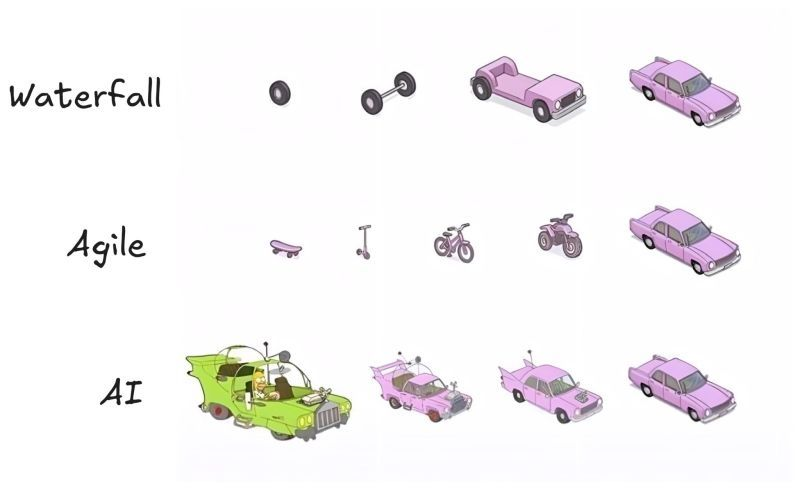
Honestly, this is the most accurate diagram I've seen.
Waterfall: You plan for 18 months and deliver exactly what nobody needs anymore.
Agile: You deliver something usable at every step, but the CEO keeps asking, "Where's the car?"
AI: You get the car on day one. It has six wheels, the doors are on backwards, and it has a rocket launcher. You spend more time making it yours than actually "building"; it's shaping. owning. verifying. That's what the best AI developers do now. They don't build. They shape and own.
@BravoKiloActual Unable to manufacture EFPs in Iraq when I was there. All Iranian. Was interesting how most American's never really knew how much of that war was with Iran.