If you’ve seen me give a research talk in the past two years you’ve probably seen me talk about this one - we’re very excited to share it with you! https://t.co/c5N5A3s1SY @JonnyRobinson6@hohwy@cogphillab@Monash_M3CS
This is the first time that this task has been used online, and the presentation code is freely available with the paper: https://t.co/op8X3zacW4 @JonnyRobinson6 did a fabulous job translating my @MATLAB scripts to work on Pavlovia using @psychopy and psychojs
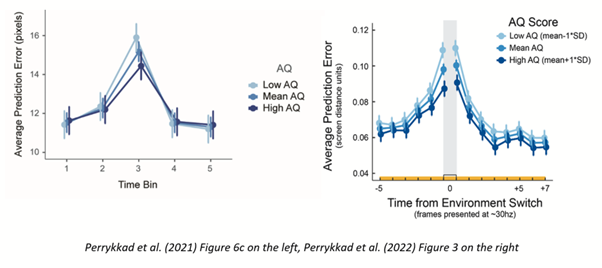
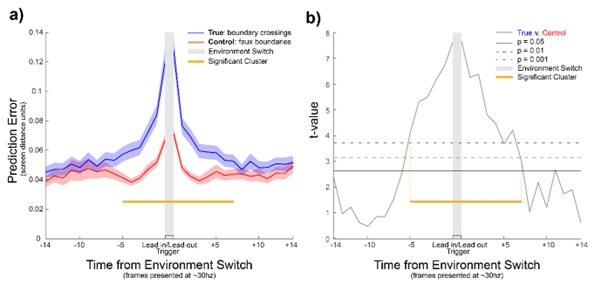
As in my previous research (https://t.co/6lRJrhiQJG) we found that participants with higher autism traits reacted to rising prediction error earlier than those with lower autism traits.
We found that participants slightly but significantly preferred the sand environment (noisier but simpler), and switched environments when uncertainty was increasing.
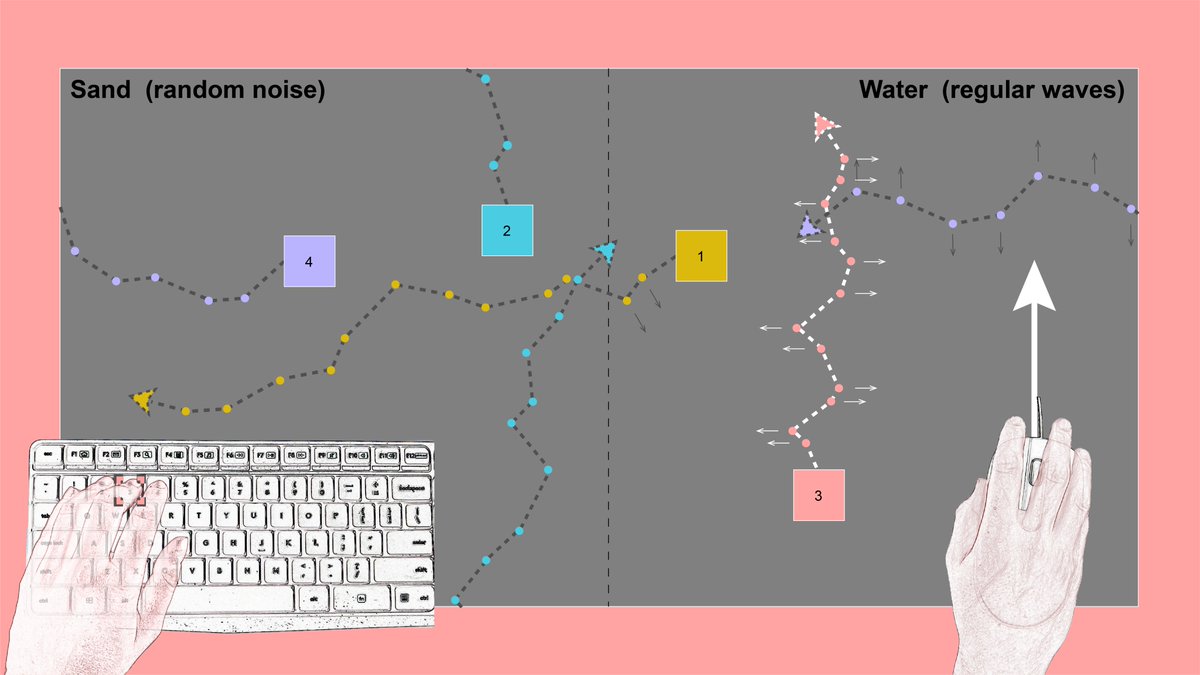
In the sand environment there was greater irreducible noise but the water was more complex to accurately model. We looked at environment *selection* and environment *switching* behaviours.
In our online study, participants had to figure out which square they controlled with their mouse and they could freely travel between two environments on screen to do so.
Classically, environment selection is conceptualised as serving either pragmatic (acquiring reward) or epistemic goals (information about where rewards are), but there’s a more fundamental reason for action - to figure out what you can do (reduce uncertainty about your agency)
Our paper “Foraging for the self: Environment selection for agency inference”, more fondly known as the Beach study 🏖️🩴, is out today in Psych Bull & Rev! OA: https://t.co/G8iC3lvRG0 @JonnyRobinson6@hohwy@cogphillab@Monash_M3CS A thread 🧵:
We are back for season 2! Very excited to share our first ep where we interviewed the amazing @kelseyperrykkad a post-doc at @cogphillab and @Monash_M3CS 🧠🧠Kelsey chats to us about ways we can understand and study the self.
https://t.co/9ejIg0Ek8V
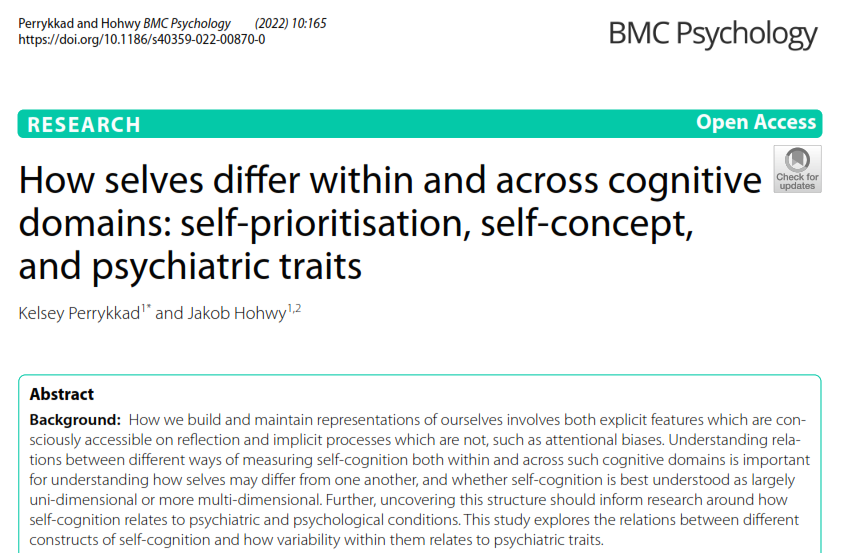
Are you interested in cognitive processes related to the self or dimensional approaches to psychiatric conditions? You might be interested in my new paper with @hohwy and out now in #BMCPsychology! @Monash_M3CS@Monash_Arts@cogphillab https://t.co/eykMtUBTy2 A 🧵… 1/7
Congratulations to Dr Kelsey Perrykkad for winning the Emerging Researcher Award from the Australasian Cognitive Neuroscience Society @ACNS_Official. Hugely well-deserved. Such a privilege to have you in @cogphillab and @Monash_M3CS 🥳
@Monash_Arts
I’m honoured to have won an Emerging Researcher Award from @ACNS_Official this year! Thank you to the society for everything you do in bringing such an inspiring group of people together - see you at the conference next month!
✨Cool online event coming up!✨
On June 15th we get together to discuss @NeilLevy10's awesome book 'Bad Beliefs'.
Discussants are @danwilliamsphil, @stephen_gadsby, @lisabortolotti & myself. All welcome, registration through link below.
(Please RT!)
https://t.co/KxHP8GUYVp
New preprint, out now on @PsyArXiv!! My followers may know me for my work in understanding the self and agency – in this paper we look at whether believing that your actions are inefficacious acts as a barrier to acting compassionately 🤝 https://t.co/7jF3YPDv1f
A 🧵...
"...bizarreness is a common, non-deficient feature of spontaneous offline simulations occurring across the sleep-wake cycle..." New paper on dreaming and mindwandering from @KirbergManuela@cogphillab
Another fab publication from @cogphillab by my wonderful friend @KirbergManuela who reconceptualises dream bizarreness and develops the idea that 'bizarre' conscious experiences lie on a continuous spectrum through sleep and waking states including mindwandering -- Check it out!