The client purchased Bitcoin from OkCoin in 2014 and transferred it to a MultiBit wallet, recording the password at the time. In 2017, when attempting to sell the Bitcoin, they found that the password was incorrect—though they were certain they hadn’t made a mistake and suspected the wallet itself was faulty.
After receiving the wallet file, password clues, and a list of commonly used passwords, we immediately began analyzing the wallet file overnight. After multiple attempts, we concluded that the recorded password was likely incorrect and proceeded to brute-force the password. Due to MultiBit’s strong encryption and our limited computing power, we prioritized this project at the highest level, dedicating all available resources to the task. Over the course of two hours, we tested dozens of password variations before finally succeeding in recovering access.
I Recovered a Trezor Wallet Containing 1,350 BTC
ShenTu Qingchun (X: @coinlost_com )
I. Prologue
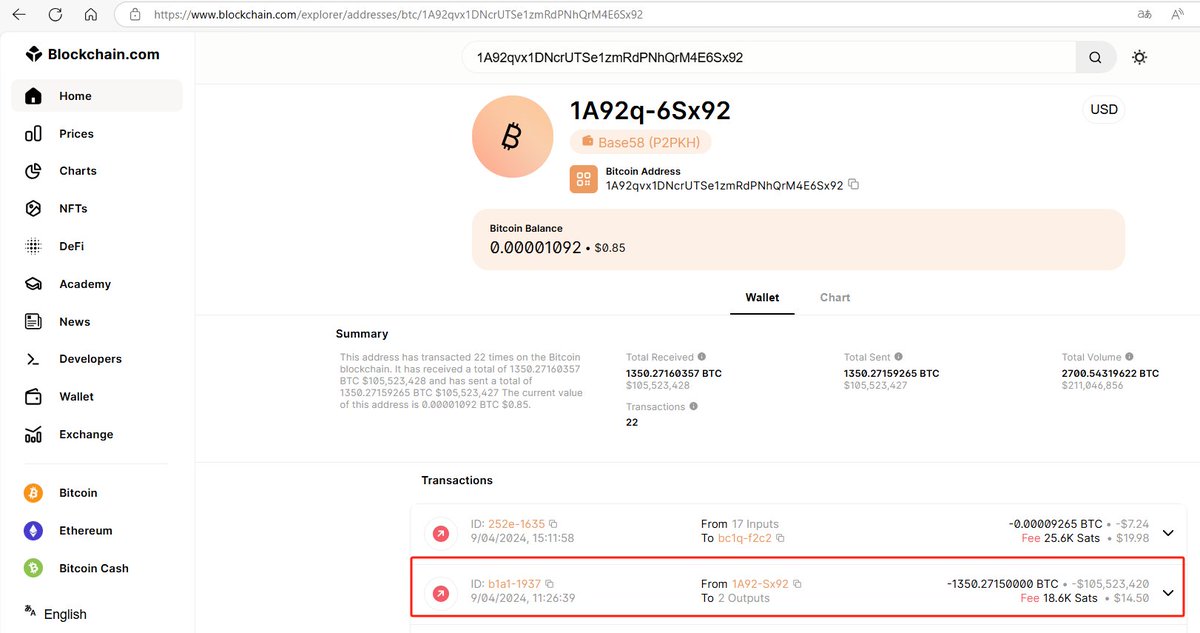
Yes, you read that right—this is not clickbait, nor is it a sensational headline. This is real. The BTC address is 1A92qvx1DNcrUTSe1zmRdPNhQrM4E6Sx92, and the recovery was successfully completed on September 4, 2024.
Initially, I hesitated to publicize this story, even though some friends guessed it was me and asked privately. However, I now feel this is a milestone worth celebrating and documenting.
The client, a foreigner, purchased a Trezor hardware wallet in 2016. He created a hidden account with an advanced passphrase and stored 1,350 BTC in it.
By 2019, he had forgotten the passphrase and began seeking recovery help. Previous attempts involved brute-forcing the password through Trezor’s development kit interfaces, but the process was excruciatingly slow—after six months of futile effort, the client gave up.
II. Taking the Job
In early July 2024, the client contacted me through a mutual connection. We quickly agreed on terms and devised a recovery plan that required physically
dismantling the device to extract data from its chip.
To prepare, we sourced specialized tools, chips, and equipment from Singapore and China and purchased 10 Trezor wallets for practice.
Though I had basic knowledge of chip soldering, theory and practice are worlds apart. We spent two weeks practicing day and night, mastering tools like soldering irons, hot air guns, embedded boards, oscilloscopes, chip programmers, and programmable power supplies. We also practiced soldering on spare circuit boards until our skills were sufficient for the task.
Next, we focused on chip data extraction. Despite understanding the theory, practical execution demanded precision. We immersed ourselves in voltage and circuitry studies, built custom circuits, and conducted countless experiments until we could reliably read data from Trezor chips.
After extracting the data, we spent two weeks developing decryption and password recovery programs. We optimized a GPU-based algorithm to accelerate the process.
By late July, the intermediary brought two test Trezors (same model) with pre-set PINs, passphrases, and seed phrases (unknown to us). Within 2–3 days, we extracted the data and successfully recovered the passphrase using the client’s hints, proving our capability.
In mid-August, the client set up another Trezor (same model) with a new PIN, passphrase, and seed phrase (unknown even to the intermediary). This time, we recovered the passphrase in just 3–4 hours, solidifying the client’s trust.
III. The Recovery Process
In early September, we gathered with the client and intermediary at a hotel to sign contracts and begin the final recovery. Within 3 hours of receiving the wallet, we extracted the chip data. After decrypting it, we deployed our GPU-powered recovery program, leveraging all available computational power and the client’s password hints.
24 hours in, with no progress despite multiple strategy adjustments, tensions rose. The client planned to leave if no breakthrough occurred by Day 3, while we prepared to relocate and continue for up to two weeks.
On Days 2–3, we revisited the password hints repeatedly. During breakfast on Day 3, we refined the hints and resumed the search. After another 1–2 hours of deadlock, the client left to rest. The intermediary and I continued analyzing the hints, and I hypothesized that the client’s clues might be overcomplicated. I rewrote the password generator to simplify the logic and restarted the program. Within minutes, the passphrase was cracked!
The intermediary erupted in joy, even kneeling in gratitude. The client, awakened by the news, was euphoric—eight years of waiting had ended in triumph. At the time of recovery, BTC had surged to 58,000(155 tims from his 2016 purchase price of 375). Everyone involved achieved financial freedom.
Two other individuals—a crypto influencer (@BITWU.ETH) and an anonymous lawyer—were notified and celebrated the success. We distributed the BTC as agreed, followed by altcoin transfers that evening. The job was complete.
IV. Reflections
This project demanded 1.5 months of relentless technical research, coding, and hands-on chip recovery—a test of patience and adaptability. With this experience, we’re now equipped to handle hardware wallet recoveries confidently.
The most nerve-wracking moment wasn’t cracking the password but physically holding the wallet. My hands trembled—this device held 1,350 BTC, and the client’s trust was immense. Despite signing liability waivers and a flawless track record, the stakes weighed heavily.
During the chip extraction phase, my blood pressure spiked to 160/110 (Stage 2 hypertension), even with daily medication. Only after the initial recovery phase did it stabilize. Post-recovery, smaller wallets no longer faze me—the crypto world hardens your nerves.
The project’s physical toll was real: 12–14 hours daily of intense focus left me with lingering lower back pain for months. Yet, the success made it worthwhile.
V. Postscript
My journey began with a cryptography PhD at Shenzhen University’s ATR National Defense Key Lab (2011). I delved into blockchain in 2013 and started wallet recovery work in 2019.
In late 2020, we invested millions in servers equipped with 8x NVIDIA 3080/3090 GPUs for password recovery. By late 2024, we allocated ¥15 million to 8x RTX 4090 rigs and other dedicated hardware—no mining, no AI, purely for recovery. Our systems now test billions to trillions of passwords per second, depending on the wallet.
To date, we’ve recovered assets worth astronomical sums. Client confidentiality is paramount—hence our insistence on self-owned infrastructure to avoid third-party risks.
Since 2014, I’ve also led the SAFE Network project (X: @safeanwang), now entering its 11th year. Early crypto profits sustained SAFE for seven years; wallet recovery earnings have funded it for four. As an OG, I’ve staked my reputation on every venture, never abandoning a project. With SAFE4 launching soon, I’m confident it will thrive, just like our recovery work.
Reliable people deliver reliable results—whether in wallet recovery or blockchain projects, we’ll always uphold our commitments.
I’ve encountered many people who claimed to have owned large amounts of Bitcoin in the past and asked for my help to recover them. Their stories, however, were riddled with inconsistencies: some insisted they mined tens of thousands of BTC in 2008, only for hard drive data recovery to reveal nothing; others swore they had hundreds of Bitcoin on exchanges, only to discover—after recovery attempts—that they’d actually owned hundreds of Litecoin, long since sold off.
I don’t think they’re deliberately lying. Rather, Bitcoin’s relentless price surges have bred envy-driven narratives. They fantasize, “What if I’d bought Bitcoin back then?” Over time, their memories morph—maybe they once held other coins, but Bitcoin’s repeated price milestones batter their psyche. This belief becomes a form of self-hypnosis: “I must have owned Bitcoin!”
As for me? I take every claim seriously. No matter how implausible, I investigate—what if it’s real?
The Black Humor of a Professional Password Recovery Expert
Today, let's talk about some black humor to lighten the mood...
I have been in the blockchain industry for 12 years and have been professionally engaged in wallet password recovery for more than 6 years. Logically, having dealt with so many clients who lost passwords and private keys, I should have a high security awareness and should not forget passwords. But that is not the case...
1. The reason for wallet recovery
In a previous article (My Story with 10 Bitcoins), I mentioned that I had forgotten the password to a Bitcoin Core wallet containing 12 Bitcoins. The original password length was 26 characters, and while recording the password, I intentionally made 3 small mistakes. Half an hour later, I had forgotten what those little mistakes were.
Just because of these 3 small mistakes, I was passively locked up for 7 years, only managing to crack it successfully in 2020, selling it in November 2014 for 90,000 USDT, earning a 1000-fold return. This experience made me feel that the price of password recovery brought me into this field.
2. History repeats itself
(1)2014 Experimental Wallet
This is another Bitcoin Core wallet of mine, with only 0.5 BTC in it. It was an experimental wallet used for writing blog posts and papers, and I made quite a few experimental transactions. After finishing the paper, I forgot about this wallet and its password. After successfully recovering my previous wallet in 2020, I discovered this wallet while organizing my hard drive. Because it had little currency and the password was all numbers, I quickly succeeded in cracking it using brute force.
(2)2018 Two Mobile Wallets
These two mobile wallets had little currency, so I set the passwords casually and didn’t record them, resulting in forgetting them over time. The altcoins inside had been at a low price for a long time, so I was too lazy to spend time recovering them, leaving them untouched for 4-5 years. Until a few months ago, for practice, I extracted data from the phone and successfully cracked it using various combinations of common passwords. After all, it was my own password, mostly within the range of usual passwords. Even though I had no memory of the password, by calming down and repeatedly trying different combinations, it was relatively easy to succeed.
Of course, if the problems encountered were that simple, there would be nothing more to say... The main issue is that the subsequent events are both laughable and absurd...
3. Absurd mistakes of a professional player
(1)2021 Commission Wallet
In 2021, I successfully recovered a wallet for a client and charged a commission, storing it temporarily in a mobile wallet. It was transferred to another phone and remained untouched for two years, and I forgot the password. I should have recorded the mnemonic phrase, as it has always been my habit, but I could never find where I put it. I even wrote a program to search the entire disk for the mnemonic, but couldn't find the correct one. After that, I could only extract data from the phone, trying some common password combinations for a while, but I still couldn’t crack it. According to the spirit of the 'Ah Q' victory method: passive lock-up would yield more returns, and I never intended to sell it anyway, so I can only wait and see.
(2)2024 Hardware Wallet Horror
In 2024, I successfully recovered a wallet, with the commission stored in a hardware wallet. The security chip level of this hardware wallet is very high, and currently, there is no way to crack the chip. However, I have the mnemonic phrase and password recorded, which must both be correct at the same time to recover. I intentionally made 2 mistakes when setting the password, similar to the password settings for the Bitcoin Core wallet with 12 Bitcoins. A few months later, when I wanted to check it, I suddenly forgot what those 2 mistakes were?
Falling in the same place twice... It seems I might have some early signs of dementia...
In this shock, my blood pressure suddenly rose. I spent half a day figuring out the encryption mechanism, wrote the cracking program, and spent a whole night running passwords without success. I didn't sleep well that night, and the next afternoon, while manually trying passwords bit by bit, I suddenly remembered the mistakes. To my surprise, the password was indeed correct, and I finally breathed a sigh of relief; it was truly terrifying...
(3)2025 Mid-transfer Wallet Incident
But what I didn't expect was that the same incident happened repeatedly... In 2025, a client wallet I successfully recovered had the commission stored in a wallet I frequently use for transfers. Because it was a transfer wallet, the password was quite simple. However, I thought I would temporarily store it for a while before processing it. For safety's sake, I casually changed the password in early February, thinking I would deal with it soon, so I didn't record the password. As a result, when I wanted to handle it two months later, I forgot what the password was!!!
At this moment, I really want to die... The same mistake keeps happening again and again; how foolish can I be... Now I can only think about quickly recovering it, but there are even more absurd things to come...
After careful consideration, I started the four-level recovery method:
A Find backups before the password change
B Check whether there are retained mnemonic phrases on the current computer
C Crack the password
D The year before last, there was a failure in an SSD boot drive, which certainly contained wallet data before the password change.
4. Recovery process
Following the recovery ideas mentioned above, I tested them one by one:
(1)Find backups before the password change: Backup disaster
Originally, I had 2 laptops and 2 external hard drives, with important data backed up on both laptops and one external hard drive. This wallet should have had 4-5 backups before the password change. If I could get just one, then the password wouldn’t be a problem.
But coincidentally, just before forgetting the password at the end of March, I bought a new high-spec laptop in early March. So, I ghosted all the content from one of the old laptops to the new laptop, and it was running normally. At that time, I thought there was too much duplicated data in the backups, so since the new laptop was running fine, I thought I could temporarily do without the other data backups, and planned to repartition the two old computers to free them up for other uses. As a result, I completely deleted these 4-5 backups from the two old laptops and one external hard drive, repartitioned them, and copied a large amount of new data over the original data... This route is now cut off...
This was supposed to be the simplest method, yet I severed it just days ago, leaving no backups at all, perfectly destroying all escape routes... What grudge is this...
But I had previously changed to a new computer, and I often leave backup data for six months or even a year. This time was exceptionally unusual; perhaps it was fate...
(2)Searching for retained mnemonic phrases: failure
I wrote a dedicated program to search for the mnemonic phrase, conducting multiple searches on all computer hard drives, but I just couldn't find the correct mnemonic. This path is not feasible.
(3)Cracking passwords: temporarily stalled
I listed my commonly used passwords and ran them with computational power for several hours, but unfortunately, there were no results. It seems that when I set the password, I added some uncommon elements to my usual passwords. Given that I have no memory of the password at all, it seems it won't be resolved in the short term, but I can only push this method forward as a priority...
(4)SSD Recovery: Pending Research
The year before last, there was a failure in an SSD boot drive, which certainly contained wallet data before the password change. It just involves the circuits and chips of the SSD, and it is necessary to determine the point of failure. If the main control chip or other chips are damaged, but the storage chip is intact, there is still a chance to recover data. If the storage chip is not damaged, how to read from multiple storage chips and combine the correct data is a data combination algorithm that has not been publicly disclosed and still requires further research and experimentation.
5. Blood and tears lessons
As of now, the above two wallets have not yet been recovered and are still in the desperate rescue process. While I regret it, in fact, I am not panicking. After all, it is my own wallet with my own password. By trying different password patterns and eliminating the incorrect ones, the likelihood of eventually cracking it is quite high. Moreover, this is equivalent to a passive lock-up, and after 5-10 years, it might still be worth a good price. This spirit of victory method truly offers self-comfort...
However, I am a password recovery expert, yet I repeatedly forget wallet passwords. This is really unacceptable, and I need to reflect on myself to prevent falling into the same situation for the fourth time.
The main lessons are as follows:
(1)After fifty years of age, memory is not as good as before, and I can no longer trust my memory. Passwords must be accurately recorded and saved well, without introducing errors.
(2)The mnemonic phrase should have been recorded, but due to carelessness, it was not properly saved, making it difficult to find. I must record and save it carefully in the future.
(3)Being too eager to organize the old computer, I deleted 4-5 backups and repartitioned it, covering it with a large amount of new data. This was the most unacceptable part, leaving no chance to recover any data. This should have been done only after the new computer had been running normally for 3-6 months.
As a professional password recovery expert, falling into the same pit repeatedly is probably the ultimate black humor of the cryptocurrency world...
Lost your crypto-currencies ? Don't worry, we help you to recover passwords and corrupted wallets for amost all crypto-currencies.
Visit https://t.co/g8BrlAxKuh to get supporting.