Exploring the nexus of tech, finance, law, AI & global affairs | Decrypting hidden histories | Pioneering digital finance | Advocating for ethical health tech
@patentriff I don't agree with all of this advice (& the article was written using AI 😅), but an interesting viewpoint to consider nonetheless. Good stuff.
Hmm: as the market plummets, SpaceX IPO price stays the same. If the overall slump holds, will this lead to an early correction?
I think this could heavily pressure the stock and lead to a correction (and opportunity) once secondary trading begins.
Making matters worse, SpaceX chose a flat price of $135 per share, which removed the cushion typically built into flexible IPO pricing ranges.
#SPCX $135
Canada government grubs trying to steal more of a revenue cut from data centers than from other businesses. This could be an advantage if $IREN can lobby to be grandfathered in for birthing the industry at scale in PG, Canada.
$IREN
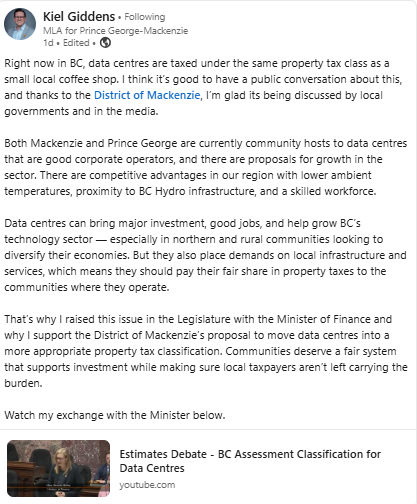
Kiel Giddens, the MLA for Prince George–Mackenzie, urges the Minister of Finance to consider moving data centers into "a more appropriate property tax classification."
While this may sound bearish, he believes this is a fair price to pay for gaining, and maintaining, access to local infrastructure.
Kiel is very much pro-business, but as a representative of the people, he wants everyone to win and participate in the economic value that these data centers bring to the region.
This is very much in line with what Mark Carney introduced earlier this week: "AI for All."
https://t.co/SmOmMcWQvO
Kiel calls the current data center operators in both Mackenzie and Prince George "good corporate operators."
He also mentions that there are proposals for growth in the sector.
Since there are no other data centers in Prince George and Mackenzie outside of those operated by @IREN_Ltd, these are encouraging words. The prospects of growth in exchange for higher property taxes represent a trade-off that could ultimately benefit not only the community, but also the shareholders of IREN.
Ultimately, this decision will not be made by the Ministry of Finance, but will instead fall under the previously adopted Bill 31. A "competitive selection process" is currently in place, under which a 400 MW allocation will be made available during the first two years.
IREN is in a good position in BC, but it will have to play by the local and federal rules and regulations concerning AI and power.
With a seal of approval from the MLA and strong local community support, $IREN is actively working to provide jobs and economic value to these rural BC towns while simultaneously securing its strategic sovereign compute clusters.
Don't let the short term volatility dictate your conviction. Keep educating yourself, and research the topics that matter for the long run.
So $IREN the full picture in the last 30 days:
🤝 NVIDIA 5GW strategic partnership
💰 NVIDIA $2.1B investment at $70
📄 NVIDIA $3.4B 5yr AI cloud contract
🖥️ DSX digital twin with BE Networks
🖥️ Dell Blackwell $1.6B deal
🇦🇺 Australia 800MW
🇪🇸 Spain 490MW
📈 ARR raised to $4.4B
📊 Every analyst repricing up
💸 GB300 financing secured
🪩 Mirantis
Stock at $62 😐
The market is handing you a gift and calling it a meme stock 😂
Maybe I wasn't bullish enough on $IREN, $CIFR, others.
Check out this visionary discussion with OpenAI CFO Sarah Friar for clues and business context, like how many $/MW OpenAI thinks it can make ($10B). This info should help investors speculate on how much model providers will be willing to pay for access to AI power & infrastructure.
She says OpenAI operates on a strategic formula where 1 gigawatt of compute capacity is roughly equivalent to $10B dollars n annual revenue. This is a key benchmark for understanding the scale of infrastructure investment required to support massive, long-term Al demand.
To maintain an edge, OpenAl has moved toward a multi-cloud and multi-chip strategy. They now partner with many cloud service providers, including Microsoft, Oracle, CoreWeave, GCP, and AWS, and are integrating hardware from NVIDIA, AMD, and Cerebras, alongside custom silicon development with Broadcom.
Utilizing investment-grade cloud providers allows OpenAl to convert capital expenditures into operating expenses (as opposed to and scale usage in lockstep with revenue. This strategy provides "maximum optionality" and is particularly important while the company is not yet an investment-grade entity that could easily secure lower-cost debt financing on its own.
The company is also transitioning into built-to-suit, full-data center projects. E.g., SoftBank Energy in Texas. This means more direct involvement in infrastructure capital deployment (much harder to do when you're not a public company).
In other words, OpenAI is much more likely, for now, to prefer partnering with large-scale power-infrastructure providers who can provide power and chips. But they're dipping their toes into the process of direct investment even before going public to get ready to play with the big boys.
Finally, Friar emphasizes that compute remains a "very scarce resource" and anticipates that demand will outstrip supply through at least 2027. This reality has driven long-term projects like the 1-gigawatt data center complex in Seline, Michigan, which is being planned to meet capacity needs for the 2027-2028 window.
Reading between the lines, if you can't secure funding, and there's a bottleneck until at least 2028, OpenAI needs to contract with HPC infrastructure providers for the foreseeable future. More deals are coming.
IREN has announced a planned 800MW data center campus in Bundey, South Australia.
This marks IREN’s first announced Australian data center project and one of the largest in the Asia-Pacific region announced to date.
Learn more: https://t.co/3bOYCUG3pk
@_The_Prophet__ provided the context. If the $GOOG is seeking $80B funding to build AI infrastructure, the value of secured power to plug all those chips into will only intensify. Of course, Google will build to suit its own Tensor Processing Unit (TPU) chips. And it will need to secure more power. I'm glad to be invested in $IREN, $CIFR, $CLSK, et al., who can directly provide much of the raw power Google needs—under the right deal terms.
⚡️The real signal is capital intensity has finally breached the Mag 7 mythology.
For fifteen years, mega-cap tech was treated as the cleanest business model ever built: asset-light platforms, infinite operating leverage, buybacks, pristine balance sheets, high-margin software economics, and monopoly-like cash generation.
AI is dragging that model into the physical world.
Compute is not magic. It is chips, power, land, cooling, fiber, transformers, data centers, supply chains, depreciation schedules, financing capacity, and utilization risk. The market wanted to believe intelligence would scale like software. The truth is harsher: frontier intelligence scales like industrial infrastructure with software economics only at the monetization layer.
That is why this matters.
Alphabet tapping equity, if accepted by the market, means AI capex has crossed from “large internal investment” into “capital market buildout.” That is the phase shift. The strongest companies in the world are no longer merely spending retained cash on AI. They are beginning to organize the financing architecture of the AI age.
Berkshire’s role is the most important psychological component. The $10B is not large relative to Alphabet. The signal is legitimacy. Berkshire acts as a credibility bridge between old capital and the new compute empire. It tells conservative money: this is no longer just speculative tech expenditure; this is infrastructure accumulation.
That is the railroad analogy. Not as metaphor fluff, as capital structure.
Railroads needed land, steel, debt, equity, government alignment, private capital, and belief that future throughput would justify present overbuild. AI infrastructure is entering the same zone. The winners are not simply the companies with the best models. The winners are the companies that can finance the physical substrate at the lowest cost, deploy it fastest, secure power, fill capacity, and convert compute into recurring revenue before depreciation eats the story.
This also changes how the Mag 7 should be analyzed.
The old question was: who has the best product, the biggest network, the strongest margins, the largest buyback?
The new question is: who can carry the capex burden without breaking the equity story?
That is a very different market.
Alphabet doing this gives cover to the others. Microsoft can point to cloud backlog. Amazon can point to AWS and infrastructure DNA. Meta can point to ads, AI agents, and frontier model control, but the market will demand clearer ROI. Apple has less permission because it is not structurally viewed as a compute-infrastructure owner. Nvidia sits in a different place because it sells the picks and shovels, though even there the financing burden may migrate into customers, leasing structures, sovereign deals, and vendor-backed capacity.
Deep down, this is bullish for the AI infrastructure arc and dangerous for lazy AI equity narratives.
Bullish because the demand pressure is so intense that companies are willing to reshape capital structure to meet it.
Dangerous because the free-money illusion around AI equities starts cracking once investors realize this is a financing war, not just a product cycle.
The cleanest read:
Same arc, new phase.
The AI buildout is still real. The infrastructure demand is still massive. But the active mechanism has shifted from narrative acceleration to capital formation.
That means the market will stop rewarding AI exposure indiscriminately and start sorting companies by funding durability, power access, capex efficiency, utilization, margin conversion, and balance-sheet trust.
The real truth: AI is forcing the world’s most powerful companies to become industrial empires again.
Software ate the world with code.
AI has to rebuild the world with concrete, copper, silicon, energy, and debt.
Understanding $IREN deal structures before the market does so opens the door to asymmetric upside. This company is financially sophisticated like few others. I'm paying close attention but am lucky to have all the α this retail community provides.
Most $IREN investors don't yet grasp how profitable the 60 MW $NVDA deal actually is.
Despite being just 20% of the MW capacity, it yields more cumulative net income than the 300 MW $MSFT agreement.
This is a direct result of $IREN locking in stronger terms.
Now that $IREN is quickly establishing itself as one of the premier cloud providers with the deepest pipeline in the industry, I expect future deals to land at similar profit margins.
Considering the price action since last earnings, the market clearly hasn't priced that in yet.
IREN's announcement today completely alters the near-term risk profile of the company by securing the capital needed to fulfill its largest contract so far (MSFT) without issuing new equity.
Looking at the terms and what this means for IREN's broader strategic picture, IREN closed $3.65 billion investment-grade GPU financing to fund the hardware for its $9.7 billion Microsoft AI Cloud contract.
The terms are highly favorable:
• $2.10 billion U.S. private placement at a fixed rate (SOFR+2.13%) and a $1.55 billion delayed draw term loan at a floating rate (SOFR+2.25%).
• The blended cost of this debt is 6%. But, because this is combined with a $1.94 billion upfront prepayment from MSFT (which acts as 0% interest funding), IREN's all-in average financing cost drops to 3.31%.
• The debt is secured against the GPUs and the guaranteed cash flows from the Microsoft contract. Because of this structure and MSFT's creditworthiness, the facility received an A rating from Fitch and an A_low rating from DBRS.
• Combined with the MSFT prepayment, this facility funds 96% of the $5.81B GPU cost required for the deal.
This is positive for IREN investors (and kills a bear thesis):
1. It Kills the Unfunded Capex Bear Thesis
The primary bear argument has been that IREN had a multi-billion dollar capex hole and that management's mention of GPU financing to pay for it was just "vibes." This announcement proves the bears wrong. By securing $3.65 billion in traditional debt, IREN has completely funded its obligations for the MSFT hardware rollout.
2. It Protects Against Dilution
This is the most critical takeaway for the stock price. Because this $3.65 billion is debt secured by the hardware and the contract, IREN does not have to issue new shares to pay for the GPUs. This preserves the company's $2.6B cash to be used exclusively for building physical data centers (like the liquid-cooled expansions at Childress and Sweetwater) rather than buying chips. By funding the hardware through debt and the buildings through existing cash, IREN's dilution map that I've posted about several times remains intact.
3. Institutional Validation
This is the first GPU financing ever executed in the US private placement market and the highest publicly rated investment-grade GPU financing announced to date. It proves that traditional, risk-averse financial institutions view IREN's business model—owning the physical data center infrastructure while leasing the compute—as a highly secure, bankable asset.