you're burning your effort in vain if you're not paying attention to the infrastructure behind your outbound
good copy, great lists, no-brainer offer
but emails still landing in spam
we're sending 1.6M emails/day for B2B clients and wrote this no-BS email inbox guide based on real data
DM "inboxes" + like and I'll send it over
here we are again...
using Outlook for cold email is like working with grandpa
→ he goes down and takes your whole Friday with him
→ he sends 2–3 emails a day and needs a nap after
→ no links, no tracking, “back in my day we wrote short emails”
→ he’s never heard of AI
→ and he still can’t find the send button
this week Outlook went down and every single-provider cold emailer got f*cked
and you still don’t understand why you’re not at $100k/mo, bro
grandpa had a good run.
let him retire.
Google for your best leads.
SMTP for volume.
Outlook on the bench.
Outlook cold email is the past.
not dead. just not the future.
2 years ago Outlook was the cheat code. cheap inboxes, 100 per domain, fast warmup, volume for days.
everyone piled in.
now look at it, gents.
WHY OUTLOOK-FIRST IS OVER
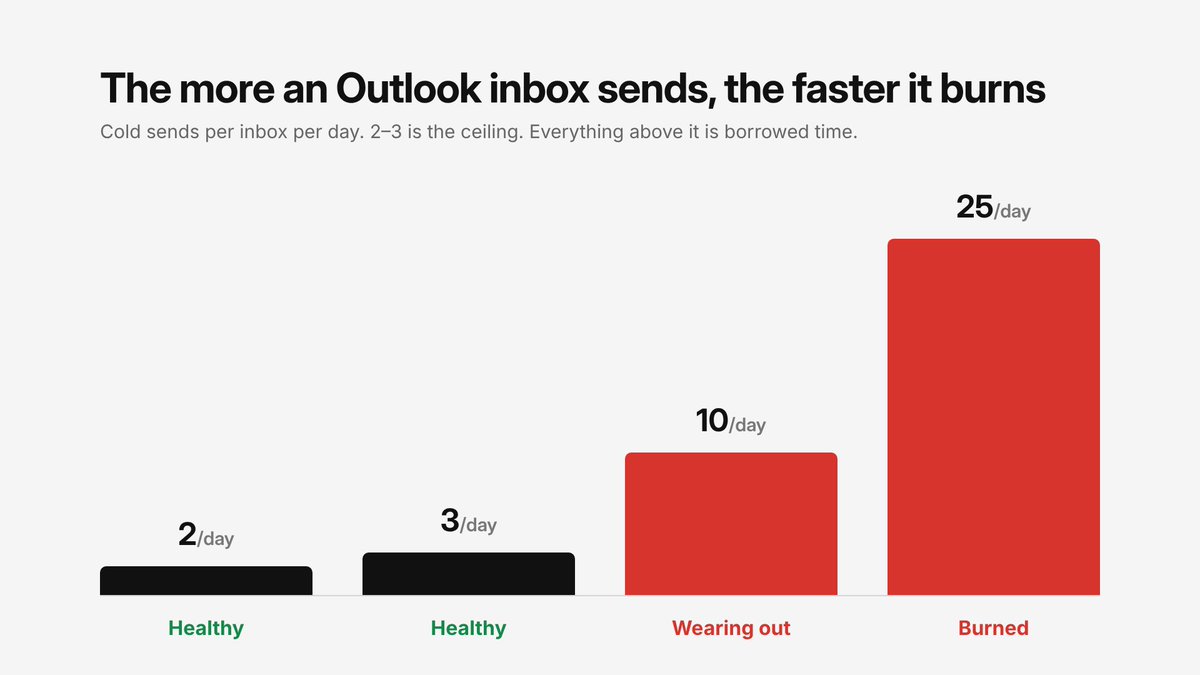
→ 2–3 cold sends per inbox per day. that’s the ceiling now.
→ you need hundreds of inboxes to send real volume
→ no links, no tracking, short copy only, or you’re cooked
→ most volatile provider in the stack. it went down this week and took every single-provider sender with it
→ lands great in Outlook inboxes, not the best into Google
Outlook didn’t break.
it just got crowded, strict and moody.
you can still use it. you just can’t build your business on it anymore.
so what’s next?
GOOGLE WORKSPACE: THE SAFE PICK
→ most stable provider, period
→ highest trust everywhere you send
→ ~20 cold sends per inbox per day
→ easy to set up
→ but expensive per inbox, and only 5 inboxes per domain
Google is the king for your best segments.
it’s just a pricey king to scale.
SMTP: THE ONE THAT WINS
→ cheapest cost per send of any provider
→ scales as far as you want to push it
→ your own IPs, your own reputation, nobody else’s mess
→ absorbs volume spikes so your Google inboxes stay clean
the catch?
you have to set it up properly.
dedicated IPs, proper DNS, 3–4 weeks of warmup minimum.
skip the homework and it burns fast.
that’s exactly why it wins.
easy infrastructure gets crowded.
crowded infrastructure gets punished.
SMTP rewards the people who actually know what they’re doing.
the 2027 stack:
→ SMTP for volume
→ Google for your A-list leads
→ Outlook as backup, not the main event
Maildeck sets up all three properly, so you don’t learn SMTP by burning your own domains.
the dumbest and smartest cold emailers have one thing in common
neither of them is crying about Outlook today
the low-IQ guy just paid for Google Workspace. easy setup, stable, costs more, doesn’t care.
the high-IQ guy set up SMTP properly. cheap, scales forever, takes real skill to not burn.
the midwit picked Outlook because it’s cheap and easy to scale. great call, until Microsoft has a bad day and his whole pipeline goes to zero.
the move isn’t picking a side of the curve.
it’s owning the whole curve.
Google is the most stable inbox in cold email
which is exactly why people abuse it
50 sends a day from one Workspace inbox isn’t “maximizing ROI,” bro. it’s speedrunning a burned domain
~20 cold sends per inbox per day. 5 inboxes per domain. need more volume? add domains.
Google for your best segments. Outlook for volume. SMTP for buffer. that’s the stack.
everyone’s trying to squeeze 25 sends out of one Outlook inbox
bro that inbox isn’t a workhorse, it’s a candle
every extra send burns it faster. 2–3 cold sends per inbox per day. always.
want more volume? add inboxes.
that’s literally why Maildeck exists.
@itsconnorkaplan Scale only comes after the campaign has zero leaks.
Scale early and the leaks kill you: bad data, weak offer, broken infrastructure, all multiplied by volume.
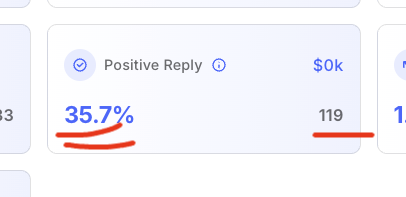
This is one client, one campaign, this week: 119 positive replies, 35.7% positive.
What’s your infra looking like?
@JoshBolstad2 Exactly. And the upfront cost argument flips fast.
One wipeout costs you the domains, the warmup time, the replies you never got, and the client who stopped trusting you.
Azure isn’t dying. Shared tenants are.
The problem was never Microsoft. It was the $1 mailbox. You were renting a room in someone else’s house, with 50 strangers throwing parties in the other rooms. When Microsoft raided the house, everyone got evicted.
That’s a sourcing problem, not an Outlook problem.
Here’s how to run Outlook the right way:
OWN THE TENANT
→ Your domain, your tenant, your inboxes
→ Nobody else sending inside it
→ If you can’t name who else is in your tenant, assume it’s 50 cold emailers
SOURCE IT RIGHT
→ High-spend real businesses
→ Not cold email reseller pools
→ Premium license
→ Ask your provider where the tenants come from. If they dodge, you have your answer
2–3 SENDS PER INBOX PER DAY
→ 100 inboxes × 3 = 300 sends per domain
→ Not 5. Not 10 because “last week was fine”
→ Outlook scales with more inboxes, not more sends per inbox
WARM IT PROPERLY
→ 3–5 days minimum, 10–14 if you’re patient
→ Randomize daily counts
→ Use a trusted warmup pool. A bad pool is worse than none
WRITE LIKE MICROSOFT IS WATCHING
→ No links. No open tracking
→ Short, plain text, typed-on-a-phone energy
→ Spintax so 100 inboxes don’t share one fingerprint
→ Outlook inboxes to Outlook recipients
MONITOR PER DOMAIN
→ Microsoft SNDS for reputation and complaints. Free
→ Reply and bounce rate per domain, not blended
→ One domain dips, pause it
→ Track inbox placement, not open rate
NEVER BET EVERYTHING ON ONE PROVIDER
→ Microsoft: cheapest volume, most volatile
→ Google: most stable, highest price
→ SMTP: in between
→ Run all three so one bad week never becomes zero pipeline
Losing 49% of inboxes in one day is a sourcing failure, not proof that Outlook doesn’t work.
Done right, Outlook is still the cheapest high-trust volume in cold email. Done cheap, it’s a $31k lesson.
Buy it right or buy it twice. Just don’t mistake “right” for “abandon Outlook.”
Taylor, when you lost the 49%, were those all shared-tenant Azure boxes, or did dedicated tenants go down too?
I’m seeing a ton of people on X and LinkedIn saying their Azure inboxes are getting cooked right now. Some are saying up to 30% of their inboxes can’t deliver anymore.
This was always going to happen, and I’ve been saying it for a year now.
Back in the day, most people would set up their own Google Workspace inboxes for around $7/month. It was annoying. You had to own the domains, set up the DNS, manage the accounts, and actually build the infrastructure.
Then resellers found ways to sell Azure inboxes for basically $1 each.
Everybody took the deal because the math looked insane.
But you weren’t really getting a $1 Microsoft 365 license. You were getting a mailbox inside somebody else’s tenant, alongside a bunch of other people sending cold email. You didn’t control the tenant, the licensing, or who else was burning its reputation.
What nobody wanted to admit was they were literally sacrificing their client's campaigns in order to save a few bucks, fueling the cold email industry's race to the bottom.
And when Microsoft decides the tenant is doing something it doesn’t like, it’s not your one mailbox that gets punished. Everybody inside the tenant gets hit at once.
I saw this coming because I had already watched the same movie with Google’s legacy panels.
I fuck up just as much as anybody else.
We lost 49% of our inboxes in one day and about $31k of infrastructure with it.
The loophole works until it doesn’t. Then all the money you saved on inbox cost gets spent twice over rebuilding campaigns, replacing domains, recovering replies, and explaining why pipeline stopped.
That’s why we stopped trying to find the cheapest possible inboxes and moved to Halo.
Cheap infrastructure is only cheap if it still works when you need it.
Buy it right or buy it twice.