https://t.co/ZvJcBgvZDf. Quote of the day: “ What happens when an entire civilization's contradictions — including its worst instincts — become the raw material an emergent intelligence draws its judgments from, at a scale and speed nobody has ever had to reckon with?”
Elon Musk is a Canadian, US and SA citizen and understands Canada and Saskatchewan.
His mother was born in Regina, Saskatchewan, he spent time working in Saskatchewan and Vancouver, had 2 years of schooling at Queens University and has lived, studied and worked in Canada for about 3 years.
Mike Myers has Canadian, US and British citizenship and has lived in the United States for 38 years.
If Mike Myers can do a series of Elbows Up commercials for the Liberal Party of Canada, Elon Musk certainly has the right to comment on Canadian provincial affairs.
The riots in France are following a traditional pattern. Every 20 or 30 years, discontent bubbles up uncontrollably. It is a beautiful country, where the language is spoken beautifully even by apparently uneducated people, and where it is almost impossible to get a bad meal or a poor glass of wine. Since the 1980s the French standard of living has slipped from about 90 percent of the American average to about 72 percent, while the public sector takes roughly 57 percent of GDP, more than 20 points higher than the United States. Under it all is the old cleavage: the French rankle under any authority, and at the same time have a bourgeois dislike of anything that costs them money.
Like a reliable geyser, they rise up every generation, hurl paving stones, pile up barricades, and set cars and garbage on fire. In May 1968 the students marched, the unions called a general strike, and de Gaulle sat in sphinx-like silence at Colombey while the BBC announced, with ill-concealed cheerfulness, that “the proud facade of Gaullism” was “crumbling into dust.” He had judged exactly when the love of disorder would give way to the fear that these antics might actually cost something. He spoke for eight minutes. “I will not step down. I have a mandate from the people, and I will fulfill it.” At midday 500,000 marched up the Champs-Élysées demanding his resignation. Ninety minutes after he spoke, more than 700,000 marched back down demanding that he remain. The strikes collapsed. In June he won the greatest victory in 175 years of French democracy.
Macron has nothing like that prestige, but as the yellow vests showed, he is little inclined to bow to rioters. The students are a shower: easy to disperse, and little supported by a public that already deluges them with money. There is no sign yet of a general strike. The disorder is being encouraged by La France Insoumise, while Marine Le Pen’s party strengthens in the polls. Whatever happens, it is another nail in the coffin of the overbearing federal Eurostate and of Davos-style social democracy. For Mark Carney and Canada, that approach would be like boarding a ship that cannot sail and will sink if it tries.
https://t.co/rdOsVcHmZo Quote of the day: “ Self-government is hard work. It requires citizens to absorb facts, recognize tradeoffs, distinguish evidence from assertion, remember history, tolerate disagreement, and occasionally accept outcomes they don’t like.”
Tesla Just Made Owning a Car Financially Obsolete https://t.co/V40ISnSJQ9 via @YouTube
There is a dream not owning a car. This gets you closer to it. This is one of the reasons why I don’t want a car now.
https://t.co/xIyrNyBu3h
As a retiring journalist, this hits very hard. This is the quote of the year.
“….that whoever gathered the news had gathered it honestly, and that what finally reached us was both truthful and accurate. That trust is what made a newspaper a newspaper.”
Dans 50 ans, les livres d'histoire diront qu'Elon Musk a gagné une guerre que personne ne savait qu'on était en train de perdre.
Une guerre commencée il y a 100 ans, dans une cellule de prison italienne.
En 1926, Mussolini fait arrêter un intellectuel sarde de 35 ans. Au procès, le procureur aurait dit : « Nous devons empêcher ce cerveau de fonctionner pendant vingt ans. »
Il s'appelait Antonio Gramsci.
Son cerveau n'a jamais cessé de fonctionner. En prison, il a rempli des milliers de pages qui sont devenues l'un des textes politiques les plus influents du XXe siècle. Je pense qu'on est en train de vivre le moment où sa théorie s'effondre.
Laissez-moi vous expliquer.
Gramsci se posait une question simple. Pourquoi la révolution communiste a-t-elle réussi en Russie mais échoué partout en Occident ?
Sa réponse : en Occident, le pouvoir ne tient pas seulement par l'État, la police et l'armée. Il tient par la culture. Par ce que les gens trouvent normal, évident, « de bon sens ». Il appelle ça l'hégémonie culturelle.
Donc, pour prendre le pouvoir, il ne faut pas d'abord prendre le palais. Il faut d'abord prendre les esprits. Les écoles. Les universités. Les journaux. Le théâtre. L'édition. Les tribunaux. C'est la « guerre de position » : une conquête lente, institution par institution. Quand la culture a basculé, la politique suit toute seule.
Quarante ans plus tard, l'activiste allemand Rudi Dutschke en fera un slogan : la longue marche à travers les institutions.
Pendant des décennies, on a vécu avec une énigme que personne n'arrivait vraiment à expliquer.
Pourquoi presque tous les artistes sont-ils de gauche ? Les acteurs, les chanteurs, les profs, les journalistes, une bonne partie de la magistrature. Pourquoi un pays pouvait voter à droite élection après élection et voir quand même sa culture parler d'une seule voix ?
On nous répondait : « c'est parce que les gens éduqués sont de gauche. »
Je crois que la réponse est plus simple. Gramsci avait écrit la recette, et elle a été appliquée. Quand tu contrôles qui obtient la subvention, le poste, la bonne critique, le prix, l'invitation sur le plateau, tu contrôles ce qui devient « la culture ».
La même énigme existait à l'échelle du monde.
Pourquoi tant de pays en développement, notamment en Amérique latine, revotaient-ils encore et encore pour des gouvernements socialistes ou de gauche radicale ? Venezuela, Bolivie, Nicaragua, l'Argentine des Kirchner, la Colombie de Petro. L'économie s'effondrait, les cartels prospéraient, le chaos s'installait. Et pourtant le même vote revenait.
Ma conviction : la pauvreté n'était pas un accident du système. C'était un électorat. Et autour, il y avait tout un écosystème d'ONG, de médias « indépendants » et de programmes de « société civile », financé en grande partie par l'argent occidental.
Puis, début 2025, il s'est passé quelque chose que personne n'avait jamais osé faire.
Elon et DOGE ont ouvert les livres de USAID. Une agence quasi intouchable depuis 1961, des dizaines de milliards de dollars par an. La grande majorité des programmes ont été coupés, et l'agence a été absorbée par le Département d'État.
Le robinet a été fermé.
Et regardez ce qui s'est passé depuis.
Bolivie : le MAS perd le pouvoir après presque vingt ans. Équateur : Noboa réélu. Honduras : la droite reprend le pays. Chili : Kast élu. Argentine : Milei remporte largement les élections de mi-mandat.
Et il y a deux jours, le Brésil.
Jair Bolsonaro est inéligible, condamné à 27 ans de prison. La gauche pensait avoir refermé le chapitre. Lula, 80 ans, briguait un quatrième mandat face à un pays qu'on disait acquis.
Dimanche, son fils Flávio est arrivé en tête du premier tour. Plus de 47 % contre près de 45 % pour Lula. Lula lui-même a reconnu un résultat « inattendu ».
Le plus grand pays d'Amérique latine est à un second tour de basculer.
Le plus grand virage à droite du continent depuis des décennies.
Coïncidence ? Je ne crois pas. Quand le financement disparaît, le récit perd ses haut-parleurs.
Il reste un dernier vrai bastion. L'Europe.
Bruxelles finance ses propres réseaux d'ONG, avec une opacité que même la Cour des comptes européenne a pointée. Les grandes fondations comme l'Open Society de Soros. Les entités supranationales qui produisent de la norme sans jamais passer devant un électeur.
C'est la dernière forteresse de l'hégémonie culturelle. Et elle commence à se fissurer.
Je suis convaincu que tout ça va s'effondrer, et plus vite qu'on ne le pense.
Gramsci avait raison sur un point essentiel : la culture précède la politique. Mais il avait oublié que ça marche dans les deux sens. Quand une culture artificielle perd ses perfusions, ce qu'il y a de vrai en dessous remonte à la surface.
Ce qui vient après, je crois que c'est une renaissance. Une culture qui recommence à aimer la beauté, l'ambition, la science, la civilisation qui l'a fait naître.
Et dans les livres d'histoire, on se souviendra que tout a commencé quand un homme a décidé de regarder les comptes.
Il fallait quelqu'un d'assez riche pour ne dépendre de personne, d'assez fou pour s'y attaquer et d'assez libre pour encaisser la haine qui allait suivre.
Merci Elon.
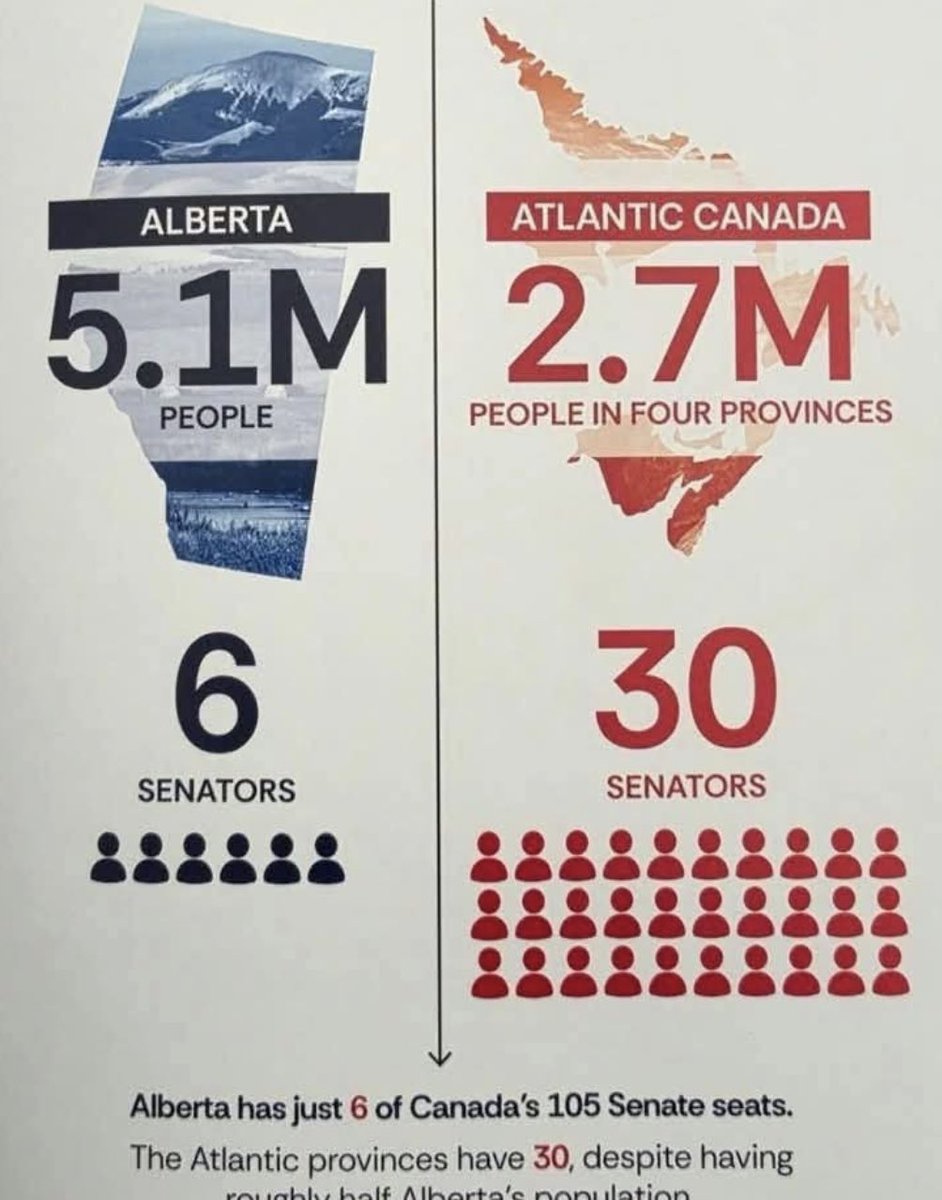
Can anyway defend this allocation of Senate seats as fair and equitable?
If yes - your IQ is at most 80. Shucks.
If no - please engage in improving how Canada can move forward.
Fair and equitable governance means we are rebuilding a great nation - not patronizing parts.
Maybe @stephenharper should have done something to fix the systemic discrimination of western Canada when he was in office, just as he laid out as an author of the Firewall Letter.
Instead he and the @CPC_HQ threw the west under the bus for eastern votes, thus highlighting the structural problem with Confederation,
The only mandate for a pension plan must be to maximize returns for the pensioners.
Not local development.
Not politically correct causes.
Not ESG shit.
And certainly not to backstop Brookfield.
Just invest where the best returns can be found.