work exists once.
right now, every tool owns its own version of your team's work. slack has the decision. google drive has the doc. linear has the task. github has the code. your ai agent has another thread of context. none of them live together, which leads to "what's the latest on ___?," "where did you put ___," and hundreds of similar questions each week.
coline puts the work underneath the apps. messages, files, ai chat, and the rest of your work live in one place, and apps are interfaces to them instead of recreations of them. your work exists exactly once.
we're launching today, and you can sign up for the public alpha at https://t.co/CqzKDGMaIn with a 2 week trial on the pro plan.
Excited to team up with @colineapp on this, all @buildrsdotdev users will get 3 months free - coline is an all in one integration tool, think clickapp but better And buildrs gets it for free.
Buildrs helping buildrs. Thanks @kodahhhhh
every company eventually creates a doc called “source of truth” and that is how you know there is no source of truth. and some companies don't even realize that they need a "source of truth" which is even worse.
the funniest enterprise software pattern is when a company buys a tool to reduce coordination overhead and then immediately needs a weekly meeting to coordinate usage of the tool, it happens
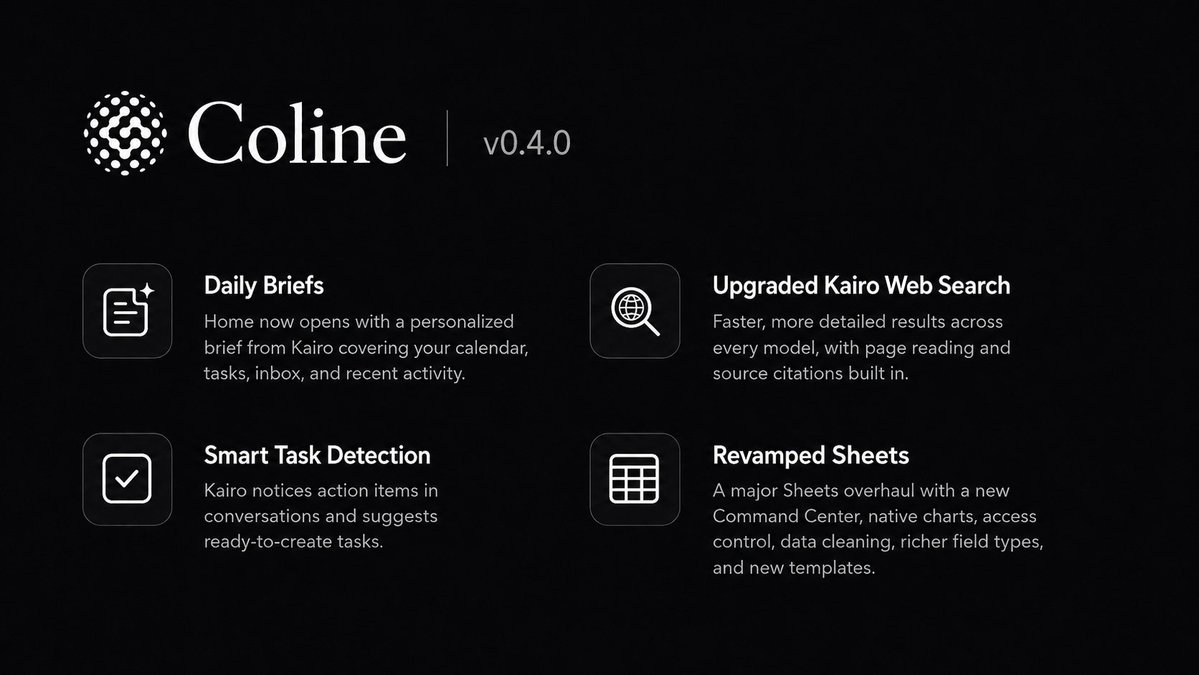
sheets got a major overhaul. a new command center with health scoring, reports, automations, finance, and planning tabs. plus, native charts, access control, data cleaning, new field types (currency, progress bars, ratings, duration), and 8 new templates.
a workspace should know what changed since you last looked.
not because someone wrote a perfect update.
not because someone tagged you.
not because you attended the right meeting.
because that is literally the job of the workspace.
Today we’re launching Coline into public alpha.
Most software today is built around isolated apps that each own their own version of your work. Slack has the discussion, Drive has the doc, Linear has the task, GitHub has the code, and your AI has another thread of context.
We think work should exist once.
Coline puts the work underneath the apps, so messages, files, AI, tasks, and the rest of your workspace can actually operate on the same objects instead of constantly syncing copies between tools.
box gave enterprises a secure way to manage documents in the cloud and became the file system for regulated work.
before box, enterprise documents lived on shared drives, local machines, email attachments, and systems that made collaboration painful. box brought cloud storage, permissions, governance, compliance, and sharing into one place that large companies could trust.
so box became the enterprise’s source of truth for controlled documents. the contracts live there. the policies live there. the regulated files live there. if you want the approved document, you go to box.
but governance is not the same as understanding. a document has a lifecycle: who requested it, what changed, why it was approved, what work depends on it, and when it should trigger action somewhere else.
box knew this. they added notes, workflows, signatures, metadata, integrations, governance tools, and AI. they tried to make content more active.
but box was built for secure content management. it protects the document, tracks the version, and controls access, but the actual business process around the document still lives across people and tools.
box earned the governed content layer. it just couldn’t become the work that happens around the content.
airtable gave teams a way to build lightweight internal systems without becoming software engineers.
before airtable, teams had two bad options: use a spreadsheet that was too loose, or wait for engineering to build an internal tool. airtable gave them databases that felt like spreadsheets, with views, fields, automations, interfaces, and enough structure to run real processes.
so airtable became the source of truth for team-built systems. the content calendars live there. the ops trackers live there. the lightweight CRMs live there. if you want to know how a team runs its custom process, you go to airtable.
but every internal tool encodes a worldview. the fields, views, formulas, and automations define what the team thinks matters. when every team builds its own system, the company ends up with many small truths that don’t fully agree.
airtable knew this. they added interfaces, automations, sync, enterprise controls, app platform features, and AI. they tried to make no-code systems more powerful and connected.
but airtable was built to let teams create their own operational databases. that makes it incredibly useful locally, and hard to turn into one shared model of the company.
airtable earned the no-code database layer. it just couldn’t unify the realities everyone built inside it.