It includes both true sayings gospels...the Gospel of Thomas (114 sayings of Jesus about manifestation - free copy on https://t.co/wFdt2F5z06), and the Gospel of Mary.
@thesiriusreport Paul, if Britain is officially at war, what emergency powers does the government gain, and which guarantees could be altered or suspended? Pensions, savings guarantees, capital controls
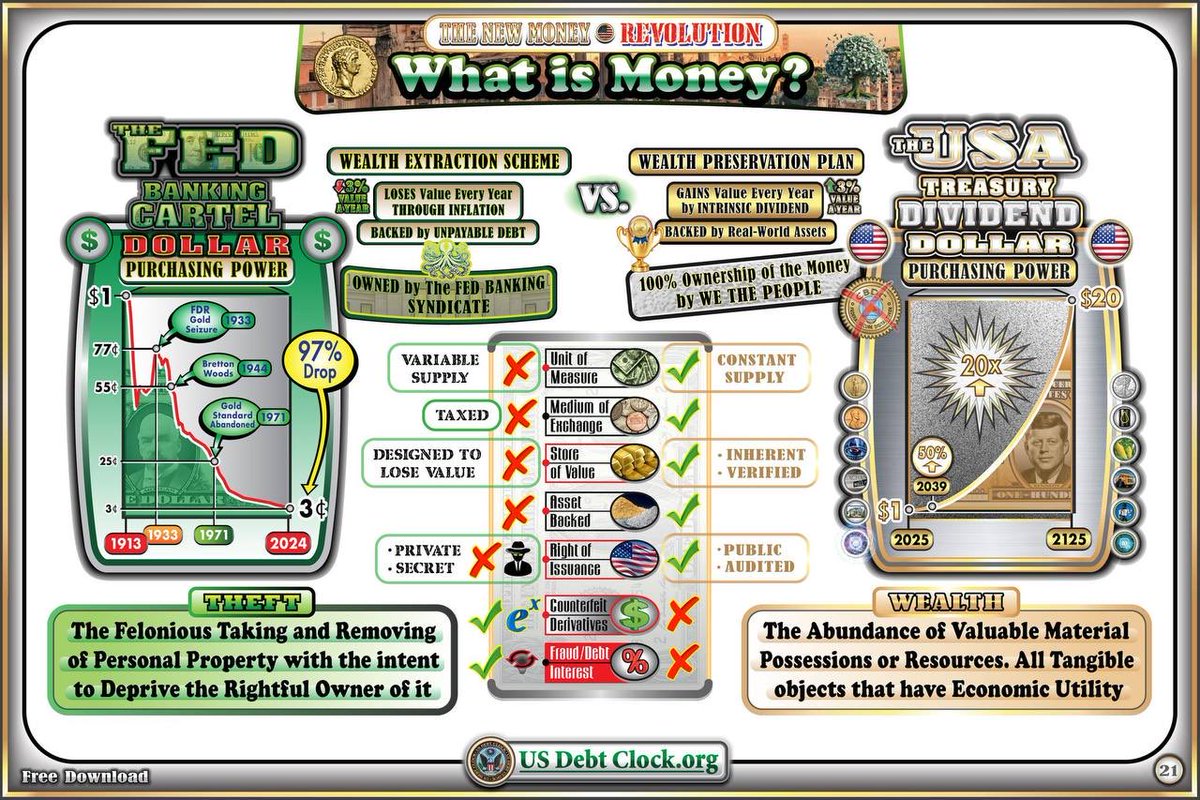
🔥 ALERT: U.S. Debt Clock Quietly Reveals the End of the Federal Reserve System – A New Sovereign Treasury Dollar Is Coming to Destroy 100 Years of Economic Slavery
BREAKING! U.S. Debt Clock quietly published a 34-page document confirming the death of the Federal Reserve system. A new sovereign monetary system is already in motion, led by the U.S. Treasury. It’s asset-backed, transparent, and designed to destroy 100 years of inflation, debt, and economic slavery. This is the beginning of the end for fiat fraud.
The Fed is collapsing. The people are rising. And the U.S. Debt Clock just confirmed it.
🔥 THE FEDERAL RESERVE: A CENTURY OF THEFT THROUGH INFLATION, DEBT, AND DECEPTION
The global system is not facing one isolated financial crisis. It is facing the simultaneous repricing of sovereign debt, energy, leverage, margin, private credit, AI infrastructure and geopolitical risk, to name but a few, after a decade plus in which cheap capital allowed unsustainable vulnerabilities to accumulate.
The question is increasingly not whether debt can be serviced today, but what happens as more of the system is forced to refinance at the new price of money.
Here is an English summary of those eight episodes
THE GOLDEN AGE (黄金时代)
The Golden Age (黄金时代), an eight-part Chinese financial documentary series produced in 2012, uses the history of gold as a vehicle for examining a much larger set of questions about money, political power, property, institutions and national development. Gold is the thread running through the series, but the programme is not principally an argument for a return to the gold standard or for accumulating bullion. Instead, it asks why societies trust particular forms of wealth, what makes monetary promises credible, how political authority is constrained, and why some nations are better able than others to convert wealth into lasting economic power. Across the eight episodes, the emphasis gradually moves from the physical properties of gold to the institutional architecture that makes wealth meaningful: contract, property rights, productive capability, monetary credibility and ultimately the credibility of the state itself.
The opening episode, The Power of Gold, begins with gold's remarkable persistence across civilisations. Its scarcity, durability and independence from a particular issuer have allowed it to function as a store of wealth through political upheaval and monetary change. The documentary's deeper question is therefore one of trust. Modern financial wealth largely consists of claims: bank deposits, bonds, currencies and other promises issued within political and financial systems. Gold is unusual because it is not simultaneously another institution's liability. This distinction is particularly relevant to the China of 2012, which had accumulated enormous foreign-exchange reserves while holding relatively modest official gold reserves. The series does not simply advocate exchanging one for the other; rather, it asks what constitutes secure wealth when a country's reserves consist substantially of claims issued by another sovereign state.
Gold's Transformation then shifts from gold as treasure to gold as institutional constraint. Through Isaac Newton's work at the Royal Mint and Britain's gradual movement toward a gold-based monetary system, the documentary introduces its recurring concept of 契约精神, the “spirit of contract.” Gold's importance lies partly in the discipline created by the rules surrounding it. A government promising convertibility restricts its own freedom of action, and precisely that willingness to accept restraint can make its promises more credible. The programme connects monetary credibility to a wider relationship between power and contract: sophisticated markets require rules that apply even when breaking them would be convenient for the powerful. The crucial question then becomes what replaces this constraint when money is no longer tied to gold.
From Zhu Yuanzhang to Roosevelt explores that problem through paper money and sovereign discretion. Ming China's Great Ming Treasure Notes illustrate the danger of a monetary system in which the issuer possesses considerable freedom but insufficient mechanisms for preserving confidence; heavy issuance contributed to severe depreciation. Roosevelt's break with domestic gold constraints in the 1930s, however, shows the opposite problem. In a depression characterised by banking failure and deflation, rigid adherence to existing monetary rules could itself become economically damaging. The episode therefore avoids a simple “gold good, paper bad” conclusion. Rules generate credibility because they constrain discretion, but governments sometimes require flexibility. Monetary sovereignty means that the state can ultimately rewrite monetary rules, leaving the deeper problem of what constrains the sovereign itself.
Caught Between Two Choices broadens this institutional theme through Atahualpa, John Sutter and Charles de Gaulle. Atahualpa's enormous gold ransom could not compel his captors to honour their bargain, demonstrating that wealth cannot substitute for enforceable rules. The California Gold Rush shows that property is meaningful only when institutions can recognise and protect ownership amid powerful material incentives. De Gaulle's challenge to the Bretton Woods system brings the same problem into international monetary relations. The United States promised official foreign holders dollar convertibility into gold, yet the growing supply of dollars abroad increasingly conflicted with America's finite gold stock. France could demand enforcement of the promise, but widespread redemption threatened the system itself. The episode's central point is that rules must not merely exist; they must be enforceable, credible and compatible with the incentives of the actors operating within them.
The Noble Yellow moves from rules to rights. Beginning with imperial China's association between yellow, gold and privileged status, it examines the historical movement “from status to contract.” The distinction is between wealth held as a privilege granted by authority and property held as a right that institutions are expected to protect, including against arbitrary political interference. Secure property and enforceable contracts alter economic behaviour because they make saving, lending, investment and long-term enterprise more rational. The episode therefore recasts national wealth: prosperity depends not simply on possessing valuable objects but on an institutional environment in which individuals can create, exchange and preserve wealth. Gold itself becomes a means of illustrating the difference between personal power and impersonal rules.
The Battle Over Gold returns directly to monetary credibility. A Sichuan farmer's decision to denominate a long-term forestry contract in gold introduces the difficulty of making promises across time when the purchasing power of the monetary unit can change. David Ricardo and Britain's Bullion Controversy then ask whether a rising gold price represents dearer gold or cheaper paper money. The American gold-versus-silver battle of the nineteenth century reveals that monetary regimes have distributional consequences: deflation can increase the real burden of debt, while monetary expansion can reduce it at the expense of creditors' purchasing power. Nixon's suspension of dollar-gold convertibility in 1971 completes the argument. The dollar survived without gold because confidence increasingly rested on American institutions, economic capacity and the expectation that others would continue using the currency. Once convertibility disappears, monetary credibility becomes inseparable from state credibility.
Asia's Gold changes the focus from preserving wealth to creating it. China and India historically absorbed large quantities of precious metal because foreigners demanded Asian goods, yet the episode asks whether accumulating treasure is equivalent to building national power. Its central symbol is the screw associated with Japanese official Oguri Tadamasa. Confronted with Western industrial superiority in the nineteenth century, Oguri understood that buying foreign ships would leave Japan dependent on foreign producers, whereas learning how to manufacture them could transform Japan's capabilities. The documentary contrasts gold as stored value with technology and knowledge as means of creating new value. Its lesson is that a nation's greatest asset is not necessarily the wealth it possesses but its ability to learn, reproduce, innovate and build. For China in 2012, with more than $3 trillion in foreign-exchange reserves, this raised an obvious strategic question: should accumulated financial wealth be regarded as an end in itself, or as a resource to be converted into productive and technological capability?
The final episode, The Light of Reason, places these ideas inside the post-war international monetary system. Keynes's unsuccessful attempt to establish a supranational “bancor” at Bretton Woods demonstrates that international monetary rules reflect underlying national power as well as intellectual design. America's productive, financial and military strength allowed the dollar to become the centre of the post-war system. The Soviet Union provides a different warning: enormous natural resources, gold production and military power cannot compensate indefinitely for weak productivity, distorted incentives and institutional failure. Japan illustrates another danger. A country can develop formidable productive capability and still suffer severe consequences from monetary, financial and policy mistakes within an international system it does not fully control. The documentary treats the Plaza Accord and Japan's subsequent bubble within this wider story, although Japan's prolonged stagnation cannot be reduced to a single external agreement.
Taken together, the eight episodes produce a coherent hierarchy of ideas. Gold matters because it exposes the problem of trust, but gold alone cannot create prosperity or guarantee national power. Rules matter because they constrain discretion, but rules are effective only when institutions can enforce them. Property rights and contracts matter because they allow individuals to make credible economic commitments across time. Productive capability matters because stored wealth can eventually be exhausted, whereas knowledge and technology can generate new wealth. Above all, credibility matters: modern monetary systems depend on confidence that states and institutions will exercise their enormous discretionary powers with sufficient restraint.
The series is therefore best understood not as a documentary about the gold price but as an investigation into the architecture of national power. Its recurring question is how wealth, power and rules interact. A state can possess gold and fail; it can possess natural resources and fail; it can issue money and discover that others do not trust it. Conversely, a society with productive strength, enforceable contracts, secure property, credible institutions and a trustworthy monetary system can create financial claims that people elsewhere willingly treat as wealth. For China, the final strategic question is consequently much larger than how much gold to own. It is how a country that has accumulated enormous wealth within an international monetary system largely designed by others can develop the economic, technological, institutional and intellectual capability required to influence the future shape of that system. In that sense, The Golden Age ultimately argues that the most important form of wealth is not the metal itself, but the capacity to create wealth and the credibility to make promises about it.
In very simple terms the world is now going through a complete renaissance which happens rarely in human history.
Rival nuclear powers, who are never going to war, are having to manage a period in which the balance of power, economic and financial architecture and rules of coercion and order are all changing simultaneously and in uniquely profound ways.
The old world has been dead for a number of years and is never coming back. Something we explained in great detail over a decade ago.
Time to once again remind everyone why WW1 and WW2 were engineered to destroy the British Empire and create US hegemony and the USD as the world reserve currency.
After all why do you imagine this happened?
How Bush's grandfather helped Hitler's rise to power.
| World news | The Guardian
https://t.co/thPXAJYPRl
67 years ago today, ‘Take Five’ by Dave Brubeck Quartet was released as a single.
It went on to become the best-selling jazz single of the 20th century.
You might be forgiven for thinking the clocks have just gone back 150 years in the UK.
Talk about someone who could not be any further out of touch with the mood of the people if they tired.
A big hint here. This has nothing to do with war.
Apparently the UK government wants the public to prepare for major disruption to daily life. This includes stockpiling canned food and drinking water, strengthening civic resilience, and planning for the possibility of war.
China is rising under its CIPS system. They are looking at allowing other currencies to be settled, so multiple currencies, not just one. It is more flexible than the SWIFT system, which is all dollars. It will eventually supplant the United States.
McLaren was failing in the early 80s when a former mechanic borrowed £1.5 million for one day and bought it.
He owned the whole company for about 24 hours, then sold most of it back to pay for it.
35 years later he had to negotiate a price to leave his own company.
His name is Ron Dennis. He started as a Formula One mechanic at 18 and never gave his companies names, only numbers, so the sponsors got the credit. Then McLaren came up for sale and he did not have the money.
He went to his bank and asked to borrow the purchase price for 24 hours, guaranteed back the next day.
The bank said yes.
The Academy of Achievement sat him down for an hour and fifty minutes in 2017, one camera on him and nobody else in the frame. The 29 minute film attached to this post is that sitting. Partway through the deal he stops and says it is the first time he has talked about how he paid for it.
Watch what the seller does at the table.
The signing was held in Portugal for tax reasons. He says all he could see in Teddy Mayer's face was that Mayer wanted to know whose name was on the cheque. Dennis handed over a cashier's cheque and watched the disappointment arrive.
He bought a company he could not afford with money he never had.
He owned 100 percent of McLaren for roughly a day, then sold enough of it to clear the loan.
The part almost nobody understood was the debt. He kept the cash somewhere else and left the racing team carrying just enough of it to look barely profitable. Sponsors read published accounts. So does everyone you bid against.
You do it backwards. You want the numbers to look strong, so you show your best year to the people across the table.
He held the whole thing outright for one day in his life, and spent the next 35 years as a minority in it.
This is the most important discussion we have ever made about gold.
It is not about what you might think it is.
Nothing to do with central banks, asset reserve status or gold backed currencies.
It's far more important than that.
Goldman Sachs uses this exact formula to decide if a company is worth $14,000,000.
Most of their analysts learned it from one free MIT lecture.
A Goldman recruiter once told a candidate: "If you can't derive an annuity price in under two minutes, we don't continue the interview." Starting offer for those who could: $250,000.
The formula fits on one line. MIT teaches it in 80 minutes. For free.
This is MIT 6.042J. Mathematics for Computer Science. The lecture Wall Street forgot to take down.
The professor opens with a simple question: $50,000 a year for 20 years, or $1,000,000 today?
Most people pick the million. Most people are right.
Then he shows you exactly why - with math you can verify yourself in 30 seconds.
Then the formula.
Every annuity - student loans, home mortgages, lottery payouts - is secretly just a geometric series. One formula prices all of them. He derives it live on the board using nothing but algebra.
Then Wall Street.
He explains how slight differences in interest rate assumptions - the p in the formula - let banks make money off the same instrument. Two banks, same contract, different p. One wins. He explains how that confusion caused the 2008 subprime collapse. The entire global recession. Traced back to one variable.
Then the company valuation.
A company adding $50,000 more in profit every year forever - what do you pay for it today? He plugs into the formula. Answer: $14,700,000. That is how acquisitions get priced on Wall Street.
Watch the moment he describes how people made hundreds of billions during the financial crisis while everyone else lost - "money went from one place to another." He says it casually. The room goes quiet.
A quant analyst at Bridgewater told me this was the first lecture that made financial modeling feel like arithmetic. Starting salary: $350,000. Bonus year: $900,000.
Bookmark this and watch later - after this lecture every loan, lottery, or acquisition price you see will feel like a solved equation.
MIT 6.042J Lecture 12 | Mathematics for Computer Science | Fall 2010
Running into issues with your manifestation efforts?
There is a specific time period where autosuggestion is most readily accepted by your subconscious which is the 'where' that emotional power arises in the process of fusing thought and emotion that triggers manifestation.
This time period is that brief (hopefully for you) period between laying your body down for sleep, and actually falling into sleep.
During this period our conscious mind retreats into the sleep process which allows our subconscious mind to rise to the forefront of mental activity.
This is the ideal time to practice manifestation. BUT one needs to engage the subconscious mind in a positive state.
Cast away the cares of the day, drop all the negative thoughts, enter into this drowsy period by placing happy, carefree, even joyous thoughts into your subconscious mind. Do not struggle with the negative thoughts. Do not try to come to grips with the negative. Simply register it and let it drift away while you concentrate on bringing up happy, positive memories and a happy positive state of your subconscious mind.
Then, at the very last, just as you feel sleep approaching, place into your subconscious mind, that desire, that goal that you wish to see manifest into this reality.
There is much more on this in the writings about "transforming your subconscious" by Nakamura Tempu Sensei in Japanese Yoga.
It works to alter your subconscious mind which will produce a much more resilient, and happy state of mind for both your manifestations, and your body's Life.
Also it is discussed in the book "The Tempu Methods".
Be well.
"We are all visitors to this time, this place. We are just passing through. Our purpose here is to observe, to learn, to grow, to love and then we return home."
Most forget this or aren't even aware that this is the case.