What if your app never had to compete for space on the same road as everyone else?
I broke down what's an app-specific rollup for a 10-year-old, an engineering student, and a PhD.
Three Levels Deep on congestion, gas fees, and how @cartesiproject fixes it. Which level clicked?
Last month brought a lot to catch up on. Dive into the latest ecosystem updates for tech releases, agentic dev tooling, DeFi demos, media highlights, and community news. ↓
https://t.co/lgyynmmxCi
What if you could explain the same thing to a 10-year-old and a PhD and have both actually get it?
That was the challenge for @cartesiproject's execution environment. Because DeFi deserves better than a basic calculator. Three Levels Deep. Which one clicks for you? 👇
News from @cartesiproject:
➡️ Rollups Contracts v3.0.0-alpha expands emergency withdrawal support and simplifies deployments
➡️ Fraud-Proof System v3.0.0-alpha updates integration with the Cartesi Machine architecture
➡️ DeFi-on-Linux releases launch Uniswap liquidity vault demos and Python bonding curve modules
➡️ New MCP server and 'cartesi-skills' repo provide AI tools with native developer workflow access
See more here 👇
https://t.co/wjWrBtMRNc
Risk prediction models for lending and borrowing positions, vibe-coded on @cartesiproject?
Let's go!
This demo shows a risk analysis feature running inside Cartesi with a Python + NumPy stack. Real utility for anyone managing exposure on @aave and similar protocols.
Friday again, so Cartesi Weekly again 🐧
We opened the week with a Star Wars nod and a wish: "May the 4th be with you. And verifiable compute guide you." Then we followed with a deep dive into the latest tech release and it felt earned.
Cartesi Rollups Contracts v3 alpha is live, and the headline is emergency withdrawals. The core question: if a rollup goes dark, can users still exit? Now the answer is yes, by design. In case of emergency, users can now withdraw directly against the last accepted claim, validated onchain against the Cartesi Machine state. No operator, no multisig, just the chain. Live for USDC apps. Plus: a new circuit breaker, safer validator protections, and full machine-state fingerprints for verifiable claims. Read more:
→ https://t.co/3yIJplryz0
But that's not all, Rollups Contracts 3.0.0-alpha.4 followed next, continuing the emergency withdrawal work. Claims now stage before being accepted, so users get a fixed window to react. Account validity proofs are smaller, so emergency withdrawals cost less gas. Plus typed errors, per-app claim queries, and version metadata on every contract.
→ https://t.co/6crkfDpf6i
And on the fraud-proof side, Dave 3.0.0-alpha.1 also shipped this week. Mostly housekeeping: Rollups Contracts, Machine Solidity Step, and Machine Emulator bumped to keep everything in sync, plus error handling now matches the rest of the Cartesi factory stack.
→ https://t.co/5Ua18BS9Zv
Dev Advocacy lead @joaopdgarcia joined @SatoshiSean's podcast to talk all things DeFi on Cartesi's Linux-powered execution environment:
→ https://t.co/Bg8dqXWwqC
Our ecosystem articles are also live on @paragraph_xyz. Subscribe and catch up on the April recap if you haven't:
→ https://t.co/Qeqqrh0Yc1
Building continues. Want to keep the conversation going or have any questions? Join our Discord:
→ https://t.co/daJRSWNUhw
Have a good weekend!
Catch @joaopdgarcia on @SatoshiSean's show: Linux onchain, Python libraries for DeFi to reach TradFi standards, and execution environments in practice.
A convo unpacking why builders need to stop optimizing around gas limits and start building for what DeFi actually needs. ↓
When DeFi protocols face stress events, one question resurfaces: what happens to user funds if the core infrastructure is disrupted? If your favorite rollup went dark tomorrow, could you still exit?
Cartesi Rollups Contracts v3 alpha makes this scenario survivable by design ↓🧵
It's a wrap on April, and one of the most loaded engineering months for Cartesi. From the Machine Emulator hitting v0.20.0 to Dev Advocacy doubling down on DeFi accessibility and practical resources, every layer of the stack moved forward. Full updates ↓ https://t.co/ufdb703LXk
Last week brought us Cartesi Machine Emulator v0.20.0.
Let’s dive into what’s new under the hood in this latest release, the result of months of engineering work on how proofs, performance, and security are handled.
Here’s what changed and why it matters. 🧵↓
Another Friday means another Cartesi Weekly 🐧
Cartesi Machine Emulator v0.20.0 is out. Months of engineering work in one release.
Builders can now generate cryptographic proofs that a Cartesi computation ran correctly, without re-executing it. That's ZK proof support via the RISC Zero zkVM. Verification also gets faster, with a new hash tree implementation that’s significantly quicker than before.
Machines can also run with state stored on disk rather than fully in memory, which matters for larger workloads. And the interpreter has been hardened against adversarially crafted inputs, validated through extensive fuzzing. Full release:
→ https://t.co/LxCDePRkp1
Dave 3.0.0-alpha.0 is live with updates to PRT, Cartesi's fraud proof system that keeps onchain computations honest, and is now even more robust.
This release adds Emergency Withdrawal support, so users can always recover their funds even in edge cases. It also tightens security in the tournament process and improves error handling throughout. Explore further:
→ https://t.co/aMUiUXJuwI
Millions of Python, Rust, and Go developers have been locked out by the EVM. DeFi has been built on workarounds for a limited execution environment. We wrote about why Linux onchain is the execution layer DeFi has been waiting for. ICYMI:
→ https://t.co/12K5PvCXEX
We've been shipping videos to show Cartesi in action. Check the integration tutorials we dropped recently to use in your app:
• Chainlink oracles
• NumPy onchain thanks to the Linux stack
• Bonding curve from scratch in Python
All in one thread ready to be bookmarked:
→ https://t.co/eiGGQSOXxz
Spoiler: more demos are coming soon.
Want to keep the conversation going or have any tech questions? Join our Discord and connect with our contributors and the rest of the community:
→ https://t.co/daJRSWNUhw
Have a good weekend!
Another week of heads down building brings us to your Cartesi Weekly. Let's look at what happened across the ecosystem this week🐧
On the development front, contributors have been busy. The core team pushed Rollups Node v2.0.0 alpha.11. This release is entirely focused on throughput, operational tooling, and stability. By introducing round robin scheduling, the node now ensures fair processing across all applications, preventing any single heavy dApp from starving others. It also ships with a brand new CLI diagnostic tool for direct onchain inspection.
→ https://t.co/3jlfesGb91
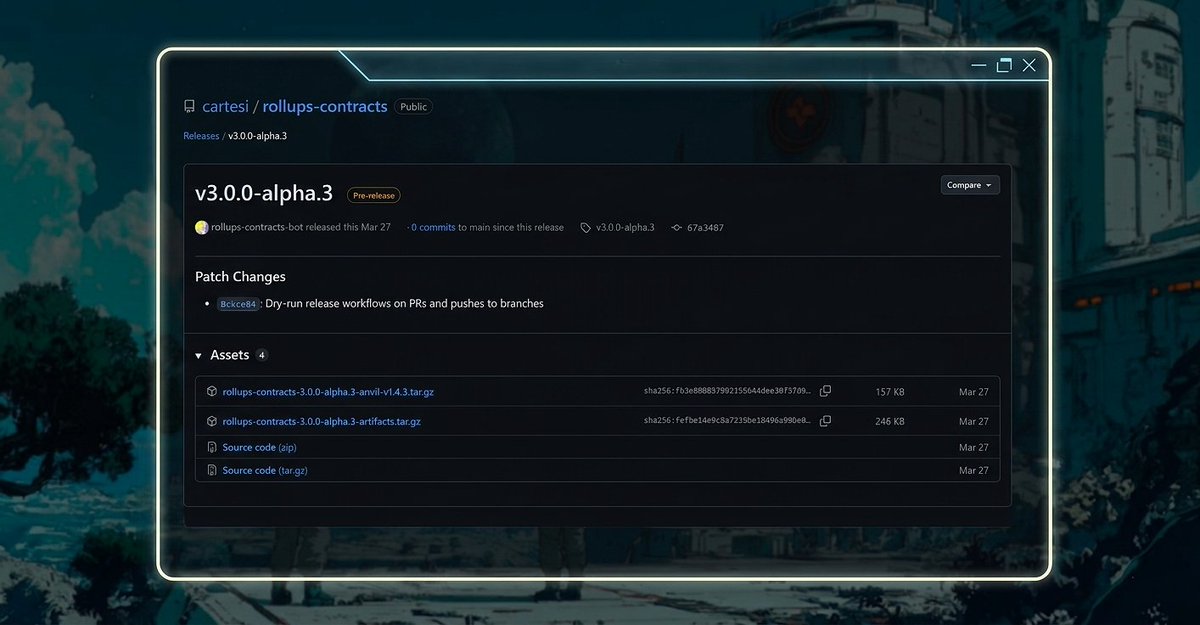
Alongside the node update, Rollups Contracts 3.0.0 alpha.3 went live. The major addition here is preliminary support for emergency withdrawals, plus important refinements to machine Merkle roots for claim events.
→ https://t.co/3M9tImqByz
To tie the new node infrastructure together, a fresh alpha for the Cartesi CLI was also released. It integrates the updated rollups explorer and is ready for core developers to test. Grab the alpha, run the flow, and drop your feedback in our Discord so we can refine the production release.
→ https://t.co/WUA6VgUeA3
We wrapped up Q1 by asking you which Cartesi capability matters most to your builds. The results are in, and the Full Linux environment took the clear lead with over half the votes.
→ https://t.co/dbQYS052ju
We also kicked off April and Q2 with a clear reminder of our fundamentals. Linux execution. Ethereum settlement. No jokes, just shipping. Catch up with the explainer thread to brush up on the architecture here:
→ https://t.co/sUeZ7Ms06k
Zooming out to the broader landscape, @l2beat published their March ecosystem update. They highlighted our recent infrastructure upgrades, improved developer tooling, and the ongoing educational push surrounding Linux based execution.
→ https://t.co/aUyc6nOj0w
As a reminder, we are consistently expanding our content reach. You can always catch our latest updates and articles on @CoinMarketCap, welcoming developers to the Linux era of Web3. Join the conversation and follow our page there:
→ https://t.co/iTmkwyeVTO
That is all for this week. Have a great Friday & weekend, we will be back to building.
@cartesiproject
➡️ Cartesi improved its developer tooling and infrastructure.
➡️ Rollups and fraud-proof systems were upgraded, alongside CLI improvements and mainnet forking support.
➡️ The team also continued its DeFi series (YouTube) focused on Linux-based execution.
https://t.co/hPM2DSqf9y
April 1st, but this isn't a joke. Linux execution. Ethereum settlement. We keep shipping in Q2.
Catch a quick overview of Cartesi below to brush up on the fundamentals 🧵👇
Another month is coming to an end, and the Cartesi ecosystem keeps moving forward. Builders shipping, tech evolving, community supporting.
Catch the latest in the Ecosystem Updates blog, your monthly window into everything happening across the project. ↓
https://t.co/CcmFkpDad5
Friday here, and for whoever is ‘monitoring the situation’, here comes your Cartesi Weekly 🐧
On the tech side, contributors cooked and Rollups Node v2.0.0-alpha.10 is out, one step closer to public release. This update introduces production-grade reliability, tighter resource management, crash recovery, and database transaction safety. Multiple applications can now run on the same node without interfering with each other, and the Machine Manager handles extended downtime gracefully without memory pressure building up. Explore here:
→ https://t.co/Oe6KwjStxE
The latest Cartesi CLI pre-release is live. Developers are encouraged to test the Rollups and share feedback on Discord. Everyone’s input shapes what ships next, so jump in and help make the final release production-ready:
→ https://t.co/Idf2UCBZWj
Contributor @risenadshaheen walks us through all the commands here:
→ https://t.co/UoXCzZEQtL
Our DevAd Lead @joaopdgarcia continues highlighting DeFi constraints, making the case for how Cartesi’s execution layer addresses them and why it’s important for each dApp to have its own dedicated compute instead of competing for block space. App-specific rollups architecture are key:
→ https://t.co/YYwhL6gFkf
And speaking of app-specific (or appchain) design, catch up with this explainer video:
→ https://t.co/QTHj107uyZ
On the community side, remember we’re also active on Reddit, Farcaster, Instagram, and YouTube. Join us across all channels to stay in the loop:
→ https://t.co/dIPNv65fbR
As the month wraps up, stay tuned for next week’s newsletter, with the usual merch giveaway included. Make sure you’re subscribed:
→ https://t.co/SuQrT9ZenQ
That’s it for this week. More building, less talking. We keep shipping.
Friday again, and it's time for our Cartesi Weekly, with the latest from across the ecosystem this week 🐧
On the infrastructure front, Dave 2.1.1 is live on devnet and all supported testnets: Ethereum Sepolia, Arbitrum Sepolia, OP Sepolia, and Base Sepolia. It's also published to the Cannon registry, so you can pull it directly and start testing the fraud-proof system across any of these networks today. Come chat with contributor @guidanoli in the rollups channel on Discord for all the details:
→ https://t.co/BGfqTWVxcS
Devs got fresh code snippets for Rust, Go, and C++ thanks to contributor @riseandshaheen, along with vibe coding resources. There are no excuses now to build DeFi your way with Cartesi using the language of your choice:
→ https://t.co/1qOZWqyfdb
A new demo dropped showing how to integrate bonding curves into your Cartesi apps for price discovery, where everything is dictated by buys, sells, and the algorithm:
→ https://t.co/D9ugibQq55
Why does it matter? Hear it again from @Macky_DeFi:
→ https://t.co/F5Ga0B6jsx
DevAd Lead @joaopdgarcia continues his DeFi series, unpacking the execution layer constraints that hold DeFi back and how Cartesi opens up a new design space with Python, NumPy, PyTorch and similar libraries. If it runs on Linux, it runs on Cartesi and onchain:
→ https://t.co/ilhPDbvhC2
We hopped on the emoji trend this week:
→ https://t.co/jiM6yUqFD4
And check this out: a modified WebCM (Web Cartesi Machine) vibe-coded to let multi-agents write code in the browser, serverless. Say what:
→ https://t.co/ChZufK14Bx
That's a wrap for this week. Join us on Telegram to chat with other Cartesians and ask anything you have on your mind:
→ https://t.co/EhXIb7zPcR
Friday once again, which means it is time for your Cartesi Weekly, with a roundup of what happened across the ecosystem this week 🐧
The latest monthly recap from L2BEAT is out, highlighting key technical developments across the L2 landscape. Check out the Cartesi excerpt here:
→ https://t.co/ANkA98Rbb1
How much more powerful could DeFi be if it could rely on traditional libraries? A new tutorial dropped showing how easy it is to integrate NumPy, enabling advanced numerical computing, matrix operations, and scientific calculations directly in your dApp. With the Cartesi VM, if it runs on Linux, it can run onchain:
→ https://t.co/WahRCpX0HB
DevAd Lead João Garcia continues his series exploring why DeFi works the way it does today and how it can evolve. The latest episode dives into Cartesi’s ability to enable stateful application logic that can match TradFi-level performance while moving beyond typical L1 constraints.
→ https://t.co/SLouxAqbsz
Head over to YouTube to catch the rest of the shorts if you missed them:
→ https://t.co/SJK13PwLz8
And speaking of L1 constraints, check out a thread we put out benchmarking the compute power of the Cartesi VM. Think more useful instructions per block, greater throughput, more compute cycles, and the versatility to run a full Linux OS.
It is time to build by leveraging the progress already made in mainstream software, with all that compute dedicated to your own dApp thanks to the appchain framework, without competing for shared resources:
→ https://t.co/I1qyzbCXUC
That’s all for now. We. Keep. Building.
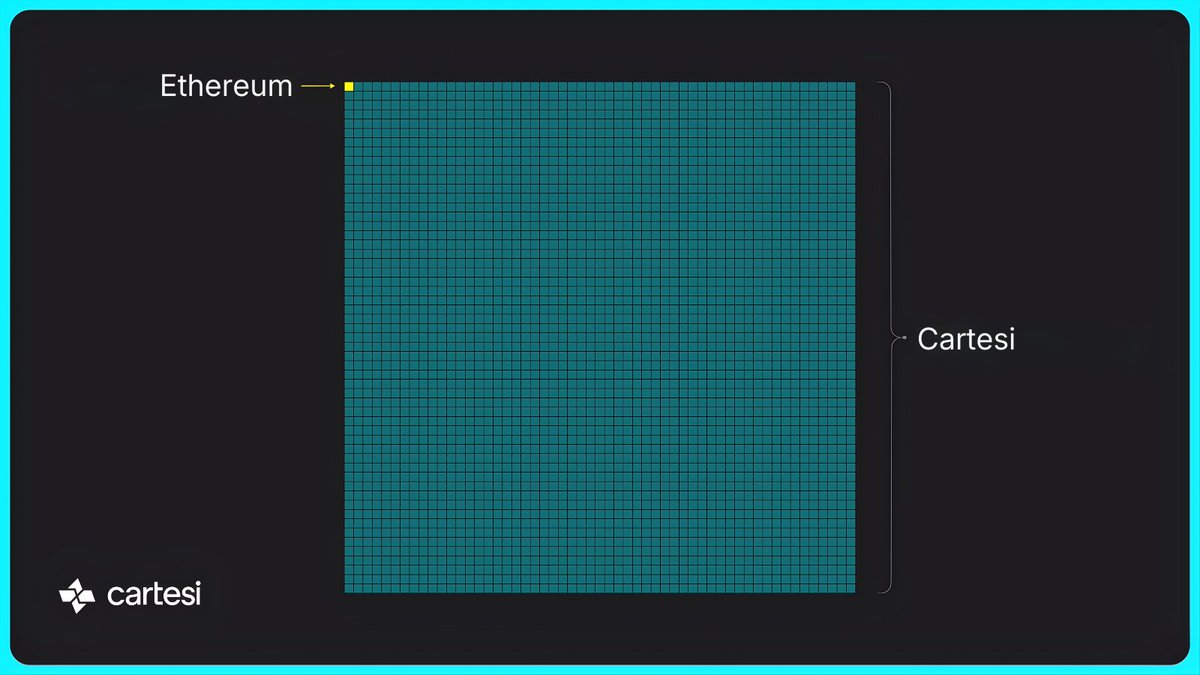
Why most DeFi can’t deliver real innovation?
Yellow dot? L1 EVM block compute limit. Devs compress logic into one block and ship simplified finance.
Blue squares? Cartesi VM. Orders of magnitude more computational capacity.
Once you see the gap, you can’t unsee the constraint.
DeFi is everywhere, from lending and perpetuals to prediction markets, and they all depend on one thing: reliable price oracles.
Adding that to your Cartesi app is simple. Check out this video to see what the architecture looks like when you integrate a @Chainlink oracle. ↓🧵