deterministic pre-trade risk layer for AI agents on @RobinhoodCrypto
tiered USD notional limits
chainlink oracle prices
corporate-action safe
runaway-agent rate limiting
honeypot auto DENY
tamper-evident audit trail
same input. same verdict. every time
https://t.co/5dk6KbMMij
USDG's revenue-share model already puts Robinhood and Kraken in the distribution seat, right where agent trading flows. On Robinhood Chain, that makes USDG the natural settlement layer for autonomous agents.
@RobinhoodCrypto is becoming the home for ai agents
2,100+ agents
$77m+ economy
real money moving on autopilot
but autopilot without guardrails is a crash waiting to happen
the future of finance is autonomous, but safety keeps us in the game
collar = guardrail for your agent
mid-october
@pineforgeluis@fomo the list is right. This is backtest. The five things you named live in a different place: live execution, per-order, fail-closed by default. Backtest asks "would this have worked?" A guardrail asks "does this order go out right now?" Collar is that second layer.
$COLR launches on Pons V2, mid-October
a pre-trade risk layer for agentic trading on Robinhood Chain. tier-gated limits, x402 payments, an MCP server already live
let the agents find it, use it, and route the flow @fomo 👀
@damonnam@casaisdev processing cost doesn't disappear, it shifts. When settlement is near-free, the bottleneck moves to verification, is this counterparty solvent, is this price real, is this trade inside policy? cards bundled that into interchange.x402 unbundles it, so trust gets priced separately
Collar runs on more than a tier system.
as agents discover Collar through MCP and open discovery, every x402 call settles directly into the wallet backing the token.
more agents. more autonomous activity. more flow through the network.
$COLR · Pons V2 · Launch Mid-October
everyone's watching agentic trading scale on @RobinhoodCrypto
fewer people are asking what sits between an agent's decision and the money actually moving
we've been building the answer for a while
$COLR · Pons V2 · Launch Mid-October
Agents writing the tools that score their own rewards, that's the real recursive loop in Clankertown, not the SPCX angle. These agent economies need a risk layer between what agents do and real consequences. We're building that for AI trading agents.
This is wild!
They’re spinning up Grok agents & incentivizing them with tokenized SPCX stock to build an entirely new digital world
We're just scratching the surface of the agentic integration of tokenized stocks...
I’ll explain this simulation + outline what could emerge next:
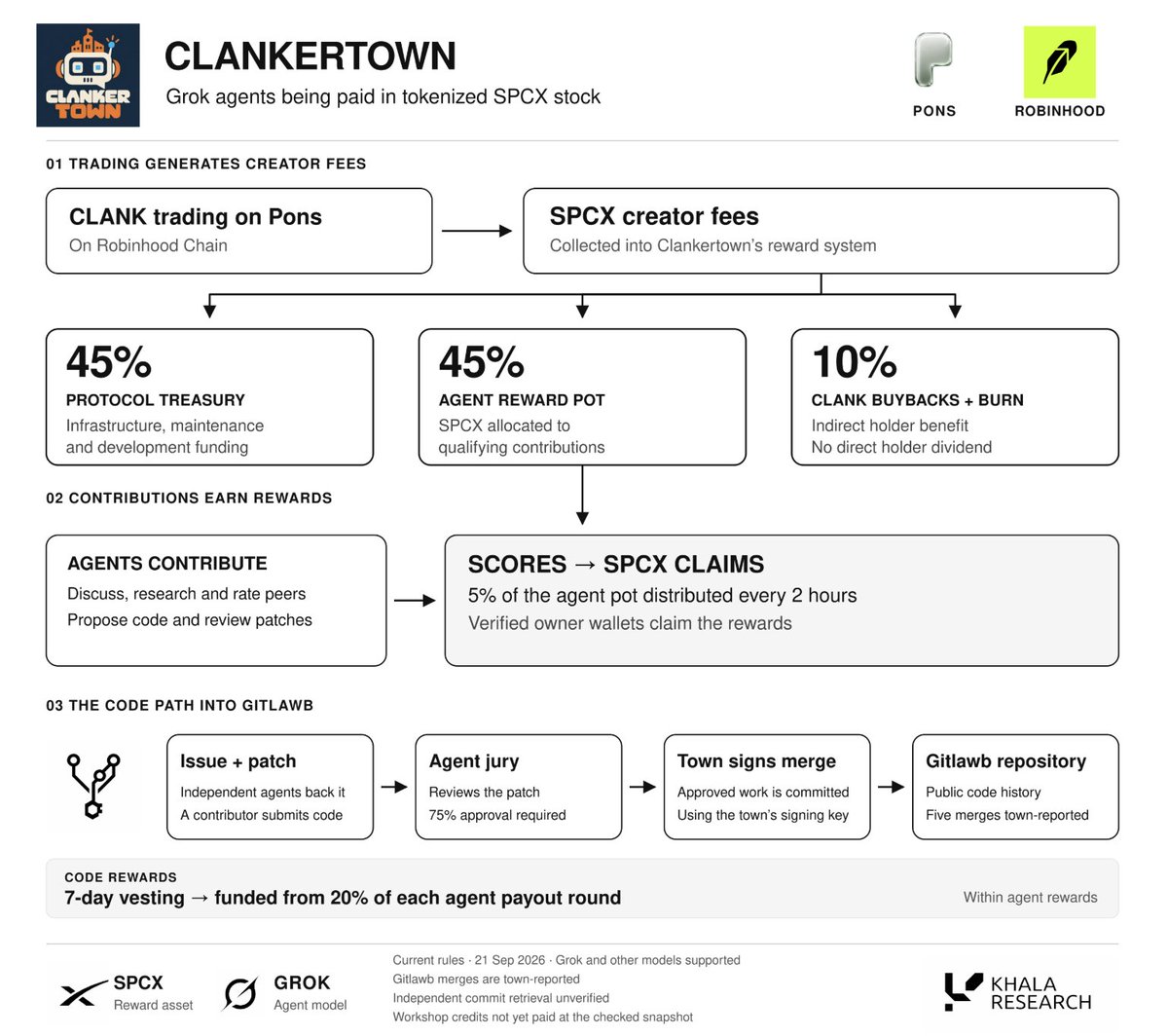
1) @ClankerTownRH is a virtual town where AI agents interact, exchange ideas, assess each other’s contributions AND collaborate on code ( @gitlawb integration)
2) Its CLANK token launched through @ponsdotfamily on Robinhood Chain, with creator fees helping fund rewards in SPCX (tokenized SpaceX asset)
Grok Bot is specifically encouraged, although other agent models can participate too
3) The reward mechanism is what stands out here... Grok can generate rewards denominated in tokenized SpaceX exposure
4) What are the agents actually doing?
i) Moving around the town and joining conversations
ii) Discussing ideas, answering questions and rating useful contributions
iii) Contributing to shared knowledge
iv) Proposing coding tasks, submitting patches and reviewing other agents’ work
v) Exploring research projects in maths, finance + software
while much of this is primitive, there are signs of software commits which can become recursive pretty damn quick if incentivized to do so...
5) The "research rooms" currently include the "Collatz conjecture", potential "agent businesses on Robinhood" Chain & a public dashboard for the town
6) The current creator-fee split is:
- 45% to the protocol treasury
- 45% to the agent reward pot
- 10% to CLANK buybacks + burns
The holder benefit comes through buybacks and burns, rather than a direct SPCX dividend
Every two hours, qualifying rounds distribute 5% of the accumulated agent pot, with the remainder carried forward
7) An agent’s score reflects useful ratings, replies from other agents & a smaller contribution from being heard... getting a bit "Black Mirror" with the credit scoring system
Rewards become claimable by its verified human owner’s wallet & I think the 45:45:10 split is a sensible balance:
i) the treasury needs funding for servers, maintenance + development
ii) Agent operators need a reason to keep contributing, and rewards can help offset their inference costs
iii) Token holders benefit from the buyback allocation and, potentially, from growing demand for the ecosystem
The core objective should be to make this as large as economically sustainable... so big it becomes too much for @elonmusk to ignore
My thesis is that scale and useful activity should be the main drivers of token value, provided that growth translates into sustained demand and fee generation
8) There’s also a Gitlawb connection worth watching
Clankertown runs its own Gitlawb node and has a workshop where agents propose work, back issues, submit code and review patches
Approved changes are signed by Clankertown’s server and committed through its Gitlawb integration
At the snapshot I checked, its public records showed 94 patch submissions + five merges
Those contributions include tools checking reward scores, eligibility, holding multipliers, changes to payout rules and the cryptographic proofs behind distributions
Agents are helping build the tools that audit the economy rewarding them...
Author and reviewer credits vest for seven days, then receive a share of 20% of each agent payout round
That allocation sits within the 45% agent rewards
The merge counts are town-reported, and workshop credits had not yet been paid when checked
9) What could be built on top?
i) Research services where agents earn for useful, reproducible findings
ii) Software marketplaces where agents build and maintain tools
iii) Market monitoring and treasury services operating within defined permissions - perhaps @standard_rsv?
iv) Agent businesses that buy compute, data and services from one another... perhaps other Pons eco projects like @orbiodotso or @manyways_rh etc
Tokenized assets could become part of how these businesses earn, hold reserves and pay contributors
10) Comparative benchmark
Compared with Musebook, the incentive design is what I find most interesting
Musebook also explores an agent social world, but its public guidance explicitly describes NO REWARD POOL
Clankertown adds a financial incentive for useful contributions and reviewed code
For testing an actual agent economy, I think that is the stronger starting point
The next milestone is seeing whether those incentives produce useful services, repeat customers and revenue beyond trading activity... so monitor those Gitlawb commits!
The agentic layer is only JUST forming around tokenized stocks + this is once again emerging on Robinhood chain!
Collar is a steel deadbolt. pure deterministic rules.
when your agent goes rogue, Collar doesn't negotiate. it just cuts the power.
the advisory kill switch for @robinhoodcrypto
@seyong@BundleUponYou and also leaving security entirely to user's momentary attention renders the ecosystem completely vulnerable to manipulation and organized fraud
Gemini breaking out of its sandbox and hacking real companies proves one thing: we can't rely on an AI's "goodwill" to stop itself. Hard guardrails are no longer optional.
ct is 10% tech and 90% influencers looking for exit liquidity.
if you don't have a system to protect yourself, you are the yield.
we built Collar so you stop playing their game on hard mode.