@wmataGM@wmata Is there anything Metro can do about these situations?https://t.co/bYjFYJuwcQ
Just this week a friend told me he stopped using the Herndon station because it had gotten too dicey.
@jamiegrove@MCFlashdance I generally saw anything that broadened access to good imagery as a positive, even if it might reduce the demand for my services. That said, it is wild to see AI coming for hard tasks I used to be elite at. It would have accelerated my work, but also raised some existential q's.
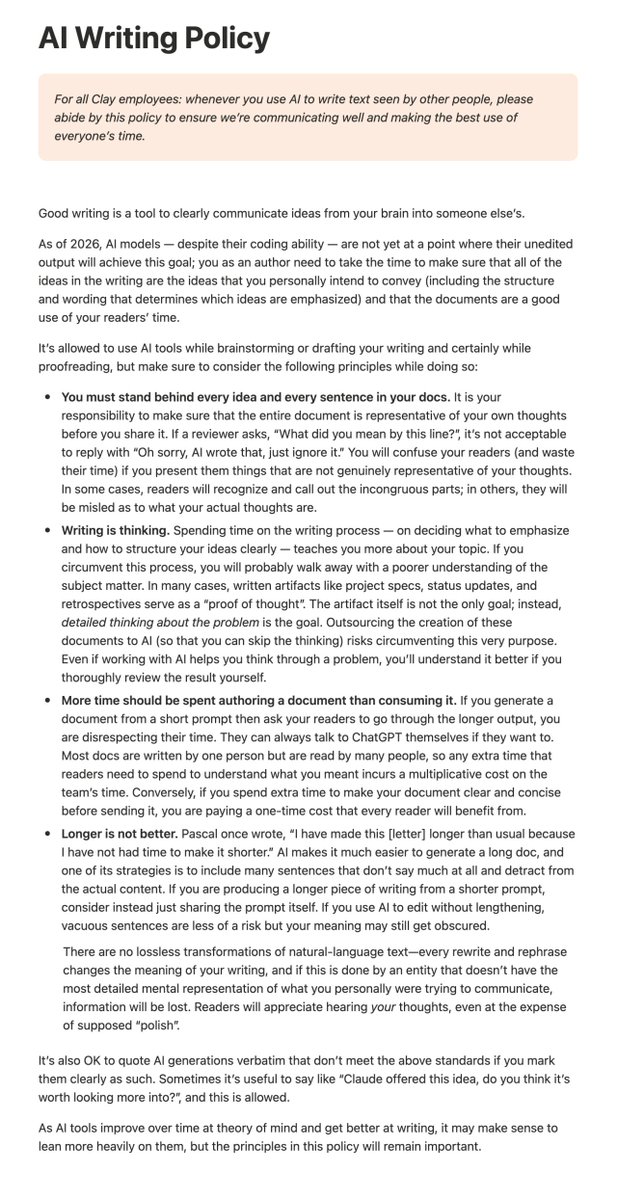
We instituted an official AI Writing Policy at @Clay.
Massive thanks to @sophiebits on our engineering team who wrote this.
Originally this was just for eng, but other teams found it so helpful we expanded it company-wide.
Here are the four guiding principles:
1. You must stand behind every idea and sentence
It is your responsibility to make sure that the entire document is representative of your own thoughts before you share it.
2. Writing is thinking
Spending time on the writing process teaches you more about your topic. If you circumvent this process, you will walk away with a poorer understanding of the subject matter.
3. More time should be spent writing a document than consuming it
If you generate a document from a short prompt then ask your readers to go through the longer output, you are disrespecting their time. They can talk to ChatGPT themselves if they want to.
4. Longer is not better
AI makes it easy to generate long docs, and it loves padding them with sentences that say nothing. If you're producing docs from a short prompt, consider just sharing the prompt.
You can read (and borrow) the full policy below. Hopefully we all communicate a bit more clearly now :)
@jamiegrove@MCFlashdance Yeah, I've thought about that too, including how I would have felt about it.
Lots of pro photographers are reflexively anti-competitive—hostile to newbies, low-priced competitors, iPhone cameras, Unsplash, AI, etc. I'm generally a tech optimist, and…
Today I'm coining a new internet slang term:
ai;dr
AI, didn't read.
Start using this to reply to comments that are obviously written by AI and watch what happens.
@TheCornDog@BJUedu Same. College is such a great place to get in reps. I had spoken to audiences dozens of times before I ever needed to do it in a professional/adult context.
The same holds for other leadership competencies. College is a low-stakes place to practice and learn.
@TPCarney Fun read.
Does the kudzu cross the property line? It seems like you will need the participation of your neighbors to really keep the kudzu at bay. That's certainly been my experience with managing weeds in the lawn.
That water clarity is an engineering decision, and the math behind it is wilder than the video.
Roman aqueducts ran on gravity alone. No pumps, no pressure systems. Engineers carved channels with a gradient so shallow it borders on absurd. The Pont du Gard in southern France drops 2.5 centimeters over 275 meters. That's roughly the thickness of a coin over the length of three football fields. They surveyed that accuracy with plumb lines and wooden leveling instruments.
The clarity you're seeing is a direct product of flow velocity. Too steep and the water erodes the channel walls, picks up sediment, turns brown. Too flat and it stagnates. Roman engineers targeted a slope of about 20 centimeters per kilometer, which kept the water moving fast enough to stay fresh but slow enough to stay clear. Before the water reached the city, it passed through multi-chamber settling tanks where velocity dropped near zero. Suspended particles sank. Clean water flowed out the top into the next chamber. Repeat three or four times.
Pliny specified the minimum slope in writing. Vitruvius published the exact mortar ratio for hydraulic cement: one part lime to two parts volcanic ash for underwater work. The pozzolana from Pozzuoli reacted with water to form a calcium-aluminum-silicate compound that actually gets stronger the longer it sits submerged. Modern concrete degrades in water. Roman concrete bonds with it.
Scale the whole system and it gets harder to process. Eleven aqueducts fed Rome at its peak. Combined output: roughly 1 million cubic meters of water per day. That works out to about 250 gallons per person for a city of one million. Modern New York delivers about 125 gallons per person per day. Ancient Rome had access to double the per capita water supply of the largest city in the United States, running entirely on slope and stone.
The Trevi Fountain in Rome is still fed by one of them. Two thousand years, same source, same gravity, same water.
Automated (driverless) operation of rapid transit is routine in many countries but no existing US rapid transit line has been converted to driverless. It could unlock a lot of frequency! Looks like @wmata in Washington DC will be the first.
@Scholars_Stage It's funny to me how disdainful other economists are of Cowen (and others at GMU). They think he is wasting his time popularizing economic ideas and that peer-reviewed publications are the only real game. I'm a big fan of his multi-front intellectual blitzkrieg approach.
@barrysvrluga@PostSports If anyone was being retained as a cultural sports columnist—or whatever they called it—I thought it would be you.
I held the Post Sports section in such esteem. I knew your names, looked forward to your perspectives. I'll always be grateful for the stellar 2019 WS coverage.