Rivals and haters keep asking me
"What will you do if Arsenal go trophyless?".
First of all, it is none of your business, but if you care to know, I have survived worse.
There was a time my team was is such a bad state that, there was a panel to decide whether to exclude Arsenal from the traditional big 6.
There was a time, when the season begins, I would already prepare myself for almost all our defenders scoring an own goal.
The latter part of Le Professor's reign was so bad that Arsenal was a recurring meme everywhere you turn. Whether on TV, radio, the internet and even my neighborhood.
There was a time, the only player Arsenal could sign in a full summer transfer window was a keeper, with the excuse that, we could not find the players we needed. 🤦♂️
I have survived all that, but you think these days that every team in the world is afraid of us is when I will not survive? Come on...
We have been second 3 times in a roll in the league, elsewhere, it is an achievement of great proportion. If Atletico Madrid did that in LA Liga they would be praised.
We just qualified for a first back to back Champions League Semi-final, who knows what will happen.
We are in a very sound financial position, that makes us able to compete with anybody in the Transfer Market, which means, we can improve this monstrous team and go again next season.
We have a fairly young talented group of players, ready to fight for this team, turning down the advances of other teams just to stay at Arsenal. Super talented kids like Dowman, Nwaneri, Salmon, MLS and a host of others to look out for.
This team is on the UP, there is no going back to those dark days.
Then I tell them, the really important question to ask yourself is:
What will you do if Arsenal wins the League or Champions League, or both?
Where will you hide? 🤣
#COYG ❤🤍
@OdohertyI64991 I reread The Stand once we went into lockdown. Strange times indeed. I'll always remember driving through deserted streets to work at the HSE briefings. It didn't quite live up to King's vision though.
Ever wonder how traffic lights and pedestrian crossings really work? Most pedestrian crossing buttons are just a placebo, in busy urban areas. The light was going to change anyway, because that type of crossing runs on a timed cycle calibrated to traffic flow.
But pressing it activates accessibility features that are switched off otherwise like the chirping sound. More interestingly, theres a spinning vibrating yoke on the underside of the box you likely never noticed. That's designed for people who are both deaf and blind.
Some crossings use passive detection, infrared or microwave sensors that detect your prescence in the force then change the lights without anyone pressing anything.
Quieter junctions wouldn't have an automatic cycle and the button genuinely works at them crossings. But even then the system adds a deliberate delay to protect traffic flow, and the button only registers during certain hours.
So if you press it at 3am the light might change in seconds. If it's 8am you're queuing behind every bus and work commuter the algorithm has already accounted for.
Traffic lights without pedestrian crossings aren't usually running on fixed timers. The lights are reactive, and the mechanism is typically buried in the road surface itself. Inductive loops are coils of wire embedded in the asphalt at junctions, visible to nosy weirdos like me as rectangular or diamond shaped cuts in the road.
When a large enough bit of metal stops over one, it disturbs the magnetic field and registers a vehicle is waiting. It's not a circuit, because the tyres would break that. It's a field disruption. A car that stops too far back from the stop line may never trigger the loop cause the light doesn't know it's there.
More modern locations use microwave or radar sensors mounted on the signal poles themselves, capable of detecting moving vehicles, estimating their speed, and feeding that data into broader traffic management systems.
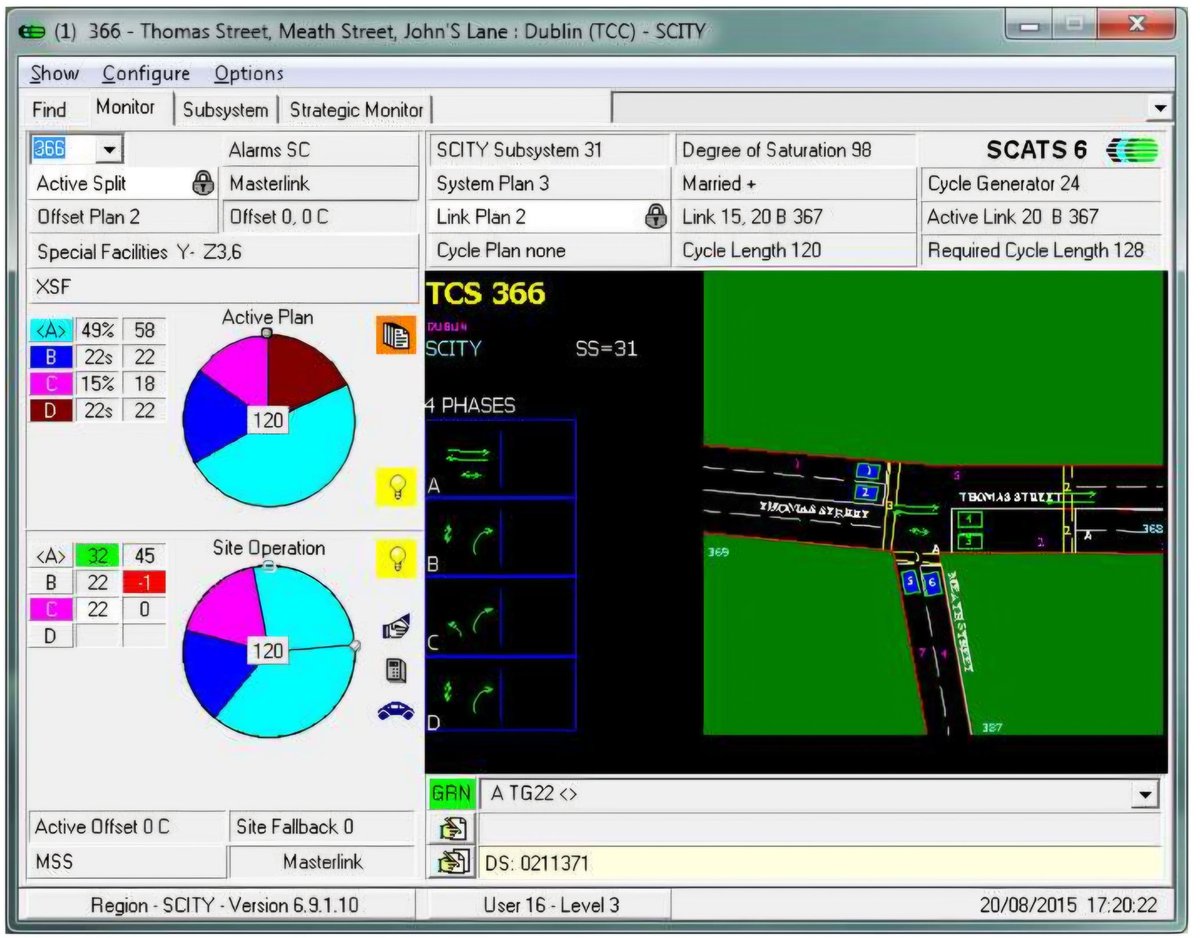
These connect to a centralised platform called SCATS. Get your minds out of the gutter. It stands for "Sydney Coordinated Adaptive Traffic System" which has managed Dublin's signals since 1989! It now covers over 750 junctions across the Greater Dublin Area.
The system manages the aggregate flow of the city. Now we have AI that learns its patterns and compensates for big events or accidents and the slow morning traffic patterns that repeats itself with slight variations on week days.
Not all vehicles are equal according to our system though. Buses carry transponders that communicate directly with traffic signals, causing lights to change early or hold green for longer to keep the schedule.
Emergency vehicles use an infrared pulse. Small optical sensors on signal heads detect the frequency emitted by an approaching ambulance or fire brigade trying to give a green light before any human has made a decision. Look out next time for the small sensor mounted above the signal housing.
Anyway, I find this stuff fascinating. There's loads more to our city most people don't know. Thanks for coming to my little traffic tech Ted Talk 😂
Buy the Dublin Time Machine a pint and support the DTM Book https://t.co/U7jtCrOTtb
Norwich City have reached an agreement for Vinnie Leonard to join us from League of Ireland Premier Division side Dundalk in July 2026.
The move is subject to medical, international clearance and approval from The FA and EFL.
✅ Dundalk FC can confirm an agreement has been reached with English Championship club Norwich City for the transfer of Vinnie Leonard.
📅 Vinnie will remain with Dundalk FC until the opening of the UK summer window 📝
👉 https://t.co/yJ9UBEjt2E
The Temple Theatre was more than a nightclub. For a particular generation of Dubliners, it was a rite of passage.Its lifespan was barely seven years. But its legacy as a sacred place for music, dancing, drugs and getting your hole makes it one of the most important spawning grounds of Dublin youth.
Long before all that good stuff, St. George’s Church was of the Georgian Northside Dublins great early 19th century Protestant houses of worship. Designed by the architect of the GPO Francis Johnston, the church began construction in 1802 and opened in 1814, he gave it a dramatic triple-tiered spire.
But St. George’s was nearly fecked from the start. The dodgy roof was made with badly designed timber trusses and began to fail under its own weight. Luckily Robert Mallet, one of Ireland’s most innovative engineers, designed a series of cast-iron trusses to stabilise it.
By the late twentieth century, the church was once again encased in scaffolding. The posh spire needed reinforcement during the 1980s. Protestant attendance on the northside had dwindled by then anyway and St. George’s was deconsecrated. Its bells, made famous by their tolling in Joyces Ulysses, were removed to Taney Parish Church in Dundrum. The aul pulpit took a stranger journey, ending up in Thomas Read’s pub on Parliament Street.
In 1991, the building was sold to actor and entrepreneur Sean Simon. On the 9th of September 1996 St. George’s reopened as the Temple Theatre! The neo-classical interior remained with the nave accomodating a congregation with a different vibe. The vaulted basement crypt was refitted with recycled church pews and converted into two bars.
The Temple Theatre quickly became Dublin’s premier dance venue, attracting an international roster like Sasha and Digweed, Judge Jules, Mauro Picotto, Scott Bond, Joy Kitikonti, and Lisa Lashes. And then, as with so many great Dublin institutions, it bleedin ended abruptly. The final weekend, over the August bank holiday in 2002, was called "End of an Era". By September 2003, the Temple Theatre had closed its doors.
So what about the urban legends of there being bodies buried under the dancefloor? Well when this Church of Ireland site was deconsecrated records indicate that some remains were removed to the consecrated ground of Mount Jerome Cemetery. But Dublin legends say deeper vaults were quickly sealed behind new partitions to accommodate the bars and sound systems.
There was a more thourough rennovation in 2004, after the club when the building was purchased by Eugene O’Connor and converted into high-end offices. The building is currently used as private office space for Temple Street Children's Hospital. The "Crypt" where people once danced to trance music is now used for storage, plant machinery, and office infrastructure.
Coming this spring...
Book 3 features stories by ten awesome authors.
Jay McKenzie, Andrew Humphrey, Thomas Nicholson, Damir Salkovic, E.F. Ritter, Rex Burrows, Mike A. Rhodes, Alistair Rey, Isabelle Nygren, and SJ Townend.
(order subject to change).
I've been thinking about this a bit.
We have this "vulnerability" culture in which people go online every five minutes and complain about what's bothering them in life. And a post about the frustrations of parenthood, especially when kids are young — blowout diapers, public tantrums, etc. — is going to get more attention than a simple post with a photo of a child, or a video of a person reading to their child. (Read to your kids, btw.)
So what we get is this weird recency bias, kind of like negative polarization in politics, around parenting. And it's unfortunate.
The other element I think of CONSTANTLY is that we've convinced ourselves, because of one-click Amazon orders and Door Dash and so on and so forth, that life is supposed to be easy. But nothing worth doing is easy. Being an athlete is hard. Writing is hard. Learning to play an instrument is hard.
Parenting is hard too. And what Roan doesn't say — and I guarantee in every case except maybe one or two psychopaths — is that every parent who complains about parenting would tell you they don't regret having kids.
Parenting is hard. But then some nights (as happened this week) you get to turn on a favorite movie and your teenage kid lays on your shoulder and laughs at the same joke you laugh at and talks about the film's cinematography because it's one of your obsessions you've passed along and no drug on the earth could levitate you more.