My friend applied to 200 tech jobs in two years. No PhD. No Stanford.
Last month Anthropic offered him $750,000.
I asked him how he broke in from zero.
He sent me a course that was never supposed to get out. A 3-hour video to build a full LLM from scratch.
A developer teaches you exactly how LLMs like ChatGPT and Claude are actually built.
I watched it last night.
Halfway through, I realized it's embarrassingly simple to break into an AI lab.
Bookmark this and read the article below.
• 00:00 - intro to LLMs
• 05:43 - LLM transformer architecture
• 40:24 - training the LLM
• 1:30:27 - modernizing the LLM
• 2:33:53 - scaling the LLM
Static agents won't survive 2026.
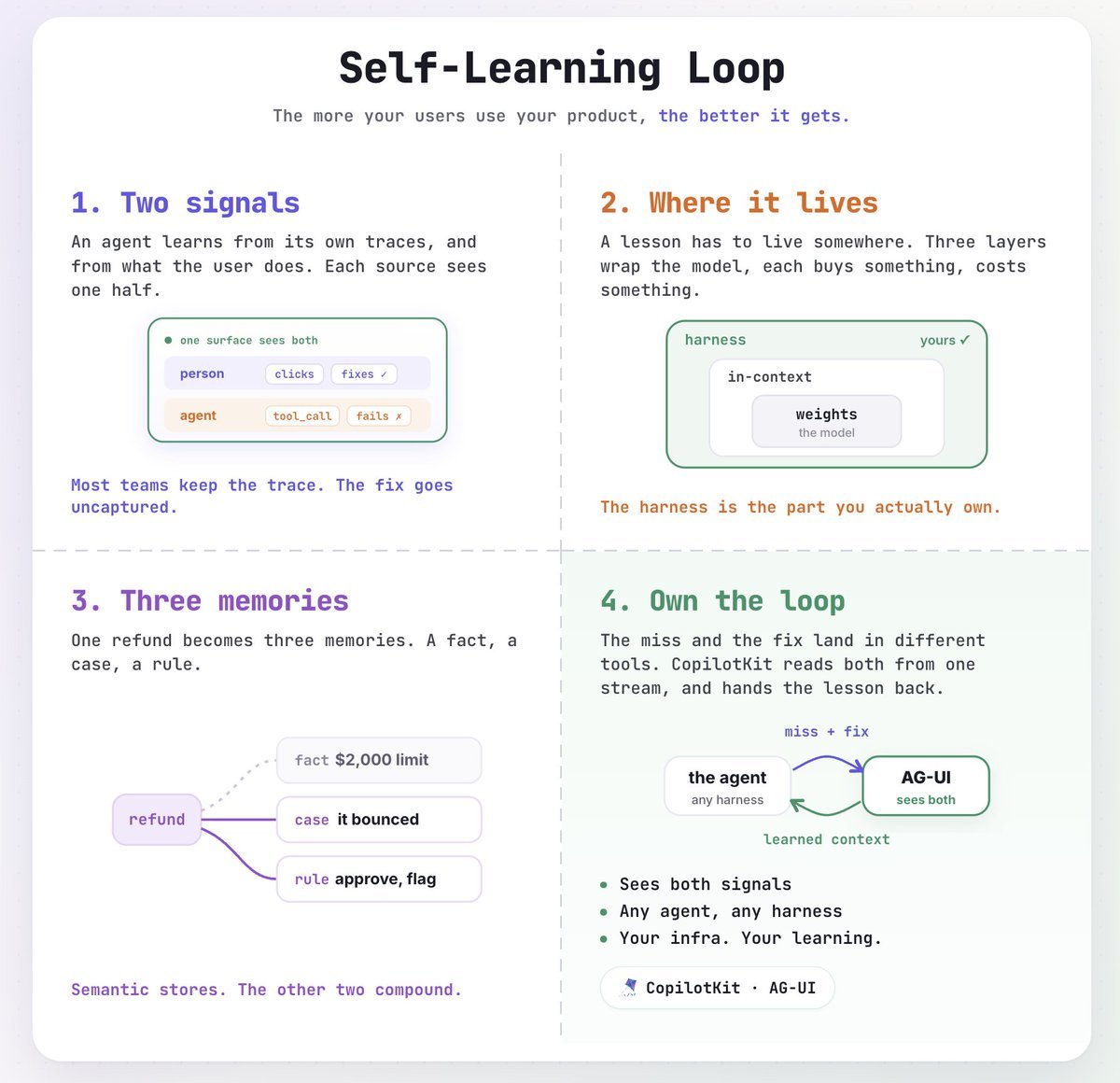
Self-learning agents are WHAT you need, and the best ones get better every time someone uses them.
Let's understand this.
Your AI Agents actually learn in 3 places:
1. Model (the weights): owned by the AI labs, the hardest layer to improve.
2. Harness (the loop, tools, prompts): medium difficulty. You can improve it, but it takes some real work.
3. Context (memory + skills): plain text you can read and edit, the easiest place to start.
You already use all three in Claude Code and Codex.
But here's what almost everyone skips:
Your agent should learn from your users, not just its own runs.
Every time a person fixes the agent's call, that's a labeled example no benchmark can give you. Worth more than a hundred synthetic tests.
Capture it. Feed it back. That's the loop that compounds.
Jane Street spent $6 billion and 4,032 GPUs on one thing: AI agents that loop through trading strategies 100x faster than any human.
Generate, backtest, kill, repeat - thousands a week, until one survives data it's never seen.
That loop is why they made $39.6 billion last year while 89% of retail went broke trading one idea they never stress-tested.
The edge was never a smarter idea. It was volume.
They test 100 strategies for every 1 you test by hand, and a second agent kills the 97 that only look good on old data before a dollar goes live.
Now the entire loop fits in a chat box. Horizon takes one plain-English sentence and spins up the same two agents.
One builds your strategy, one tries to kill it - backtests 5 years in seconds, and only what survives goes live on your exchange.
The $150 billion setup. Free while beta open.
Bookmark this & read the full breakdown below - the exact two-agent loop, step by step, and who just handed it to retail.
Claude Code just dropped "Getting Started with Loops"
This is their first official document about Loop Engineering.
Spoiler: prompt engineering didn't survive.
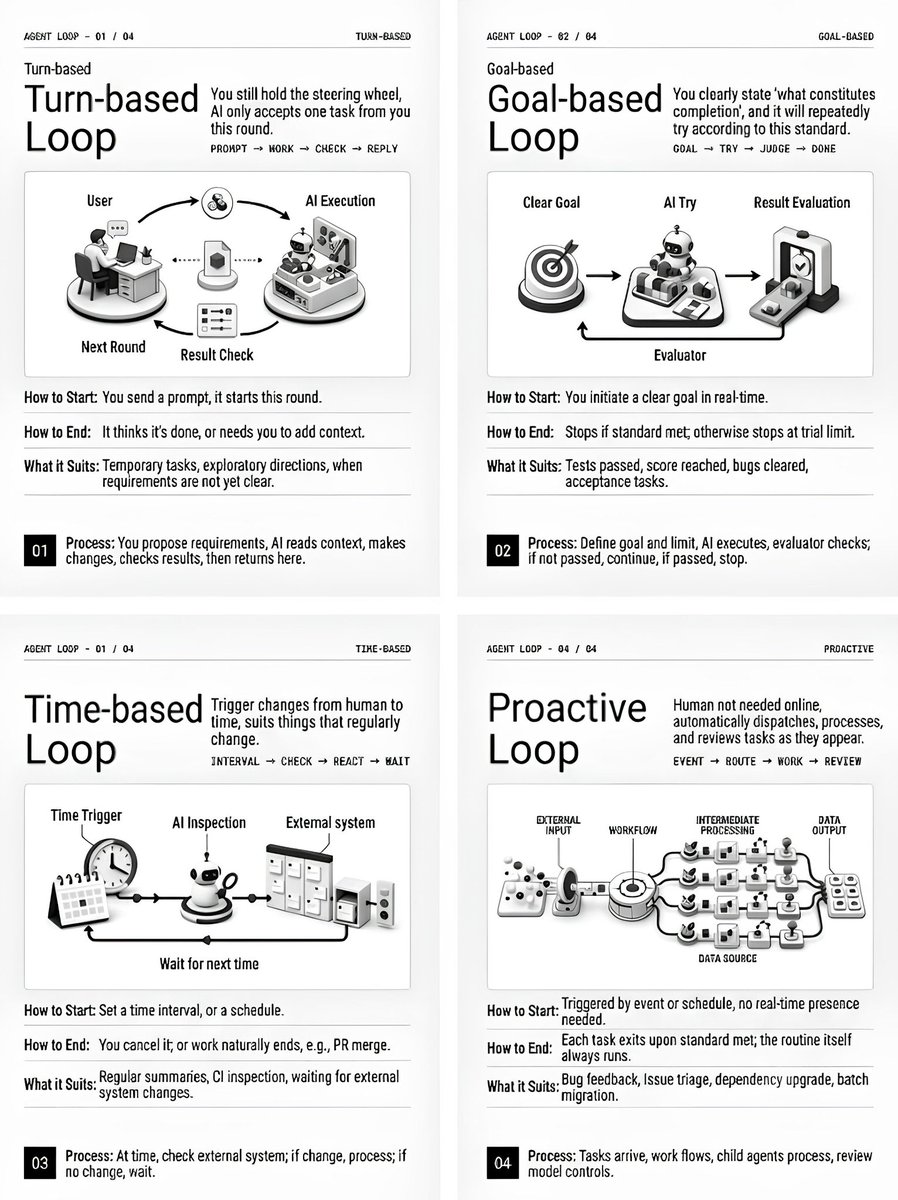
Here's the full guide in one post:
1. Turn-based
Every prompt you send already runs as a loop: Claude gathers context, takes action, checks its own work, and repeats until it decides the task is done or realizes it needs your input.
2. Goal-based
You define what "done" looks like with /goal, and Claude keeps iterating toward it. Every time it tries to stop, a separate evaluator model checks your condition - if it's not met, Claude gets sent back to work until the goal is reached or the turn limit hits.
3. Time-based
This is the /loop command: нou set an interval and a prompt fires on schedule. For example, every 5 minutes Claude checks your PR, addresses review comments, and fixes failing CI.
4. Proactive
Here you set up an event once, and the loop triggers itself whenever that event happens - with zero human input.
Anthropic also shared optimization advice - and this part matters most:
- Loop quality depends on system quality.
- Tokens are the real cost
None of this is magic. It's the same familiar parts - /goal, /loop, Skills, Hooks - composed into systems that run without you.
I built exactly that kind of system in my article:
Loop that wakes up at 6 AM, finds work on its own, reviews itself, and leaves ready PRs for you. Step by step, from SKILL(.)md to cron trigger:
YOU CAN BUILD AN AI SECOND BRAIN IN 15 MINUTES.
No coding experience. No $1000 course.
Here is the entire setup.
Step 1: Download Claude Desktop.
Step 2: Download Obsidian.
Step 3: Create a new vault and start dropping .MD files into it.
Step 4: Tell Claude Code to connect to your vault using Karpathy's prompt: https://t.co/5LkhJDHoBm
That is it.
Your entire knowledge base becomes searchable, connectable, and queryable by the most powerful AI model on earth.
Every note you have ever written.
Every idea you have ever captured.
Every resource you have ever saved.
Claude reads all of it, finds connections you missed, and surfaces insights from your own thinking that you FORGOT you had.
Most people use Claude as a search engine.
The people building second brains use it as an INTELLIGENCE LAYER on top of everything they know.
That gap is the gap between asking Google a question and having a research partner who has read everything you have ever written.
Bookmark this.
Build it tonight. Follow @cyrilXBT
Loop engineering - the reading list
In 2026 agents stopped being about smarter prompts and started being about longer runs.
Everyone needs to stop writing stupid prompts and start learning Loop engineering.
The real question isn't "what do i type". It's "how does my agent keep going for 40 minutes without falling over".
1. Can it recover from a failed step?
2. Can it control spend?
3. Does it know when to stop?
All of it comes back to loop design:
[ READING LIST ]
1. Addy Osmani - Loop engineering:
https://t.co/kzIbYW8wLG
2. Firecrawl - Loop engineering:
https://t.co/8UhKcZvbw9
3. Oracle - What is the AI agent loop:
https://t.co/Jg5ic7dxJc
4. OpenAI - Harness engineering:
https://t.co/7i34jS1Qk9
5. Martin Fowler - Harness engineering for coding agent users: https://t.co/1QvsIHGbXa
6. From React to loop engineering - Agentic loops:
https://t.co/WERkgRXWsy
7. Mem0 - Loop engineering for ai agents, memory-first:
https://t.co/mJxzguwX7z
[ OPEN SOURCE WORTH READING ]
1. Codex CLI: https://t.co/TCbo5tNb3b
2. Openhands: https://t.co/KgPJOHgLK4
3. Pydanticai: https://t.co/6Dd1Hu9Etj
4. OpenAI Agents SDK: https://t.co/JobwcV75dH
[ WHAT TO STUDY ]
- How the loop runs?
- How the loop stops?
- How the loop verifies?
- How the loop recovers?
- How the loop is debugged?
[ THE POINT ]
- Prompt decides how the agent starts.
- Context decides what the agent sees.
- Loop decides how far the agent gets.
Scheme:
Think -> Act -> Observe -> Verify -> Evolve -> Repeat
[ START HERE ]
Before you touch anything above - read my Article first -It's the entry point.
CLAUDE CODE YA NO TE PREGUNTA SI EL BUG ESTÁ ARREGLADO. LO COMPRUEBA ÉL MISMO.
Se llama Dev Browser. Ya suma 5.600 estrellas en GitHub.
Es un skill que le da a Claude Code la capacidad de abrir un navegador real, navegar y verificar visualmente que lo que acaba de programar funciona.
→ Se conecta a tu Chrome real, con tus sesiones ya logueadas, en vez de abrir uno vacío desde cero
→ Ejecuta scripts completos en lugar de ir paso a paso, así que es mucho más rápido
→ Corre en un sandbox aislado, sin acceso a tu disco ni a tu red, por seguridad
→ En su propio benchmark le gana a Playwright MCP en tiempo, coste y número de pasos
Es como si tu desarrollador ya no te dijera "debería funcionar" sino que abriera la pantalla delante de ti y te lo enseñara.
Menos "confía en mí", más "mira". Repo abajo.
@farzyness If cybercab works, then why to build its variant with steering wheel/pedal and not sell it directly to consumer (different paints) for personal use. Given regulation for FSD remain same where use it as taxy or personal usage ..
we’re hiring 50 engineers in the next 2 weeks
AI engineers
ML researchers
Founding product engineers
Designer Engineers
FDEs
These are across seed-series B startups we’re working with backed by investors like YC, Seqouia, a16z, khosla and others
APPLE JUST SHOWED HOW TO RUN 10 AI AGENTS LOCALLY ON MAC - NO CLOUD, NO API KEYS, ZERO COSTS
00:10 Apple engineer says: "your data stays on your device, AI available anywhere at any time, zero usage costs"
agent reads your code, checks GitHub, finds what needs attention and writes a report - all on your Mac, nothing goes to the internet
10 agents work simultaneously - one writes code, another tests, third fixes bugs - parallel with no queue
built a full iPad app from scratch in 2 minutes, fixed its own mistakes and compiled without issues
takes 5 minutes to set up - and you never pay again for a bot that runs 24/7
Essential apps every coder should know
https://t.co/4cTFUvgsmF - Open-source typeform alternative
https://t.co/QCIrPtspXK - track & monitor server HW, uptime
https://t.co/QfIg7QXA2P - Push code. Everything else is handled.
https://t.co/x4cuOUOT3D - Markdown to production docs
https://t.co/bXjTZMHLlJ - Gallery of web/app design inspiration


![0x_kaize's tweet photo. Loop engineering - the reading list
In 2026 agents stopped being about smarter prompts and started being about longer runs.
Everyone needs to stop writing stupid prompts and start learning Loop engineering.
The real question isn't "what do i type". It's "how does my agent keep going for 40 minutes without falling over".
1. Can it recover from a failed step?
2. Can it control spend?
3. Does it know when to stop?
All of it comes back to loop design:
[ READING LIST ]
1. Addy Osmani - Loop engineering:
https://t.co/kzIbYW8wLG
2. Firecrawl - Loop engineering:
https://t.co/8UhKcZvbw9
3. Oracle - What is the AI agent loop:
https://t.co/Jg5ic7dxJc
4. OpenAI - Harness engineering:
https://t.co/7i34jS1Qk9
5. Martin Fowler - Harness engineering for coding agent users: https://t.co/1QvsIHGbXa
6. From React to loop engineering - Agentic loops:
https://t.co/WERkgRXWsy
7. Mem0 - Loop engineering for ai agents, memory-first:
https://t.co/mJxzguwX7z
[ OPEN SOURCE WORTH READING ]
1. Codex CLI: https://t.co/TCbo5tNb3b
2. Openhands: https://t.co/KgPJOHgLK4
3. Pydanticai: https://t.co/6Dd1Hu9Etj
4. OpenAI Agents SDK: https://t.co/JobwcV75dH
[ WHAT TO STUDY ]
- How the loop runs?
- How the loop stops?
- How the loop verifies?
- How the loop recovers?
- How the loop is debugged?
[ THE POINT ]
- Prompt decides how the agent starts.
- Context decides what the agent sees.
- Loop decides how far the agent gets.
Scheme:
Think -> Act -> Observe -> Verify -> Evolve -> Repeat
[ START HERE ]
Before you touch anything above - read my Article first -It's the entry point.](https://pbs.twimg.com/media/HMdh8IGWoAABwoq.jpg)


