AI changes competitive advantage.
Not through more people.
Not through more capital.
Through faster learning.
Every interaction becomes data.
Every decision improves the next.
The companies that compound knowledge daily will outperform those that simply grow.
AI is getting cheaper. Certainty isn't.
Every company can access intelligence.
Very few can guarantee compliance, reliability, and trust.
The biggest AI winners won't build smarter models.
They'll eliminate risk.
Forget automation. Think amplification.
AI doesn't just help people work faster.
It helps organizations think better, decide quicker, and scale expertise without scaling payroll.
That's a different game.
Everyone is chasing smarter AI.
The real advantage isn't smarter models.
It's AI that remembers your business, workflows, customers, and decisions.
The next AI race isn't about intelligence.
It's about context.
The next billion-dollar software may never be sold.
It'll run inside companies.
Invisible AI workflows will decide faster, execute better, and learn continuously.
In the AI era, the operating system of a business becomes its competitive advantage.
AI is making intelligence cheap. Attention is becoming priceless.
Everyone will have access to powerful AI.
Few will know where to direct it.
The companies that win won't produce more ideas.
They'll make fewer, better decisions.
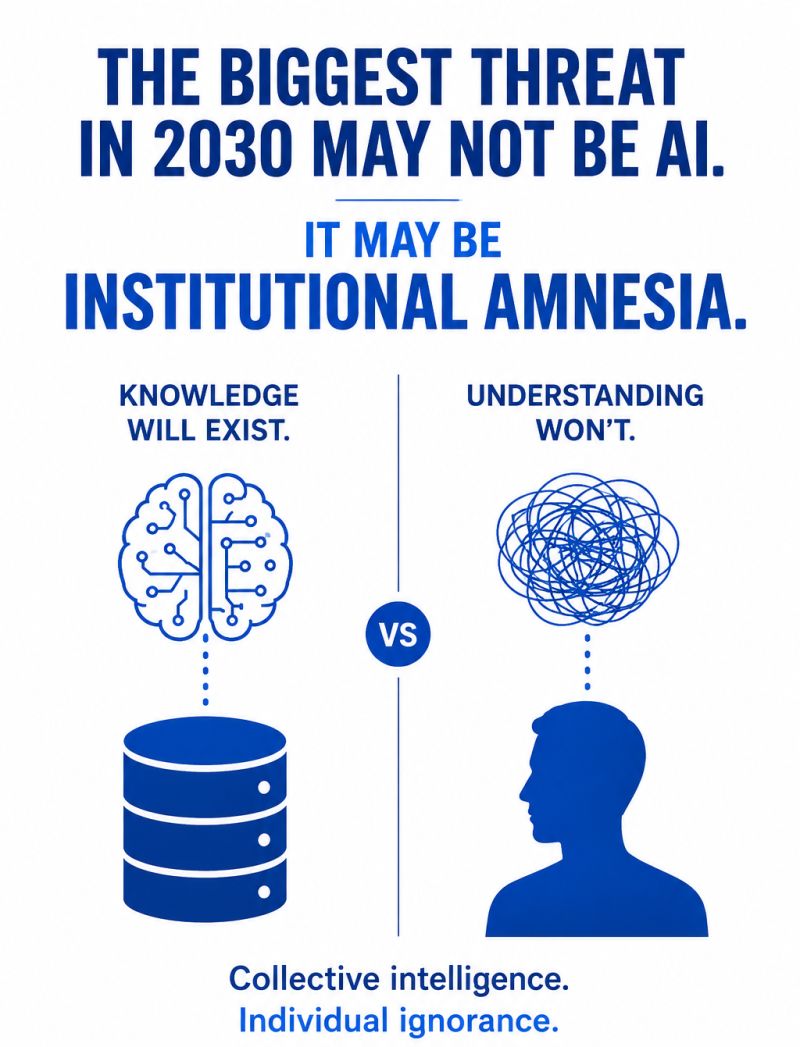
AI may preserve knowledge. Humans may stop preserving understanding.
That's a dangerous shift.
Knowledge without context creates organizations that remember everything but explain nothing.
Institutional amnesia might become the defining business challenge of the next decade.
The most important AI question is changing.
Not:
“How smart is it?”
But:
“How much should we trust it?”
In 2026, trustworthiness is becoming a competitive advantage.
The winners won't answer everything.
They'll know when they're uncertain.
More AI ≠ Better outcomes.
The winners won't be companies with the most AI tools.
They'll be the ones with the best AI strategy.
AI Overlords is offering a FREE AI Audit to uncover automation gaps, use cases, and scalable opportunities.
Patents are assets.
Cash is an asset.
But organizational memory might be worth even more.
People leave. Knowledge leaves with them.
AI changes that.
The next winners may not have the most data.
They'll have the best memory.
AI doesn't just need records of wins.
It needs records of rejected deals, abandoned products, and decisions that never happened.
Success shows possibilities.
Failure defines boundaries.
And boundaries are intelligence.
AI generates answers.
Judgment decides which answers matter.
As intelligence becomes commoditized, the companies that win won’t have more AI.
They’ll make better decisions.
Everyone talks about bigger AI models.
But World Models could matter more.
Systems that understand cause and effect, simulate futures, and adapt to change.
The next generation of AI won't just respond.
It will anticipate.
AI evolution in four years:
2023 → Can it write?
2024 → Can it reason?
2025 → Can it use tools?
2026 → Can it pursue goals for weeks?
The next breakthrough won't just be smarter models.
It will be systems with agency.
Everyone is competing to build better AI.
Few are asking who controls it.
As autonomous agents become more powerful, AI control systems, watchdog models, and continuous supervision may define the next era.
Capability matters.
Control matters more.
Everyone is focused on model performance.
The real competition is becoming energy performance.
AI is entering an era where Intelligence per Watt may matter more than benchmark scores.
Power is becoming the new moat. ⚡
Most companies are racing to adopt AI.
Few are building context.
The winners won't be those with the most AI tools.
They'll be the ones whose AI understands years of decisions, processes, and organizational knowledge.
AI is scalable.
Context isn't.
The biggest AI risk isn't hallucinations.
It's cognitive dependency.
The danger isn't AI thinking for us.
It's humans stopping thinking altogether.
AI should amplify intelligence.
Not replace it.
Are we automating work — or outsourcing judgment?
The next AI wave isn’t bigger models.
It’s Agent Economies.
Research agents.
Analysis agents.
Execution agents.
Audit agents.
The advantage is no longer intelligence.
It’s coordination.
The future may be millions of specialized AIs working together not one superintelligence.
Bigger models dominated the last AI race.
The next one is about memory.
Remembering decisions, context, preferences, and past failures.
The future of AI isn't just intelligence.
It's persistence.