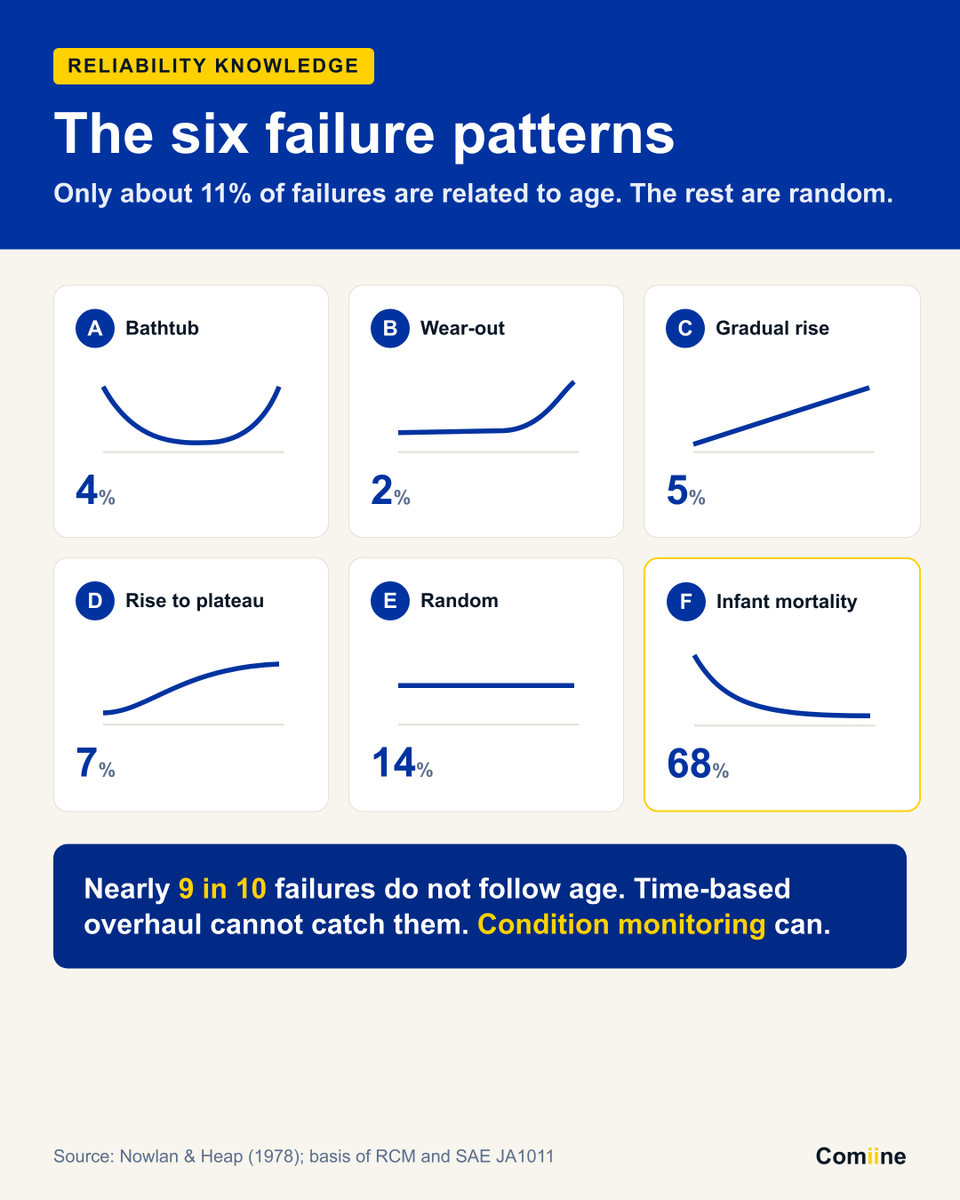
This is the foundation of Reliability-Centred Maintenance and the standard SAE JA1011: stop overhauling on a calendar, start monitoring condition and acting on evidence.
Nowlan & Heap, 1978
In 1978, Nowlan and Heap studied thousands of failures for United Airlines. What they found rewrote maintenance thinking.
They mapped six failure patterns. Only three relate to age. And together those three explain just 11% of failures.
Think about what that means. Stripping down a healthy machine for a time-based overhaul does not prevent those failures. It can cause them, by introducing fresh infant mortality every time you open the machine up.
Better data beats better guesses.
Before any new tool, the highest-return maintenance habit is a complete, closed-out work order for every job: what failed, why, and who signed off.
That is where reliability decisions come from. 1/3
Which assets cost the most hours, what fails most often, and where to focus a limited team. Comiine is built to make that habit effortless, capturing the full job on the phone at the machine and syncing when signal allows, online or offline.
@mining Framing reliability as a business issue, not a maintenance one, is right. The hard part on the ground is that the knowledge to prevent the next failure usually already exists.
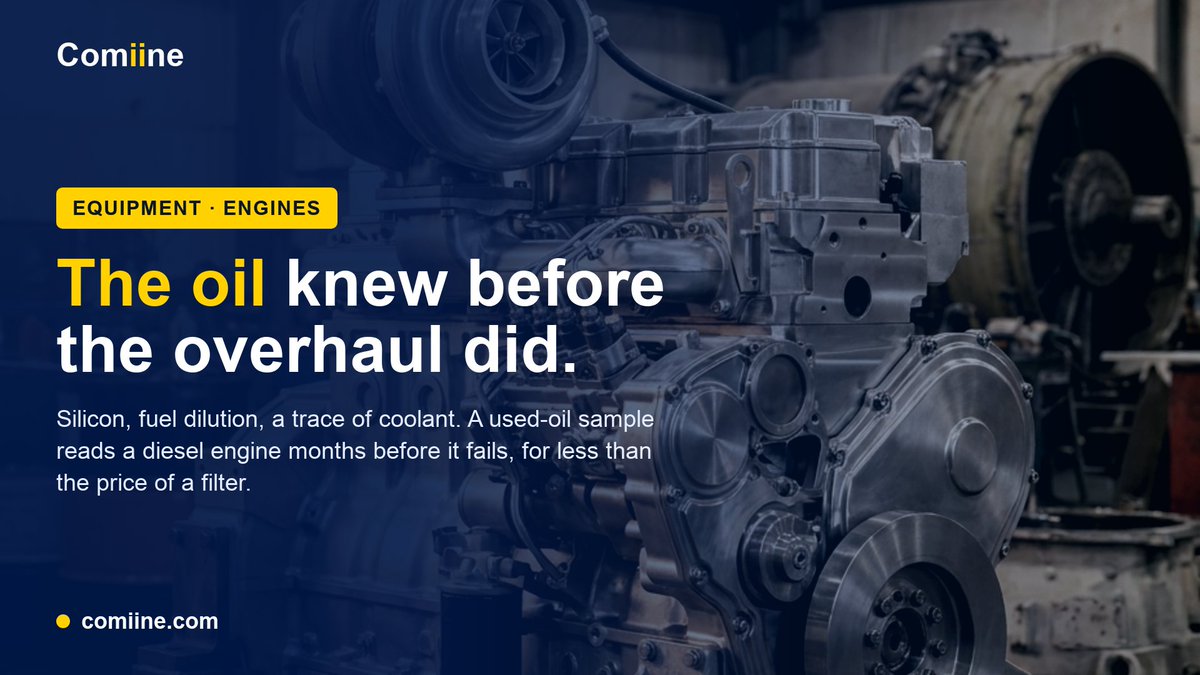
A diesel engine hints before it dies. Most arrive in a used-oil sample.
Silicon = dirt past the air filter.
Fuel dilution = thinning oil, rising soot.
Coolant trace = internal leak.
Baseline at rebuild, sample every service, trend the direction.
What number do you check first?
The best teams aren't luckier. They catch the pattern early and leave notes the next shift can find.
What's the FIRST thing you check on a pump that "sounds off"? 👇
We're building @comiinehub to keep that record on the machine. https://t.co/8y9SRFQG1U, book a demo!
Your pump started dying weeks before it stopped. You just didn't have the notes.
How centrifugal pumps really fail - and how to catch it early. A thread 🧵👇
#Maintenance#Reliability#Mining
Write down the "normal" for each critical pump;
sound · bearing temp · discharge pressure · amps
That one baseline turns every future check into an early-warning system. You can't spot drift if you never logged the start.