Those recent viral rust photos/footage of the USS Abraham Lincoln (CVN-72) in Thailand overstated the story.
Yes, the hull looked rough in pictures, but the ship itself was never in question, that's the part the headlines skipped.
Today at Laem Chabang Port in Thailand, local crews under US Navy contract handled the cleanup, rust removal, hull washing, clearing marine growth.
Abe had just wrapped over 280 days of sustained combat operations against Iran that whole stretch. So when you're choosing between keeping jets flying and touching up paint, the paint loses every time, and it should.
Today's ship clean-up proved the ship was always fine, it just needed a wash.
[ Footage by Army Military Force]
The U.S. Army could strike a moving warship from 1,000 km away, and it wouldn't need a new launcher to do it.
Lockheed Martin is preparing a ramjet-powered Precision Strike Missile (PrSM) Increment 4 that existing HIMARS launchers could fire at moving ships and relocatable land targets alike.
No earlier PrSM could pair that range with moving-target capability. Mobile batteries, scattered across dispersed positions along coastlines, could then reach into maritime operations from land.
Lockheed is already building the factory capacity to support production. The proof comes in 2027 and 2028, when flyoff competitions will test the design and its readiness for the field.
L3Harris has shown a prototype air-to-air missile for the Extended Range Counter-Small Unmanned Aircraft Systems Missile program.
Instead of a solid-propellant motor, it uses a solid-fuel ramjet, which takes oxygen from the air. That lets it carry more fuel in the same body and fly farther.
The missile is meant to fit the Stinger Vehicle Universal Launcher, which now carries four Stinger missiles on mobile air defense systems such as the AN/TWQ-1 Avenger and the Sergeant Stout. It should outperform the Stinger, which reaches 4.8 km and an altitude of 3.8 km.
L3Harris has received $60 million to develop the missile, and Northrop Grumman has received $18.8 million for the ramjet engine.
Nothing hides them this time.
North Korea has rolled 122mm self-propelled howitzers out into the open on the Kaepung County coast, about 1.5 km from South Korea's Aegibong Observatory in Gimpo, barrels aimed south.
The armour bears a slogan: “Annihilate the U.S. imperialist aggressors.”
Nearby, soldiers drill beneath red flags while armoured vehicles and fence-building work continue.
Artillery is normally kept on reverse slopes or in bunkers. Seeing it in plain view is the point.
South Korean analysts read it as a deliberate show of force, not an ordinary tactical deployment.
The U.S. Army could strike a moving warship from 1,000 km away, and it wouldn't need a new launcher to do it.
Lockheed Martin is preparing a ramjet-powered Precision Strike Missile (PrSM) Increment 4 that existing HIMARS launchers could fire at moving ships and relocatable land targets alike.
No earlier PrSM could pair that range with moving-target capability. Mobile batteries, scattered across dispersed positions along coastlines, could then reach into maritime operations from land.
Lockheed is already building the factory capacity to support production. The proof comes in 2027 and 2028, when flyoff competitions will test the design and its readiness for the field.
Cheap air-launched cruise missiles from the ERAM program, launched by Biden and funded by Europe, should start arriving in Ukraine soon. Will Trump dare delay or block them?
L3Harris has shown a prototype air-to-air missile for the Extended Range Counter-Small Unmanned Aircraft Systems Missile program.
Instead of a solid-propellant motor, it uses a solid-fuel ramjet, which takes oxygen from the air. That lets it carry more fuel in the same body and fly farther.
The missile is meant to fit the Stinger Vehicle Universal Launcher, which now carries four Stinger missiles on mobile air defense systems such as the AN/TWQ-1 Avenger and the Sergeant Stout. It should outperform the Stinger, which reaches 4.8 km and an altitude of 3.8 km.
L3Harris has received $60 million to develop the missile, and Northrop Grumman has received $18.8 million for the ramjet engine.
Nothing hides them this time.
North Korea has rolled 122mm self-propelled howitzers out into the open on the Kaepung County coast, about 1.5 km from South Korea's Aegibong Observatory in Gimpo, barrels aimed south.
The armour bears a slogan: “Annihilate the U.S. imperialist aggressors.”
Nearby, soldiers drill beneath red flags while armoured vehicles and fence-building work continue.
Artillery is normally kept on reverse slopes or in bunkers. Seeing it in plain view is the point.
South Korean analysts read it as a deliberate show of force, not an ordinary tactical deployment.
The Kongsberg company has presented a containerized launch system for the NSM cruise missiles.
The system, called the NSM Mission Module, is based on a 20-foot maritime container and can hold 4 NSM missiles, with a range of approximately 300 km and a payload of 120 kg.
The use of a container allows for the creation of a discreet launch system, and it can be used in a stationary configuration, on a truck, or on a maritime platform.
Helsing unveiled Contra, an autonomous air defence system, with two interceptors: AD-1 Inferno and AD-2 Ambush
The announcement follows reports that Russia's Geran-4 and Geran-5 jet drone output has risen to about 4,000 a month, with new launch sites bringing parts of the EU within range.
AD-1 INFERNO:
— Jet propulsion
— Over 700 km/h in speed
— 20+ km operating range
— Over 9,000m operating altitude
— Containerised launch
AD-2 AMBUSH:
— Solid rocket motor propulsion
— Over Mach 2.5 speed
— 20 km+ operating range
— Over 9,000m operating altitude
— Containerised launch
A Chinese H-6KG bomber has been photographed carrying what looks like a new large electronic jamming pod, nearly identical to the RKZ930-22 or RKZ930-32 pods on the J-16D, the PLAAF's dedicated electronic warfare jet, but with a differently shaped nose.
If it is a working jammer, the H-6KG, the latest version of China's modernized Tu-16 derivative with D-30KP2 engines and long-range cruise missiles, could blind or confuse enemy radars on its own during an approach rather than relying on escort electronic warfare aircraft.
The J-16D, a two-seat Flanker derivative first shown at Zhuhai in September 2021 and often compared to the U.S. Navy's EA-18G Growler, has carried RKZ930-10, -22, -31 and -32 pods.
I believe their distinct shapes cover different radar frequency bands, similar to the U.S. Navy's Next Generation Jammer.
Helsing unveiled Contra, an autonomous air defence system, with two interceptors: AD-1 Inferno and AD-2 Ambush
The announcement follows reports that Russia's Geran-4 and Geran-5 jet drone output has risen to about 4,000 a month, with new launch sites bringing parts of the EU within range.
AD-1 INFERNO:
— Jet propulsion
— Over 700 km/h in speed
— 20+ km operating range
— Over 9,000m operating altitude
— Containerised launch
AD-2 AMBUSH:
— Solid rocket motor propulsion
— Over Mach 2.5 speed
— 20 km+ operating range
— Over 9,000m operating altitude
— Containerised launch
Agreed, the nose is the tell. Low band needs a large aperture and lots of prime power, which suits the H-6KG's airframe and generators, much like the NGJ-MB/LB split.
Transmit-only is plausible if receive and ESM sit elsewhere on the aircraft. More and/or better imagery of the inlets and antenna fairings would help me narrow it down.
A Chinese H-6KG bomber has been photographed carrying what looks like a new large electronic jamming pod, nearly identical to the RKZ930-22 or RKZ930-32 pods on the J-16D, the PLAAF's dedicated electronic warfare jet, but with a differently shaped nose.
If it is a working jammer, the H-6KG, the latest version of China's modernized Tu-16 derivative with D-30KP2 engines and long-range cruise missiles, could blind or confuse enemy radars on its own during an approach rather than relying on escort electronic warfare aircraft.
The J-16D, a two-seat Flanker derivative first shown at Zhuhai in September 2021 and often compared to the U.S. Navy's EA-18G Growler, has carried RKZ930-10, -22, -31 and -32 pods.
I believe their distinct shapes cover different radar frequency bands, similar to the U.S. Navy's Next Generation Jammer.
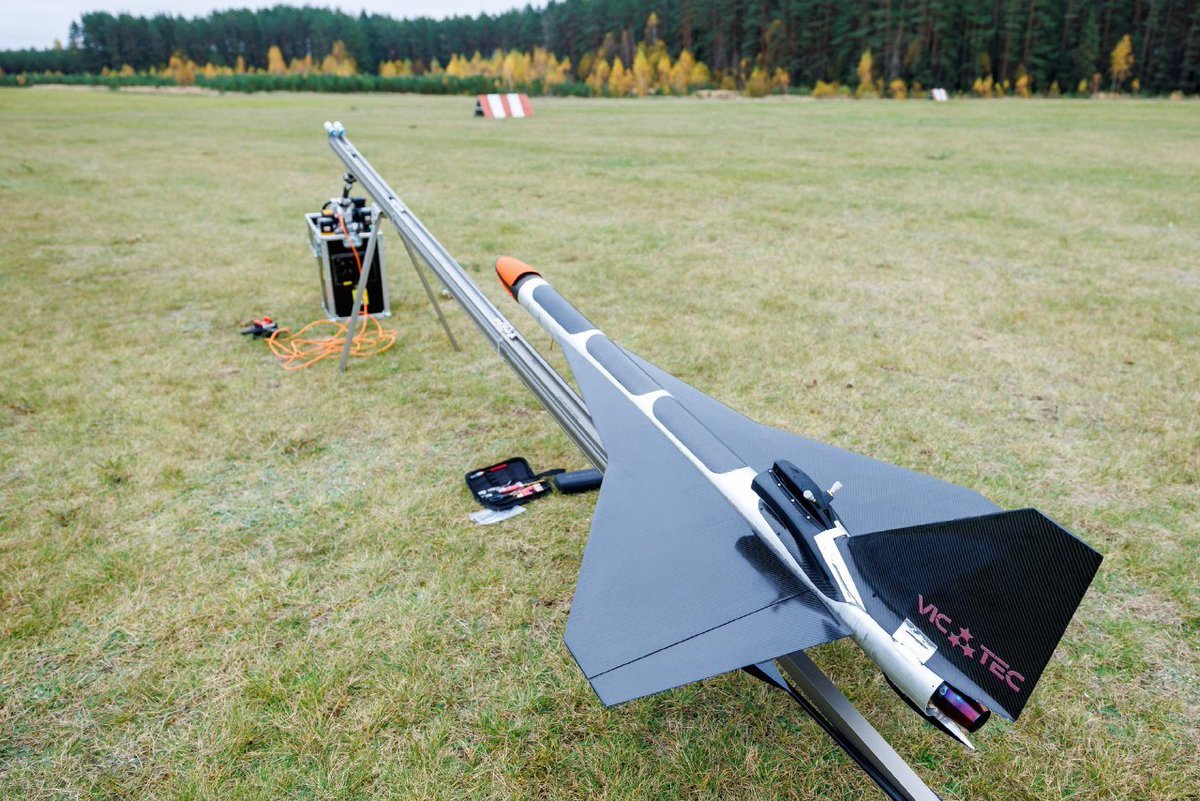
The SDA (Strategic Defense Alliance) has unveiled the X-12 reactive drone interceptor.
The drone has a cruising speed of 350 km/h, a maximum speed of up to 700 km/h, a range of up to 126 km, and an altitude of up to 10 km.
The X-12, developed by companies from Lithuania, Latvia, and Ukraine, has already undergone testing and is planned to be supplied to Ukraine.
BAE Systems showed its TRV-150 drone as an air defense platform carrying three APKWS II rockets.
At Eglin Air Force Base, it intercepted multiple aerial targets in one flight without landing. The laser-guided rockets reach about 6 km, and the drone flies roughly 36 minutes.
BAE also agreed with the U.S. Department of Defense to raise APKWS II production from 25,000 to 35,000 units a year.