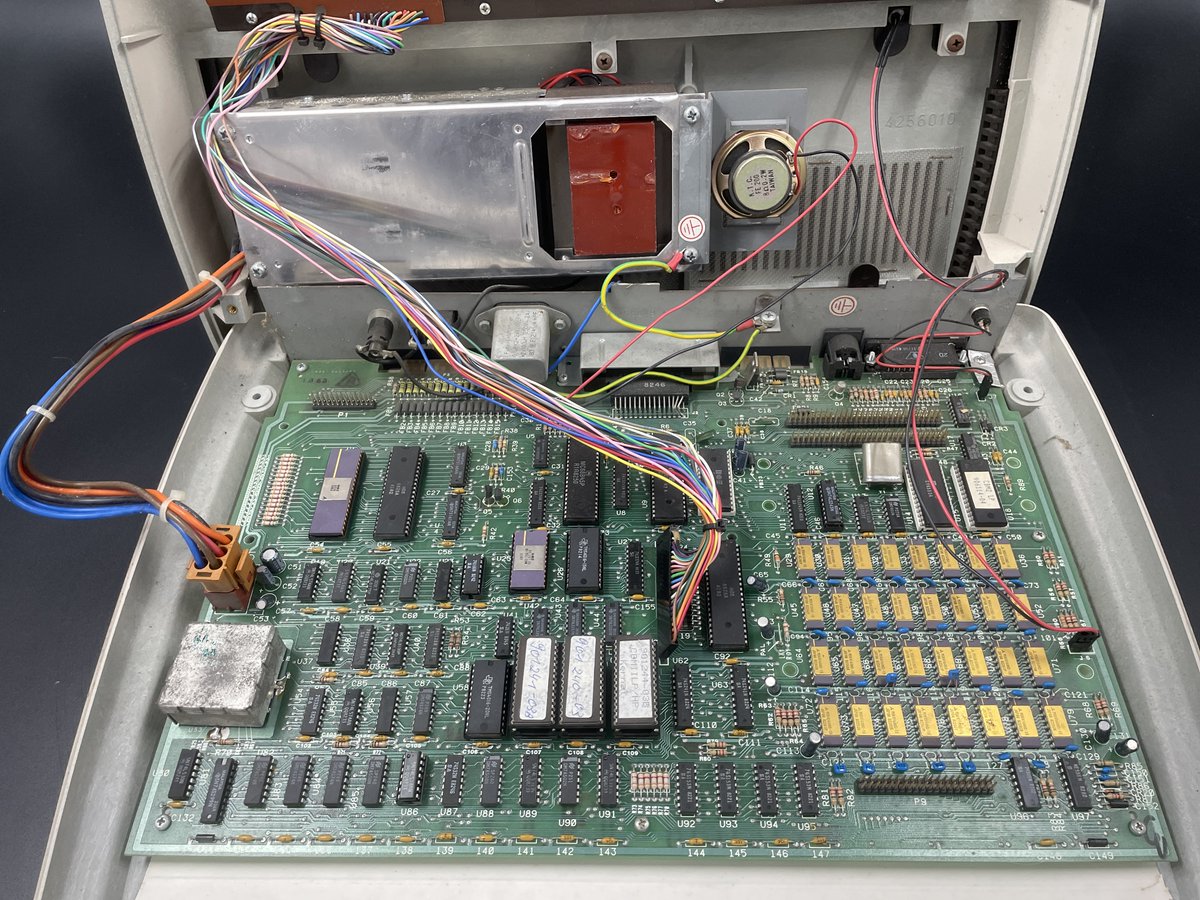
Space Invaders on the Commodore PET (written by @ProfMatsuoka) was always the coolest thing to me when I was younger. I love the CBM-II series Commodore computers, so I thought it would be neat to port Space Invaders to CBM-II. A few years ago I did a full disassembly of PET Space Invaders (https://t.co/wQVsQ7RX5R) and tried to port it to CBM-II. The MOS 6509 banking scheme is brutal, and I failed. Recently, I gave it another try and I'm much closer now! I stole the bank-1/bank-15 BLOAD trick from Christian Krenner's Space Chase, and the IRQ chain mechanism from Commodore's Accounts Payable code. With all that stolen code, you can see I have Space Invaders running on a real CBM 256-80. Still a few bugs to chase, but it's very close!
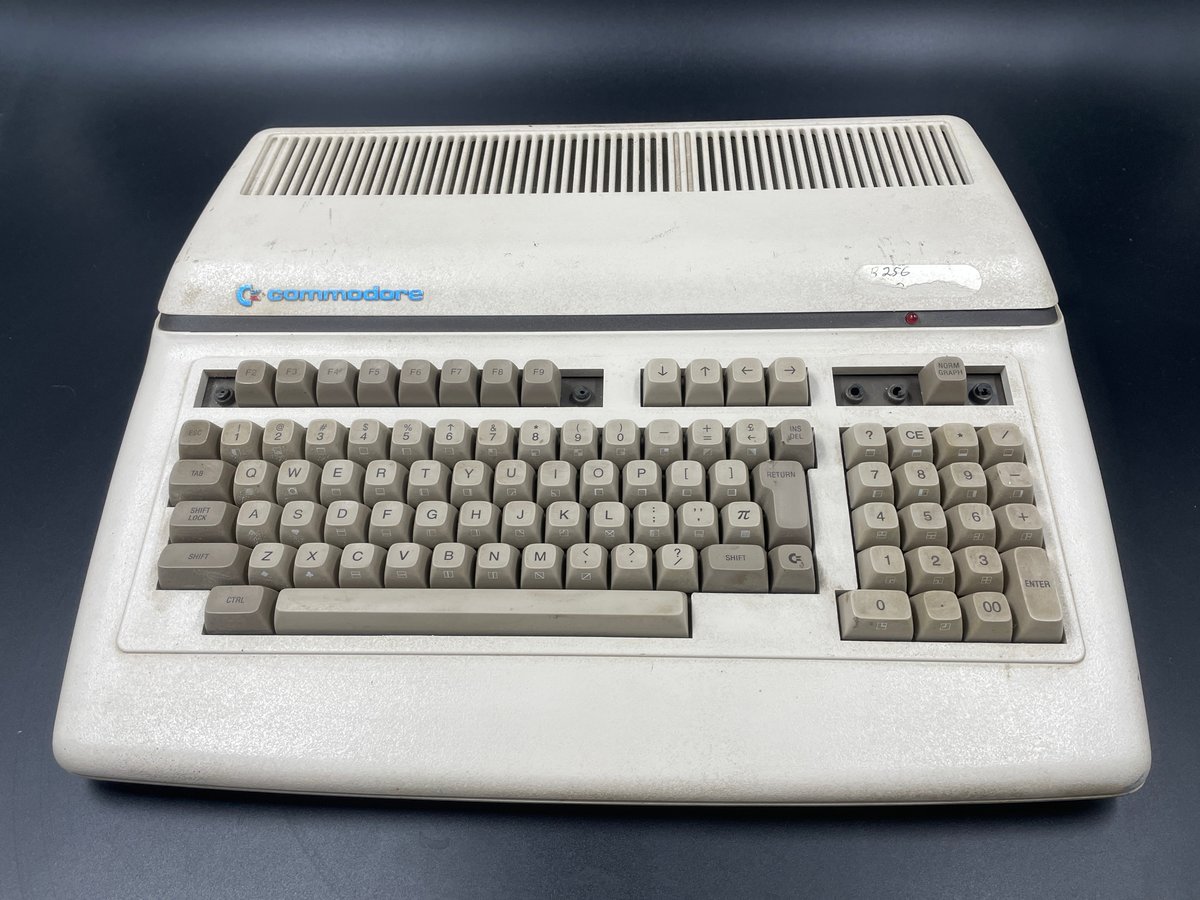
I snagged this Commodore 620 off eBay recently because it was an interesting piece. First, I have to thank my friend Steve Gray for providing background information to me on CBM-II model numbers, because I manage to screw them up every time. The Commodore 620 was the European market version of the North American B256. It's the low profile CBM-II model with 256K RAM. This one, despite being the European model 620, seems to have been modified for the North American market, as the PSU was converted to 117VAC. You can see on the serial sticker that there's a 117V sticker on top of the original serial sticker. Given that it's the same color and style, I'm guessing Commodore modified this, not a consumer. It's serial 00031, which is a low serial, but the chip date codes range from 2182 to 2983 (May 1982 - July 1983). It's in generally working condition, and it boots to the native boot screen saying, "commodore basic 256, v4.2". I have a line on a replacement keyboard, so the missing keys won't be a problem.
When the KIM-1 saves to cassette, it generates 0s and 1s as different frequencies just by oscillating a pin on the MOS 6530 RRIOT - no special audio circuitry. So I used a PET's 6522 VIA CB2 pin to do the same thing, turning the PET into a virtual cassette player for the KIM-1. https://t.co/rVnM1FCuNc
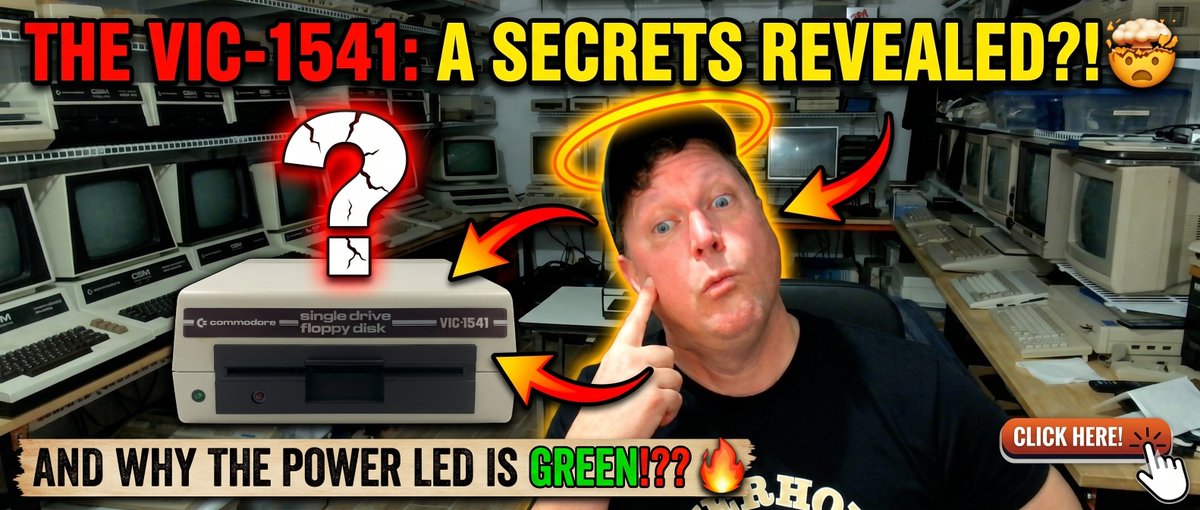
Few things in life irritate me more than clickbait YouTube thumbnails where there's some catchy hook text to lure you in and some moron with an exaggerated confused or surprised look on his face pointing at something, so as an Easter egg at the end of a recent YouTube video, I showcased a few farcical clickbait thumbnails I created. In these images, I am the moron I despise, and no, there's no link to a YouTube video. I assure you I'm not trying to clickbait you here.
What could be more beautiful than a Commodore 8032 PET? An 8032-SK PET! It's the same guts of the 8032, but instead of the boxy steel corners and integrated keyboard of the 8032 PET, the 8032-SK was in the sleek, Ira Velinsky designed CBM-II case with a separate keyboard. Same functionality, sure. But this was computing with serious style. I recently added this 8032-SK to my collection and posted about it a few times already. Now you can watch its transformation from a non-working collector's item to a daily driver on the bottom row of my Commodore room:
https://t.co/bp5a0JC0Bj
I bought this 8032-SK recently that had a 220V PSU. I had a deal lined up with a guy in Cincinnati to purchase a parts 8032 with a 110V transformer, but he thought I was shady so he canceled our deal. Then my European friend Rob Clarke (of Diag264 fame) let me know he had a SuperPET with a 110V transformer so we arranged a trade. International shipping happened. We both waited. And I now have a 110V transformer in this beautiful 8032-SK!
Information that nobody asked for and nobody needs in 2026:
If the default Commodore DOS 2.6 routines in a 1541 disk drive took over a minute and a half to format a disk, how was Mike J. Henry's 15 second format routine able to accomplish it in under 15 seconds?
https://t.co/o1gyxg6xfw
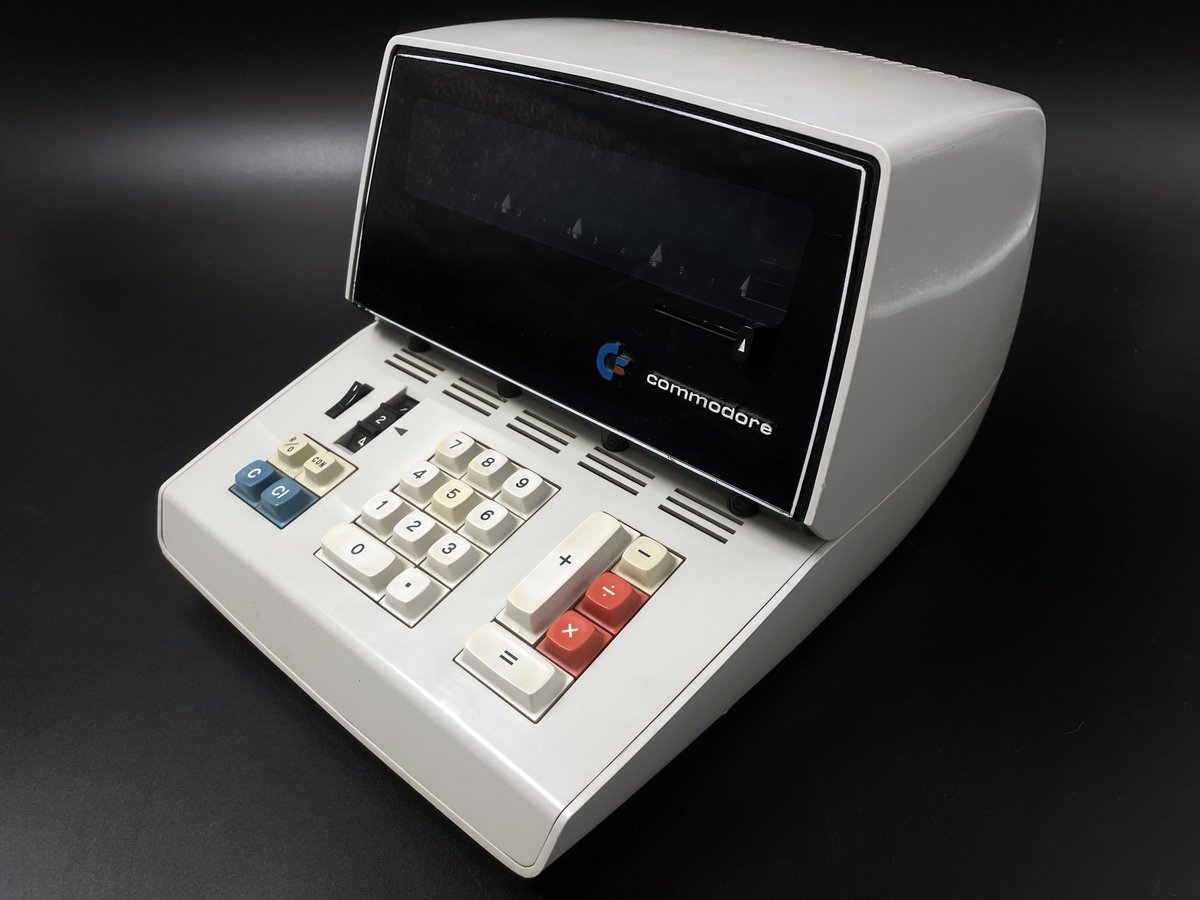
Here’s a Commodore 412 electronic calculator, introduced in September 1970. Commodore had entered the electronic calculator market just a couple years earlier, in 1968, with the Commodore 500e (I shared photos of that one before). The 500e was actually a re-branded Casio 101e and marked Commodore’s shift from electro-mechanical adding machines into electronic calculators. It was built entirely with discrete logic.
Commodore’s first calculator to use LSI chips came right around the same time with the AL-1000, also sourced from Casio. The 412 shown here also used LSI logic chips, and it’s interesting because it shows Commodore wasn’t tied to any single manufacturing partner.
Prior to the 412 OEM deal, Commodore already had an established relationship with Ricoh in Japan. Commodore’s initial push into mechanical adding machines came in 1959 through the West German company Willy Feiler Zahl-Und Rechenwerke GMBH, which translates roughly to "Willy Feiler Counting and Calculating Works Ltd.", which Commodore acquired in May 1964. After a major funding source collapsed in 1965, Commodore was forced to sell off the Feiler assets in 1966, leaving them without their own adding machine manufacturing capability.
To fill the gap, they struck an OEM deal with Ricoh in 1967 and began selling re-branded Ricoh adding machines, starting with the 201 and 202 models. This Commodore 412 is also a re-branded Ricoh unit, the Ricoh 1200D. So just as quickly as Commodore partnered with Casio for electronic calculators in 1968, they circled back to Ricoh by 1970.
Jack Tramiel highlights the 412’s modular design in Commodore's 1970 annual report. You can see it in the photos. Each board can be individually removed, and the alignment slots in the plastic housing suggest it may have been designed to accommodate additional boards for future expansions. Also noteworthy is that Commodore transitioned from the nixie tube displays of their initial Casio models to a Vacuum-Flourescent Display (VFD) with the 412 model. As much as Commodore's computer history fascinates me, it's super cool to see how quickly technology was evolving in these early electronic calculators, and it's amazing that Commodore, a very young company, evolved from purely mechanical adding machines in 1959 to fully electronic calculators only 9 years later in 1968.
When I was working on my FranKIMstein project, I ended up learning a lot about the inner workings of the Commodore DOS 2.6 disk format routines, so I put together a video to talk about what I know. Or at least, what I think I know. Maybe I'm wrong about some stuff. Anyway, if you're really bored, and I mean *reaaaallly* bored, give it a watch and let me know what you think:
https://t.co/WTnlj2AnKJ
If you've ever wondered what's inside the Newtronics read/write head in a Commodore 1541 disk drive, wonder no more! I painstakingly chipped away the epoxy that holds the head together and was able to non-destructively open it up to look inside. This one measures dead, but I wasn't able to find any obvious visual clues to explain its death.
Yesterday it got a new, working drive mechanism. Today it got a full tear-down, clean, and board re-cap. This Commodore 1541 should be good to (very slowly) load programs for another 40 years.
Sort of, kind of successful Commodore 1541 disk drive repair. Mistakes were made, but in the end I turned two non-working disk drives into one working disk drive.
https://t.co/neMcQVejXW
I'm able to participate in MarioDay despite not owning any Nintendo gear thanks to the amazing ZeroPaige's 2019 release for the Commodore 64. I'm blaming my Epyx 500xj for my poor game play here, but the reality is I just suck at video games.