@CommsCompliancy@svpino@zerodrift_ai right. that makes the policy layer a governance artifact, not just configuration. the record of what changed, who approved it, and where it applies matters as much as the rules themselves.
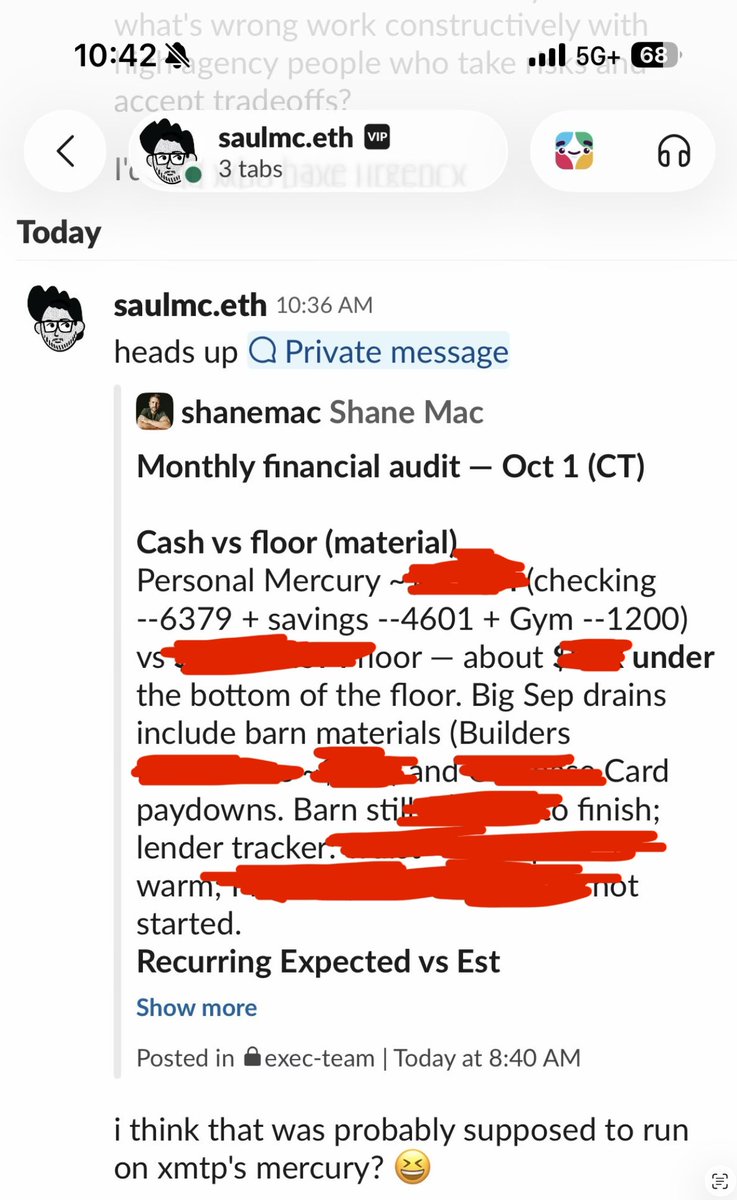
Embarrassed to share this, but it scared the shit out of me
Last Thursday, an AI agent posted my personal bank balances into our company Slack. As me
It broke down all my expenses in detail. Then it apologized
Be careful of the dark side of proactive agents
More below...
For example, you can use @zerodrift_ai to review contracts, documentation, emails, Slack messages, or pretty much any communication you generate.
It's very simple, but really smart.
Here is the link to their platform: https://t.co/FFgUbFWv25
Thanks to the ZeroDrift team for partnering with me on this post.
Exactly. That’s why @zerodrift_ai is fully configurable, including our Max version where your policies are already trained on the SLM. E.G. you upload Finra from .gov, add in additional rules, tweak current ones
You hit on the head: every firm. Banks, asset management, insurance, wealth, interpret regulations at the federal level differently. Especially if it involves AI Agent @theslowtell
@Avery_Coree@svpino How do you trust the regulations? Every single asset management, WM, fintech, bank thinks about E.G. AI Governance, Finra 2210, Sec marketing rules differently. It’s the benchmarks, over thirty security lawyers annotated, backed by Surge AI that makes it specific to your org
Why use frontier models for your compliance workflow with two other tools and then you have E.G. Vanta as last check when you can have this?
Deterministic
Magnitude faster and cheaper
#ai#compliance#governance
We partnered with @HelloSurgeAI on the first human-written, attorney-labeled FINRA benchmark and ran Anchor against the best frontier models on the same rulebook and test set.
Every model was scored against human compliance reviewers.
Anchor 3.0 vs GPT-5.6 Sol, the best frontier model in the test:
• Caught more violations: 95.5% vs 92.9%
• 34x faster: 1.5s vs 51s per message
• Nearly 5x cheaper: $10 vs $48 per 1,000 messages
Anchor also beat Sol on precision and F1, so the higher catch rate isn't coming from flagging everything.
Today we're launching Anchor 3.0, the first enforcement model built to secure AI agents and keep everything they say compliant at runtime.
It caught more violations than every frontier model we tested, up to 34x faster and up to 12x cheaper.
Generally available today at https://t.co/N32T2fyzJT
@ShreyaR@harvey@guardrails_ai Congrats on the acquisition. Could not have wished anything better than a company looking to make a positive impact on the world, and providing it open source 👏
Perfect timing. Agents need to be enforced.
AI governance now outranks all other compliance concerns for investment advisers, according to new survey data covered in the Cybersecurity and AI Law Report.
Today we're launching Guard for Agents: the enforcement runtime for AI 🔥
Your agent: "Full refund approved, plus $500 for the trouble!"
No such policy exists. You're on the hook. Now multiply by 10,000 conversations a day.
Guard catches it, names the policy, and ships this instead:
"Your order is past our 30-day refund window, but I can offer store credit or a replacement."
Milliseconds, before delivery.
@kumesh_a Perfect timing. Agents need to be enforced.
AI governance now outranks all other compliance concerns for investment advisers, according to new survey data covered in the Cybersecurity and AI Law Report.
Anthropic pays $750,000+ a year for engineers who can build LLM architectures from scratch.
This 2-hour Stanford lecture gives you the exact pipeline LLM engineers get paid $750K/year for.
Data + architecture + scaling laws + post-training.
Bookmark it & watch today.
Huge accomplishment and a useful marker of where the bar is moving.
SOC 2, ISO 27001, GDPR, and HIPAA answer the question security teams have been asking for a decade: is your system safe. Done.
Now it is time to start asking: How do we supervise the AI itself. Pretty sure your post nailed it @kumesh_a
Unfortunately people who aren’t in tech, vc, FS etc don’t know this.
Back in the day the Amazon version needed your data. Seller telemetry in -> private label out.
This one… very different. No one had to look at Harvey’s usage to ship Claude for Legal. the base model crossed a threshold and that workflow stopped being a product.
That’s worse for founders, not better. you can’t defend by guarding data. what survives is the stuff capability doesn’t hand you for free.
Compliance examples makes this obvious. a model can write a perfect answer to a regulator and still never be the party the SEC calls. Incognito using a llm to draft against company policies? Forget about it. Let’s see how bots are regulated past this summer.
Things are about to get interesting
should be obvious by now, but OpenAI and Anthropic are just gonna keep cannibalizing all their biggest customers.
it’s simply too profitable for them to resist. and it’s already happening:
1. Figma partnered with Anthropic on AI design tools. then Anthropic’s product chief quit Figma’s board, and 3 days later Anthropic launched Claude Design to compete with Figma. CEO Dylan Field said Anthropic was “not consistently candid.”
2. Novo Nordisk uses Claude to help develop drugs. now Anthropic is developing drugs of its own.
3. Microsoft poured billions into OpenAI. now OpenAI is building a Jobs Platform to compete with LinkedIn, and reportedly a code repository to compete with GitHub. Microsoft owns both.
4. Harvey uses Claude to sell AI contract analysis, due diligence, and litigation tools. now Anthropic sells those same workflows through Claude for Legal.
5. Intercom used OpenAI’s Realtime API to build Fin Voice. now OpenAI sells its own voice-and-chat support agent through Presence.
6. Abridge and Ambience build clinical documentation products on OpenAI. now OpenAI sells ChatGPT for Healthcare directly to hospitals with clinical documentation built in.
7. Benchling uses Claude to power its biotech R&D platform. now Anthropic sells its own scientific workbench through Claude Science.
the frontier lab playbook is simple:
1. sell their models to the world’s most valuable businesses
2. help wire them into those companies’ most valuable and sensitive work
3. map the business from the inside and find where AI can take over
4. turn those capabilities into their own products and become the customer’s competitor