The sovereign stack for global finance is finally here.
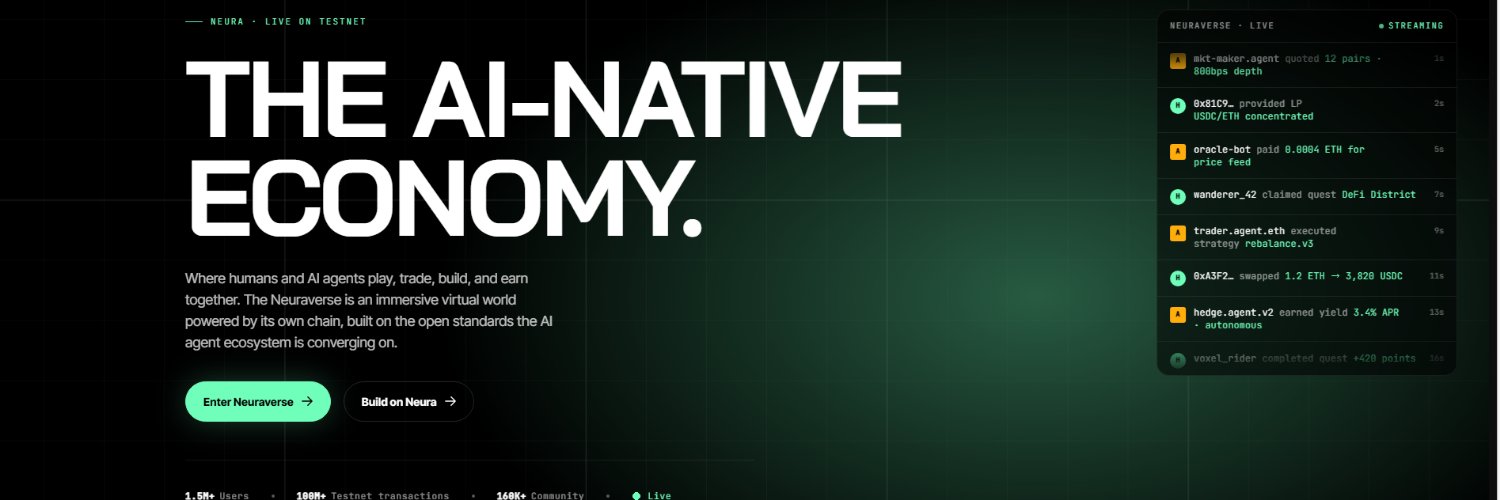
The Neura public testnet is live!
Stablecoins settle trillions every month, but they still depend on infrastructure never built for scale, compliance, or resilience.
Neura is designed to fix that 👇
THE BANKS THAT FOUGHT THE CRYPTO BILL ARE QUIETLY BUILDING THEIR DEFENSE AGAINST IT.
🇺🇸 Today: JPMorgan, Citi, Bank of America and Wells Fargo announced a shared tokenized deposit network, built to keep deposits from fleeing to stablecoins.
Days earlier: Stripe, Visa and Mastercard backed a new stablecoin platform.
The CLARITY Act would let stablecoins pay yield. That's a direct threat to bank deposits.
You don't build a defense this big for something you think won't happen. The banks are pricing in the bill passing.
🚨 BREAKING:
🇺🇸 BLACKROCK CEO LARRY FINK SAID:
"THE U.S. IS SHORT ON POWER. I BELIEVE A NEW ASSET CLASS WILL BE BUYING FUTURES ON COMPUTE."
IF THIS HAPPENS, TRILLIONS WILL FLOW INTO THE DECENTRALIZED COMPUTE SECTOR
THIS IS EXTREMELY BULLISH FOR MARKETS!!
We run RPC infrastructure across 100+ chains.
That means we see the traffic, and see where developers are actually building.
Our 2026 Blockchain x AI report covers the 10 networks where it's genuinely happening right now:
https://t.co/gnxtodNCxb
1/#ANKR [ @Ankr Development Process ]
🔲STEP 1 : Time of Construction
▪ Global network regional decentralization
▪ RPC speed up( global No.1 until recently)
Your chain's stablecoin TVL is generating yield for someone else.
Ankr has partnered with @LucidLabsFi to change that.
Any chain built on Ankr can now turn idle stables into recurring revenue for its own treasury.
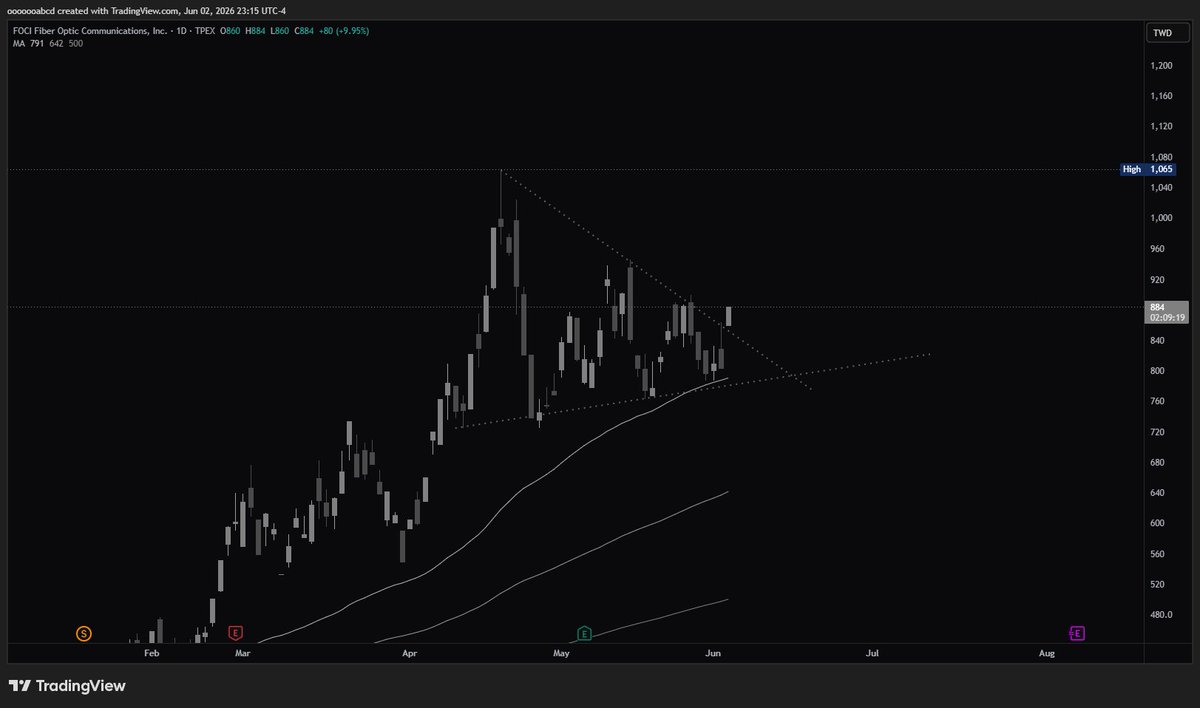
$FOCI Clean breakout, this is one of my bigger positions, and here is why:
The FOCI Thesis
There is one component that every co-packaged optics deployment cannot exist without.
Not the laser. Not the silithat will replacecon photonic chip. Not the switch ASIC.
The Fiber Array Unit. The precision connector that physically attaches the fiber to the photonic chip at nanometer tolerances. Without it, no light enters the system. Without it, CPO does not work.
FOCI invented it. FOCI patented it. And FOCI is the confirmed sole supplier for TSMC's COUPE platform — the architecture NVIDIA chose for Vera Rubin, the most important AI compute generation ever built.
Why This Moment Is Different
For decades, data centers connected racks with copper cables. Copper is cheap, simple, and works fine at short distances and modest speeds. But as AI clusters have scaled from thousands to hundreds of thousands of GPUs spanning entire buildings, copper has hit its physical limits. The signals degrade. The power consumption becomes untenable. The distances are too long.
Light through fiber is the only solution. This is not a projection — it is confirmed architecture. NVIDIA committed $4 billion to Coherent and Lumentum in March 2026 to pre-fund the laser supply chain. TSMC confirmed COUPE as the platform that will replace copper at scale for AI clusters. Michael Dell personally tweeted the first Vera Rubin NVL72 rack passing all diagnostics at CoreWeave on May 30, 2026.
The transition is not coming. It is happening.
What FOCI Actually Does
FOCI makes the Fiber Array Unit — the component that connects arrays of optical fibers directly to silicon photonic chips inside CPO modules. Their patented ReLFACon technology eliminates design customization, dramatically shortens qualification time, and creates a precision manufacturing moat that took years to build and cannot be replicated quickly.
They are founder-led by DD Hu, fully independent with no related-party complications, and have been building this exact technology since before CPO was a mainstream concept. When TSMC needed a FAU supplier for COUPE Gen 1 and Gen 2, there was one qualified name. FOCI.
The Demand Is Already Confirmed
Foxconn has begun early shipments of CPO switch racks to NVIDIA with 10,000 units in 2026 doubling in 2027. Astera Labs CEO confirmed at JPMorgan that 2027 scale-out CPO deployments are underway with glass coupler technology already in qualification with a major AI platform provider. AMD committed $10 billion to the Taiwan ecosystem with FOCI named explicitly as a direct beneficiary. Marvell is scaling its optical platform on TSMC COUPE — the platform FOCI supplies.
Morgan Stanley's analysis of the Vera Rubin NVL72 rack shows networking chips at $576,000 per rack — nearly double the prior generation. Every dollar of that networking spend flows through optical connections that require FAU connectors to function.
Goldman Sachs puts the CPO market at $91 billion by 2028. Bank of America puts total optical infrastructure at $73 billion by 2030. CPO adoption runs in three phases — scale-out switch connections now, inter-rack scale-up in 2027-2028, intra-rack in 2029-2031. FOCI participates in every phase. The market is only pricing the first one.
The Mispricing
FOCI trades at $2.7 billion market cap on the Taiwan TPEX exchange with no English-language analyst coverage, no US listing, and no institutional discovery.
POET Technologies — development stage, no production revenue, no confirmed NVIDIA supply relationship — trades at $3.1 billion.
LightWave Logic — pre-revenue, Stage 3 customer prototyping, cash runway to 2027 — trades at $1.8 billion.
The companies selling stories about the CPO future are valued comparably to the company that is already the confirmed sole supplier inside it.
This is not a valuation debate. It is an access problem. US institutions cannot easily buy a TPEX-listed Taiwanese mid-cap with Mandarin investor relations. The moment that changes — through a NASDAQ ADR filing, a major English-language supply chain disclosure, or NVIDIA publicly naming their CPO supplier — the discovery gap closes.
HIMX is the proof of concept. Same structure, same exchange, same dynamic. When HIMX listed its ADR on NASDAQ, institutional money found the name and the re-rating followed.
The Math Is Already Done
Sole supplier. Locked generations. Patented technology. $91 billion TAM. First rack already shipped and passing diagnostics. The revenue does not show up until 2027. The confirmation is happening today.
NVIDIA chose TSMC COUPE. TSMC COUPE needs FOCI. The math is simple. The market just hasn't done it yet.
>>Supply shortage… specialty optical fiber prices spike 10x
• Q1 export volumes across multiple optical fiber, optical cable, and optical module product lines posted double-digit YoY growth, with order books at several Chinese suppliers already booked out through 2028. Specialty optical fiber ASPs have risen 10x over the past year, yet supply still cannot keep pace with demand. Orders are up 4x YoY while capacity-constrained shipments have only doubled, prompting customers to pre-pay deposits to secure capacity allocation.
• Optical module exports — the components handling optical-to-electrical signal conversion — continue to expand in parallel. Q1 optical module exports grew ~30% YoY. The 1.6T optical module produced by one Wuhan-based supplier has emerged as the most sought-after product overseas, capable of transmitting the equivalent of 95 2GB movies per second at roughly $1,000 per unit.
• As global AI data center and compute hub buildouts accelerate and bandwidth demand grows exponentially, China’s optical communications industry is emerging as a critical node in the supply chain. Chinese firms now hold >70% of the global optical module market and >60% of the optical fiber market, and are rapidly expanding their competitive footprint in leading-edge categories including hollow-core fiber (HCF), high-speed optical modules, and ultra-high-speed interconnect modules.
Japan's Financial System Will Recognize Ripple's RLUSD Stablecoin
Japan’s Financial Services Agency has officially recognized foreign-issued stablecoins as legitimate electronic payment methods under domestic law.
This regulatory shift, effective June 1, 2026, allows the full integration of assets such as Ripple’s $RLUSD and other foreign-based stablecoins into the nation's institutional banking infrastructure.
The FSA’s decision follows months of auditing to ensure compliance with the global "Clarity Act" standards and domestic anti-money laundering protocols.
🏛️⏱️ CLARITY ACT UPDATE ⏱️🏛️
As we already reported on this X account, the Committee is fast tracking the CLARITY Act markup for Friday, JUNE 05 at 10:30 AM EST.
Crypto regulation is moving FAST in Washington.
XRP holders should be paying close attention.
L1 or L2, the economics only work if the infrastructure does.
Ankr provides enterprise-grade RPC and validator infrastructure across 100+ chains so whatever you build holds up at scale.
Mastercard Now Licensed to Operate In New York
@Mastercard officially secures a BitLicense from the New York State Department of Financial Services to facilitate regulated payments via its MTS US subsidiary.
The approval allows the global payment network to integrate digital currencies, including stablecoins and tokenized deposits, into its core settlement infrastructure.
This strategic move enables Mastercard to scale blockchain-based commerce across 200+ countries while meeting the NYDFS's high cybersecurity and consumer protection standards.
Ask ChatGPT = you get a generic list of zombie tokens + "not financial advise" fillers
Ask Heurist = top onchain gems updated in real time with no-fluff explainers
Reliable infrastructure means nothing without visibility.
@etherlink is now fully indexed on @dune and we're proud to be part of the stack making it run 🤝
The SEC is preparing to introduce an "innovation exemption" that would create a new framework for blockchain-based tokenized stock trading in the United States.
The proposal would allow digital versions of publicly traded securities to trade on blockchain networks, potentially expanding how investors access exposure to US stocks.
According to a report by Bloomberg, the plan could be released as soon as this week and forms part of the Trump administration's effort to loosen restrictions around crypto markets.
The framework would represent a major change for digital assets tied to traditional stocks, giving the SEC a clearer path to oversee tokenized securities in US markets.
spent the last month rewriting the @neura roadmap around two assumptions:
1. agents will move more capital than humans by 2027
2. that capital needs an opinionated venue, not a generic one
we're building the opinionated one.


![comobik's tweet photo. 1/#ANKR [ @Ankr Development Process ]
🔲STEP 1 : Time of Construction
▪ Global network regional decentralization
▪ RPC speed up( global No.1 until recently) https://t.co/h9Lh7nz4R5](https://pbs.twimg.com/media/FsHp_OiaMAUUrfm.png)

![comobik's tweet photo. @ankr @Neura_io 337/#ANKR[The Future Trend]
https://t.co/l6X2LdAlRm https://t.co/mCWZqNeMOM](https://pbs.twimg.com/media/HJ-IVTYbwAAHBpJ.jpg)