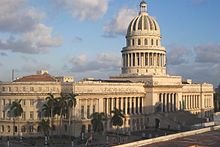
1. I chose to focus on Cuba's current government for my Comparative Government Digital Project. Cuba's current socialist government has existed since 1959. (THREAD)
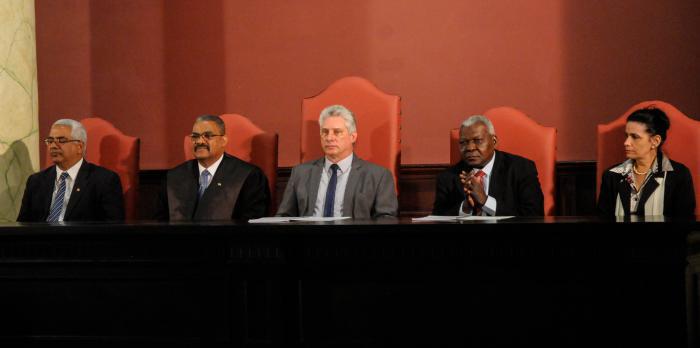
2. The current leader, Miguel Diaz-Canel, was elected by the National Assembly in 2018 in a secret vote. As the president, Canel is also the leader of the Council of State and the Council of Ministers. This position is not most supreme, however. Above the president is the...
1. I chose to focus on Cuba's current government for my Comparative Government Digital Project. Cuba's current socialist government has existed since 1959. (THREAD)
3. Cuba does have a constitution; they have governed under a constitution since 1976, though they have gone through several over the decades. A new Constitution was ratified earlier this year. The new constitution divides the powers of the President and turns focus away...
4. Cuba does have a judicial branch that is independent from the executive branch, as its members are chosen by the National Assembly. But it is worth noting that the branch is still, nonetheless, headed by the country's president, Miguel Diaz-Canel.
5. Cuba is a secular country with no official religion. Up until the last several decades, people in government could not be affiliated with any religion. Since discarding this rule, the country has eased up on restrictions on religious institutions and even banned persecution...
6. Freedom of expression is not a protected right in Cuba; all press is monitored by the government and those who express views against the state's values can be subject to institutionalized harassment, imprisonment, and even violence. A former Cuban physician Oscar Elias...
7. Civil dissent is not protected or tolerated in Cuba. Civil dissidents can be subject to institutionalized arrest, imprisonment, harassment, and violence. Only the opinions favoring the actions of the government are published.
8. Cuban citizens do not have the true freedom of speech, as they are only free to express opinions favorable to the government. Citizens can now openly practice their religion, however, and the Cuban government has banned religious persecution.
9. Cuban citizens do not have a guaranteed right to privacy, and the government determines all news, advertisements, books, and media the citizens are exposed to. But because internet access is primarily limited to Communist Party leaders, there isn't much need for online...
10. All Cuban citizens can travel freely out of the country as of 2013, without check from Cuban officials. Before 2013, it was much harder for a citizen to leave the country; they had to have government permission before leaving and could be subject to imprisonment if they...
11. Cuba is a one-party system, the Communist Party being the nation's official party. People who express viewpoints that don't align to the Communist Party can be subject to arrest, imprisonment, harassment, and violence. Further, all news and media is vetted by the...
12. Since the end of the Cold War, Cuba has recognized international boundaries and norms, but continues to be actively opposed to the institution of neoliberalism in third world countries. The country is a close ally to Venezuela, Brazil, and Argentina.
13. By values alone, Cuba differs greatly from the U.S. While the U.S. promotes the institution of capitalism, Cuba promotes a socialist government and economy. While the freedom of speech is a defining value to the US, the Cuban government actively controls and fights...
14. Though the future is unknown, little of Cuba's politics have changed over the passing decades. The socialist state of Cuba that established itself in 1959 stays standing.
6. Freedom of expression is not a protected right in Cuba; all press is monitored by the government and those who express views against the state's values can be subject to institutionalized harassment, imprisonment, and even violence. A former Cuban physician Oscar Elias...
...Biscet, for example, had his medical licence revoked and was imprisoned for his non-violent protest against Castro. There are certain rights guaranteed to Cuban citizens, however. Cubans are now protected from religious persecution, for example, and all have the right to...
5. Cuba is a secular country with no official religion. Up until the last several decades, people in government could not be affiliated with any religion. Since discarding this rule, the country has eased up on restrictions on religious institutions and even banned persecution...
4. Cuba does have a judicial branch that is independent from the executive branch, as its members are chosen by the National Assembly. But it is worth noting that the branch is still, nonetheless, headed by the country's president, Miguel Diaz-Canel.