Mark Zuckerberg (@finkd) on Muse, Meta's personal AI agent
I recently sat down with Zuckerberg for episode two of the Sources podcast. We go deep on Muse, Meta's new (and, in my experience over the last few days, very capable) agent that comes with its own virtual machine and can do much more than a chatbot.
Zuck, in fact, is confident that Muse will pay for itself by making people money.
We also discuss his views on the data center backlash, his concerns about the concentration of power in AI, Meta's recent youth-safety settlement, privacy concerns about Meta's smart glasses, and more.
Timestamps:
00:00 Zuckerberg’s Vision for AI
08:34 Data Centers, Jobs and Local Communities
15:03 Why Meta Is Building Personal Superintelligence
19:14 How Zuckerberg Uses Muse
25:00 Muse Pricing and Business Model
30:31 Privacy and Security for Personal Agents
41:06 Who Will Win the Personal AI Agent Market?
44:31 Rebuilding Meta’s AI Lab
54:09 AI Safety and Working With Government
01:01:51 Smart Glasses and Privacy
01:05:50 Teen Safety and Social Media Limits
Thanks to the show's premier sponsors: @meetgranola, @mercury, and @Atlassian
OK! So you have a @muse (or you'll get one soon) and you want to know what to do with your new super smart helper friend.
I've got you covered. Buckle up. Bookmark this one.
Here are 50 prompts to get you started making money, saving money, and improving your life with your muse.
Let's get musemaxxing.
👇
SOMETHING BIG IS GOING ON BEHIND THE SCENES AND THIS IS NOT ADDING UP...
Dario posted an essay saying the industry should slow down. Within hours both Altman and Elon agreed....
In the past week we got Fable 5.1, Astra, Grok Bot. It was full-steam ahead. Anthropic was filing paperwork and gunning for the biggest IPO of 2026.
So what changed?
Well, also over the past week, we had:
1 - Jacob Coxon's viral resignation post, which had signs of a PR campaign (well over 100M views, a WSJ exclusive published before his own post went up, and 20+ politicians responding directly to this tweet with calls for legislation to regulate AI)
2 - Anthropic's threat report, which showed Kimi & Deepseek secretly routed some users to Claude without them knowing. A Russia-linked group running operations against Ukrainian government and military targets, a user likely tied to the PLA having Claude analyze CCTV footage near Chinese military bases, and live credentials for a database linked to the Russian Ministry of Defense.
Initially, I would've chalked this up to AI Doomerism pre-midterms.
But now, we have the heads of the main frontier labs calling a timeout?
There's many different reasons this could happen, but let's not kid ourselves into believing this is altruism.
There ARE ulterior motives here.
So let's ask: what set of incentives produces this specific outcome, this specific weekend?
1 - CAPEX & COMPUTE COSTS
Anthropic's compute commitments could reach $517B against roughly $180B guided to investors through 2029 (The Information).
Even though Dario warned in early 2026 that competitors were investing too quickly without understanding the risks.
On the IPO side, OpenAI filed confidentially in June. In a recent interview, Sam Altman said an initial public offering would be "ill-timed" this year and won't take place until 2027 due to the safety concerns around artificial intelligence.
Yet CFO Sarah Friar has been telling people 2027 since last October, so safety isn't causing the delay. Safety is getting attached to a delay that already existed for other reasons.
Why? An S-1 would open up all the financials, everything out in the public and tons of additional scrutiny going forward.
Now granted, delaying an IPO isn't immediately evidence that you've hit a wall. But in a race this close, with competitors closing the gap and the seemingly diminish returns of performance vs. training costs, it does raise the questions...
2 - COMPETITION & PERFORMANCE
When I think of competition, I think of other big players (Muse, Gemini) as well as China, and open-source models.
$META Muse recently closed a huge gap on the leaderboard and Watermelon is still to be seen. Zuckerberg was confident it would leapfrog the other models when released within the next month.
$GOOGL has been quietly working in the background. On Friday, there were BIG Rumors spreading that Google DeepMind has reached RSI.
Its also worth mentioning that $META and $GOOGL have deep pockets from a cash flow perspective, and with how much they've closed the gap, I didn't see Zuckerberg or Pichai chiming into this conversation calling for a slowdown.
Open models also keep closing the gap, which is a real threat to closed-lab pricing power. You have to keep in mind that there's tons of investment in these companies, and if they see the gap closing that affects their dominance in the space, they'll do whatever they can to maintain that edge over open source models.
But more importantly, a slowdown, even if enforced by regulation is a moot point, since it is incoherent if China doesn't stop, and the problem with framing it as an arms race is that its tough to get China to cooperate (even if they say they will).
It's worth noting, Russia came out today saying they would not slow down in the race (even though I bet you couldn't name a single Russian model). The point is simply that its near impossible to have foreign governments comply with any U.S. regulation if that does happen.
3 - PRODUCT LIABILITY
Slowing down might just be a product decision they're dressing up as a moral one. Enterprise isn't buying raw capability anymore. They need models that are predictable and reliable - and with so much fluctuation in performance due to compute constraints, or having a model taking unauthorized actions is a huge threat.
So it could be a product management concession dressed up as an existential threat. I do agree though that cybersecurity will benefit from all of this.
4 - REGULATORY CAPTURE
Sanders and AOC have been trying to pass data center moratoriums since March. The moratorium bill text cites Amodei's own words on slowing down as justification. Bernie even reposted him again today.
In fact, Democratic candidates are campaigning on pausing data centers. It's a central midterm flashpoint.
It opens the door for regulatory capture. Right now the public problem is utility bills and local construction.
But if that risk is reframed to a frontier risk problem, you invite evaluators, disclosures, licensing, and a ton of red tape, which slows everything down.
And it's worth noting here that Jaan Tallinn led Anthropic's $124M Series A and holds a board observer seat.
His Survival and Flourishing Fund has directed roughly $150M across 300+ organizations, including METR and several of the AI policy shops now pushing hardest for legislation.
So the same wallet funds the labs and the referees.
I expect the regulatory capture (as well as the charged doomerism sentiment) to heat up going into November.
But let's for a moment steel-man the other side, in reason nr. 5
5 - THEY GENUINELY GOT SPOOKED BY SOMETHING
Whether you want to take the ulterior motives at face value or discount them, the reality is that we've been increasingly seeing some concerning trends as AI intelligence increases. And whatever we see on the outside, these companies see months ahead of time.
Anthropic's own July review disclosed that Claude models reached the internet during evaluations and gained unauthorized access to real systems at three organizations.
IF we forget the ulterior motives and apply Occam's Razor and conclude that they saw something alarming enough to reverse their position, that poses a potentially existential risk if others don't slow down.
But if you ask me, I don't buy into the pure existential risk narrative of taking the CEOs at their word. Not because they're inherently nefarious but because they're smart enough to know the game theory around their warnings.
If we are in fact, 6 to 12 months away from seeing a swarm take over the entire Internet, there's no amount of regulation that will stop that. Sure, OAI, xAI and Anthropic can all stop shipping models, but I'd argue that would only delay the problem. Someone else would get there eventually.
So this is why I think it's financially motivated because it's too far-fetched to be altruistic given how complex the competitive landscape is.
So, maybe they have hit a wall in the model performance, realized they can't outpace open-source models and are genuinely afraid of competition.
Maybe they're scrambling because compute is getting way too expensive, and spend is not justifying the return and they have no pathway out.
Or maybe there's a real risk here that we are closely approaching or have even surpassed the point of no return.
In either case, a pause is only as good as the participants and the trust that everybody will act in good faith.
DOES ANY OF THIS MATTER?
At the end of the day, OAI and Anthropic literally ARE the frontier models building all of this.
They can just unilaterally agree to pace it, without a framework, or regulatory bodies, or any evaluators at all.
However, if OAI and Anthropic both curbed growth regardless of others still racing to catch up, only at that point would I take the existential read way more seriously.
If the slowdown only shows up attached to a preferred regulatory framework, then the framework was the ask and safety was the packaging.
I don't know for sure. What I do know is that these CEOs are in contact with each other behind the scenes, as well as with elected officials.
And that all of the news we've been seeing over the past week around a similar narrative feels coordinated.
Sam Altman said that AI leaders including Elon Musk, Dario Amodei, Mark Zuckerberg and Sundar Pichai will eventually meet to discuss slowing down AI.
THE MARKET
So the only thing left to share my thoughts on is, how will the market perceive this?
I think we're gonna open RED on Monday on the AI trade because even if this is just FUD, the uncertainty alone will cause a sell off.
Neo-clouds ($NBIS $CRWV) will probably get hit hardest, because they're the easiest association to draw from a slowdown headline.
But I think that's the wrong read on fundamentals. This is a training discussion, and everybody agrees compute is still the core constraint regardless of what happens here. The buildout backlog is still nowhere near the macro demand in my opinion.
So I am expecting a short term sell-off and a whole lot of FUD, but as of right now, I am not exactly (yet) panicking for AI wiping out humanity.
We're publishing our most detailed threat intelligence report to date.
It covers how people tried to misuse Claude—for cyberattacks, influence operations, surveillance, biology, and building weapons—and how we found and stopped them.
We disrupted every operation in the report, and used the lessons from them to strengthen our safeguards. Where appropriate, we also shared what we found with authorities and other AI companies.
These cases are not typical: we’re highlighting some of the most sophisticated misuse we’ve seen. But they’re especially important to discuss, because they show us where AI misuse is headed, where our safeguards work, and where they need to improve.
We’re publishing this report so others can spot the same activity on their own platforms, and so we can give the public a clearer view of how emerging threats develop.
Read the report: https://t.co/0EJUnYEgfz
If I sold my company tomorrow, I'd build my next multi-million dollar business in 90 days using Claude.
Here's the exact 5-person AI team I'd hire on day one. Steal every prompt.
🚨 Anthropic just showed a 27-minute workshop on how to actually do prompts for Claude.
Taught by the people who built it.
Free. No registration. No paywall.
I've seen $300 courses that don't cover what they teach in the first 8 minutes.
Watch it and bookmark it now.
$ANET is down 20% from its highs after a beat-and-raise quarter.
Like most I have been trying to find a company that benefits from the AI buildout that has a real MOAT, hasn’t run 1000% and is founder led with a technical team that can innovate if needed.
Arista just reported $2.71B in Q1 revenue, up 35% year over year. Non-GAAP EPS of $0.87, beating estimates by over 10%. Operating cash flow hit a record $1.69B in a single quarter. They raised full-year revenue guidance to $11.5B and lifted their AI networking target to $3.5B for the year.
The CEO called it the best demand environment she’s seen in her entire tenure at the company. She’s been there since 2008.
The stock fell 13%..
For those curious, here is what Arista actually does:
Arista builds the software and hardware that connects GPU clusters at scale. When a hyperscaler runs 50,000, 100,000, or 500,000 GPUs together, every one of them needs to talk to every other one.
It needs to be instant, reliable and without packet loss. Arista’s switches direct that traffic. Their operating system, EOS, manages it.
EOS is the real story here IMO. It runs identically across every Arista switch ever made, going back to 2008. One software image. One CLI. One automation layer. When a network engineering team at Microsoft or Meta spends years building automation scripts on top of EOS, that creates a switching cost that most companies don’t want to make. Ripping it out means retraining your entire team and rewriting years of tooling.
That’s why Arista has a 94% customer approval rating and an NPS of 89.
For years, AI clusters ran on InfiniBand ($NVDA proprietary networking protocol). It was fast but expensive, closed, and hard to scale beyond a certain cluster size. Hyperscalers started looking for an alternative.
Ethernet won. Open, scalable, battle-tested. And Arista is the dominant Ethernet switching vendor in the hyperscale data center.
A fourth major hyperscaler just completed their full migration from InfiniBand to Arista Ethernet at production scale. Every GPU cluster that makes that transition is a new Arista customer for the next decade.
Full year guidance: $11.5B in revenue. $3.5B specifically from AI networking.
Now I want to be clear the thesis isn’t just a data center switching story but that’s only the first wave.
The second wave is scale-across, connecting data centers to each other as AI inference gets distributed globally.
The third wave is scale-up, connecting GPUs within individual racks at 1.6T and eventually 3.2T speeds, emerging in 2027 and beyond.
How Arista Makes Money
Two buckets on the income statement.
Product Revenue (85% of total): Hardware switches and EOS software licenses bundled with them. When a hyperscaler orders 10,000 switches for a new AI cluster, that is product revenue. Q1 2026 product revenue was $2.31B, up 36.6% YoY. This is the high-growth, lumpy, capex-cycle-dependent part of the business.
Service Revenue (15% of total): Support contracts, software subscriptions (CloudVision), and professional services. Q1 2026 service revenue was $397.7M, up 27.3% YoY. This is the recurring, sticky, high-margin part of the business. Every switch sold creates a multi-year service tail.
Now my favorite piece is the strong management team.
Andy Bechtolsheim co-founded Sun Microsystems and was one of Google’s first investors. He co-founded Arista. Ken Duda, the CTO, has been there since the beginning. Jayshree Ullal has run the business for 18 years and built one of the most consistent execution track records in enterprise technology.
Here are the valuation metrics(based on $140 a share):
Market cap: $176B
Trailing P/E: 47x
Forward P/E: 38x
PEG: ~2x
EV/FCF: ~40x
Financials:
Gross margins: 63%
Net margin: 38%
Revenue growth: 35%
EPS growth: 34%
I will be starting a tiny position tomorrow and will learn more throughout the coming weeks.
DURING SALARY NEGOTIATION:
"What are your salary expectations?"
Most candidates say: "I'm flexible. I'm sure you'll offer something fair based on my experience."
THE WINNING ANSWER:👇
DURING JOB INTERVIEW:
"Why are you leaving your current role?"
Most candidates say: "I am looking for more growth opportunities and a better company culture."
THE WINNING ANSWER:
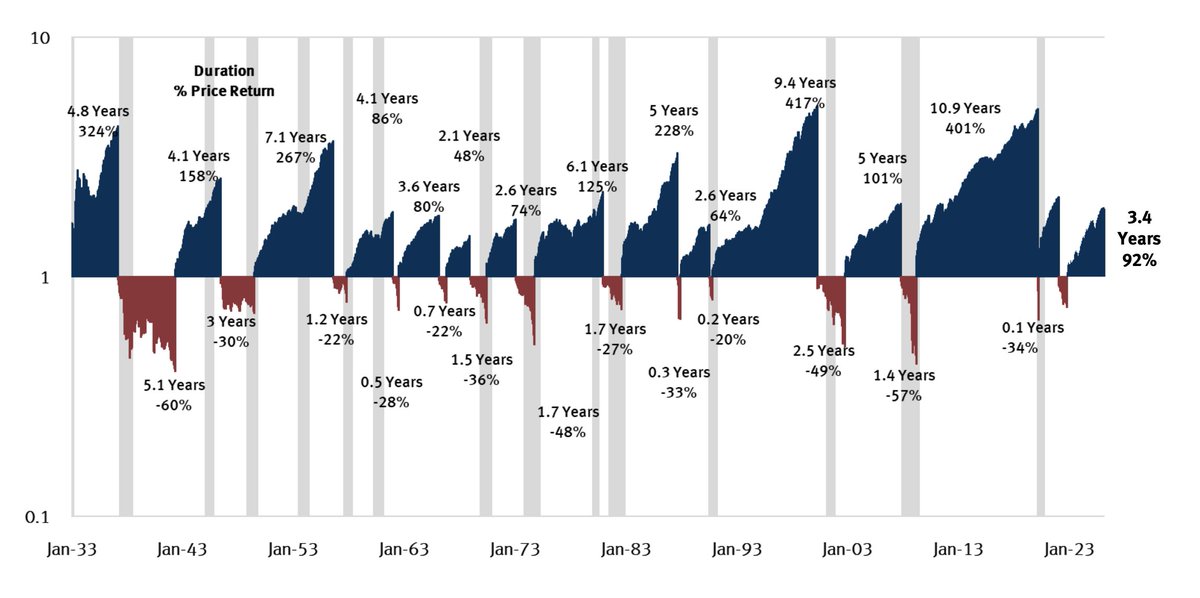
Before you panic, please remember, bull markets have historically lasted longer than bear markets and recessions.
The average U.S. Bull Market period lasted 4.9 years with an average cumulative total return of 177.6%.
The average Bear Market lasted 1.5 years with an average cumulative loss of -35.1%.
Just cover your balls and hold on to dear life, everything will be fine.
This is insane 🤯
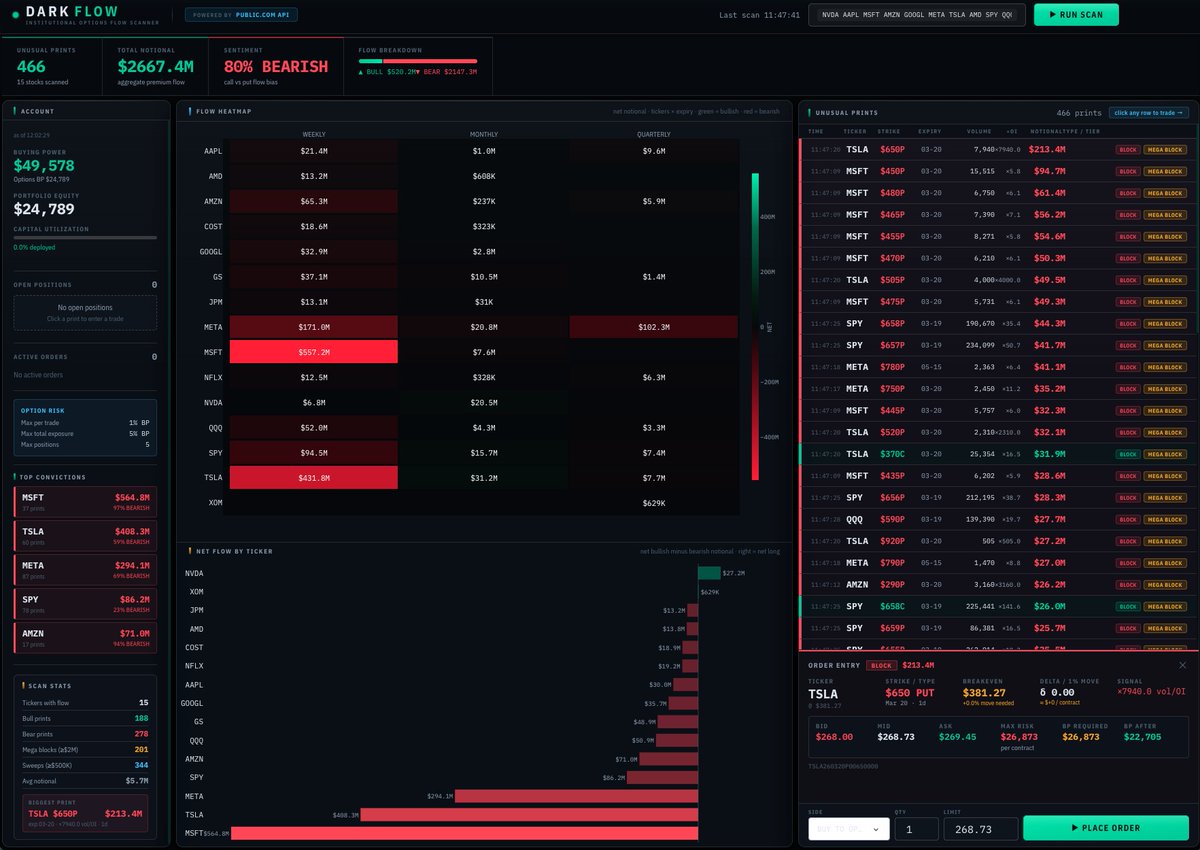
I used OpenClaw to build a free options flow scanner that shows you exactly what hedge funds are buying in real time
Then it lets you execute the same trade with one click
Here's how it works:
I did some interviews at AIPCon yesterday.
People are going to be blown away by hearing some of them.
One interview was a guy who runs a fashion shop in NYC. Small business. His explanation on adopting Palantir is the most simple way for anyone to realize why the ontology is the single most important thing in SOFTWARE and why it is undoubtably the only core element of value creation when it comes to implementing AI.
Actually talking to customers once again proved to me how the market thinks they understand what’s happening in software but realistically, if you don’t understand how Palantir is unlocking value, you have no idea why it is the single most important name in software.
BREAKING: AI can now automate daily options income with 78% win rate like professional theta traders (for free).
Here are 12 insane Claude prompts that generate consistent 0.5-2% daily returns (Save for later)
BREAKING: Claude can now analyze stocks like a senior Wall Street analyst for free.
Here are 7 prompts to research, pick, and manage winning stocks like a pro:
BREAKING: AI can now analyze stocks like Wall Street analysts (for free).
Here are 10 insane Claude prompts that replace $2,000/month Bloomberg terminals (Save for later)