@FBASellerGuy Great info, thanks!
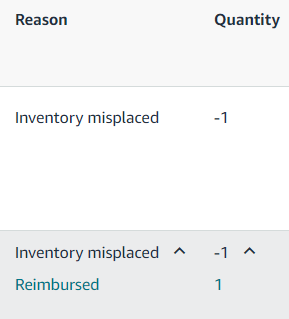
I’ve noticed that every FNSKU that has a dropdown arrow in the Reason column, has already been either Found or Reimbursed.
I focused on the ones without a dropdown arrow and got reimbursed for all of them.
@SaulSellsStuff Exactly! A2A + OA combo has many advantages: Grab more stock. Discover a new site.
And – if gated and you can’t buy 50 pieces from Amazon – OA can be used for ungating.
1. If I repeated every action I took today, every day for a year, where would I end up?
2. Is this the place I want to be?
If you're confident in your current path, this prompt will help you be more patient.
But if you're on the wrong path, it will help you course correct.
Prompt 5: The Compounding Projection
It's cliché, but all successful outcomes come from compounding.
Our success (or failure) is a result of tiny, daily actions compounded over time.
But in the moment, it can be hard to gauge your progress.
So ask yourself these 2 questions:
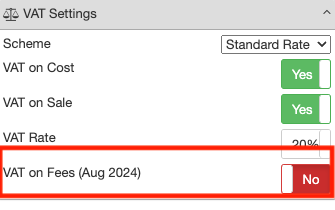
New feature on @SellerAmp showing toggle for "VAT on fees".
If you are VAT registered, AND if you're NOT VAT registered, you will want to toggle this to "Yes" when sourcing from TODAY.
Leaving this as "NO" when you're NOT VAT reg will lose you a lot of money!
Your August profit and ROI% will be very disappointing,
if you are a UK non-VAT registered seller
and you are still sourcing without having changed your SAS VAT settings.
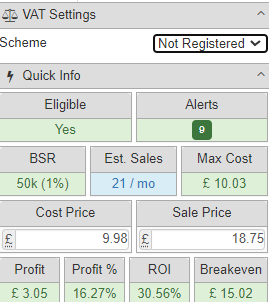
But as per August, the non-VAT registered seller will have to select in Selleramp SAS the ‘Not Registered’ VAT scheme and VAT will be calculated on all Amazon fees.
£3.05 profit and 30.5% ROI
Something OA and wholesale guys don't talk about is $1000 compounded at 12.5%(extremely extremely extremely extremely conservative) quarterly, in 10 years is over $110,000. Playing the long game > everything else
The same money invested in the stock market would be MAYBE $2500.
My family thinks I'm crazy, I think they're crazier. When you start thinking about OA/wholesale as an investment vehicle it starts looking a lot better.
Where else can you turn $40,000 ----> $10,000,000 while paying for living expenses in 10 years?
@dickiebush A perfect head fake: Learn Dutch (as you are in Amsterdam) and live like a local.
This will strengthen your concentration, communication skills and creativity.
DR. ANDREW HUBERMAN: HOW TO IMPROVE MOTIVATION & FOCUS BY LEVERAGING DOPAMINE
Our brand new episode with @hubermanlab
• Why dopamine peaks without effort are dangerous
• Why focus and motivation circuits are just like exercise
• How to overcome procrastination
• Practical tips for boosting motivation
• Why Andrew limits 80-85% of workouts to 80-85% intensity
• Why Andrew cautions against frequent “dopamine stacking” with stimulants and nicotine
• Combatting extended laptop and phone use with long distance viewing
• Why Andrew recommends limiting alcohol consumption to 0 to 2 drinks per week
• Whether or not smartphones and social media are increasing the prevalence of ADHD
• Andrew’s supplement routine and weekly workout regimen
And so much more
Link in the next tweet
New episode featuring Stanford professor, neurobiologist, and host of the incredibly popular Huberman Lab Podcast, Dr. Andrew Huberman (@hubermanlab).
What makes Andrew truly exceptional is his ability to translate scientific findings into practical, actionable advice, enabling listeners to leverage new understandings of biology and neurobiology to improve their lives.
In this episode, Dr. Huberman showcases his truly immense knowledge of the brain's dopamine system, which is incredibly central to many modern issues of motivation and attention that many of us struggle with.
The public perception of Dr. Huberman's work often focuses on his unique distillations of protocols, but what I particularly enjoyed about this conversation was finding a common thread: the benefit of having an essential life philosophy of valuing "hard effort" over outcomes, something Andrew refers to as "forward center of mass."
This podcast explains down to a neurobiological level why embracing discomfort can activate our motivation circuits, elevate dopamine and other catecholamine levels, and retrain brain regions like the anterior midcingulate cortex, ultimately growing our capacity for effort and striving at a fundamental level.
A big thank you to Andrew for equipping us with this knowledge, enabling us to apply these insights for individual personal and professional growth.
This episode is available on X, YouTube, Spotify, and everywhere else. Links in comment.
Timestamps:
0:00 - Introduction
2:37 - The neuromodulatory role of dopamine
4:29 - Driver of motivation vs. experiencing reward
9:35 - Why dopamine dynamics act as a "wave pool"
13:15 - Why dopamine neurons need a recovery period
18:32 - Why dopamine peaks without effort are dangerous
21:52 - The number one sign of a highly motivated individual
23:59 - Dopamine reward-prediction error
26:18 - How effort and anticipation influence dopamine release
28:21 - Does lacking motivation reflect dopamine system deficits?
33:00 - Why motivation has a 'warm-up' period
37:16 - Why to attach reward to effort itself
47:51 - Tips for fostering tenacity in children
50:05 - Visualization of negative outcomes (why to do it)
52:51 - How to overcome procrastination
58:51 - How exercise affects the dopamine system
1:03:35 - Cold exposure vs. drug highs
1:05:29 - The entrainment effect of same-time exercise
1:09:24 - Why you shouldn't rely on stimulants
1:16:52 - "Counting walls" during deliberate cold exposure
1:21:44 - Cold exposure parameters for increasing dopamine
1:24:18 - Cold plunge alternatives for replenishing dopamine
1:25:35 - Why Andrew limits most workouts to 80-85% intensity
1:28:37 - Using exercise & cold exposure as stimuli for the brain
1:31:08 - Why "hard efforts" retrain the brain to overcome
1:33:31 - tMS and ultrasound as neuromodulatory therapies
1:36:22 - What does Dr. Huberman think of @neuralink?
1:38:02 - Advantages of neuromodulation over pharmacotherapy
1:39:28 - Why non-sleep deep rest may replenish dopamine
1:49:45 - My experience trying NSDR after poor sleep
1:51:04 - The ‘body still, mind active’ state for creativity
1:54:15 - How to cultivate a healthy relationship with social media
2:00:44 - The unique psychosocial dynamics of X (formerly Twitter)
2:02:05 - Andrew's recommended daily use limit for Instagram
2:04:09 - Does @lexfridman have a symbiotic relationship with X?
2:04:39 - Is screen time increasing the prevalence of ADHD?
2:06:20 - Why Andrew recommends setting social media constraints
2:09:32 - Is social media increasing divorce rates?
2:12:12 - How low solar angle sunlight affects the circadian rhythm
2:22:10 - Limiting the adverse effects of late-night artificial light
2:23:57 - The light bulb that mimics sunrise and sunset
2:25:09 - How to spike morning cortisol by 50% (and why that's good)
2:26:21 - What's the optimal time to view morning sunlight?
2:27:11 - Can light panels replace morning sunlight?
2:28:33 - Combatting laptop & phone use with long distance viewing
2:30:00 - Why two hours outdoors daily may prevent myopia
2:35:06 - Why Andrew recommends limiting alcohol to 0-2 drinks per week
2:43:09 - How alcohol affects the dopamine and serotonin systems
2:48:47 - Treating ADHD with drugs, supplements, & behaviors
2:53:30 - Why studies on school start age suggest ADHD is overdiagnosed
3:00:00 - Andrew's weekly workout routine
3:13:14 - Why a disciplined life is not a deprived life
3:05:43 - Andrew's diet & why his dinners are higher in carbs
3:06:39 - The science of the physiological sigh3:07:34 - Andrew's supplement routine
3:10:00 - Andrew's experimentation with peptides
3:15:10 - How Andrew processes sometimes negative feedback
3:20:30 - The volatility of interacting with internet crowds