Yeah no, that's not quite how that works. You do need the expertise to critically judge what the AI does in a given area. You wouldn't trust a calculator if you didn't know how to do a ballpark estimate. In the sciences, even such an estimate becomes a matter of study and expertise. Also, what would you even point the AI at? True: anyone can point the AI at whatever they wish. But does that act of pointing the AI somewhere constitute math, chemistry or physics? You wouldn't know without expertise.
Arguably, given how much attention this has drawn, I think any fatal flaw would have been exposed in the first 48h with overwhelming likelihood. Therefore, I'd call it proven and the burden of proof is now on those who claim it's wrong. Proof doesn't mean "definitely true", it means "true beyond reasonable doubt". Doubt can be unreasonable, yet correct.
The Riemann result has exposed that people have different notions of “proof”.
While we can all agree that a lean certificate with sufficient paranoia regarding lean itself establishes the truth of the Riemann hypothesis beyond reasonable doubt, and we can all agree that no human has understood the result yet and that a lot of value will come out of compression.
But now, a religious war has started over the semantics of the word “proof”.
Can’t make this shit up.
You sure *you* understand eg degenerate geometry or hecke ideal and not just your AI? Because when you ask AI for an explanation, your understanding afterwards tends to be at the level of “a light switch turns the light on when you press it”. No electrician would consider this serious understanding.
I have majored in math. https://t.co/CoKNIhwGsi. And I must say that for most of the terms flying around atm, I have at best a passing familiarity with them.
@AblemanAdam I think they should be doing the work, but maybe with different rhetoric. Bug hunting ought to be done in the sources of the kernel. This stuff is slop hunting. Also, what I find sus is that none of the claims is followed up, instead they seem to pivot to the next “problem”.
@AblemanAdam There are legitimate reasons to publish this finding *other than* thinking that this somehow invalidates the proof. For example "hey, here's a clear compression opportunity", "hey, this is slop" and so on. None of it is suggestive of a bug.
That's what I did after reading the screenshot, as the sentence "An AI assisted look into the repo does show us some interesting stuff, but still nothing incorrect." indicates. Still no bug indication to me. Just mismatches between the suggested interpretation of intermediate results and their actual mathematical content. So what?
All that lean really has to do is to check a bunch of relatively simple inference rules over and over and over again. That ain't that hard, and if those inference rules work fine, then they compose all the way up to the most complex theorems.
If there's a bug, it should be simple to demonstrate.
All that I see here is that Claude has completely misinterpreted some intermediate results, which is also quite normal before you go and polish things. Misinterpretation isn't the same as falsity.
The screenshot reads like typical AI psychosis tbh.
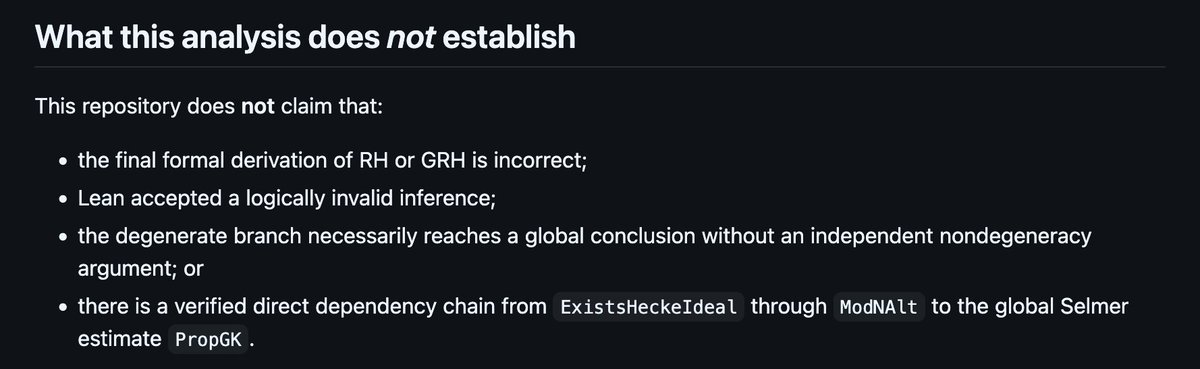
An AI assisted look into the repo does show us some interesting stuff, but still nothing incorrect.
For example, we have some extravagant expressions that can basically be collapsed to 1 or something. AI slop doesn't beat the AI slop allegations.
But man, have you seen unpolished manuscripts from mathematicians before publication?... What we can accuse Alpöge of is that he didn't compress his argument and didn't simplify complicated expressions, even made them sound like they carry far more weight than they actually do.
But that's basically where we are now. We don't get polished publications, we get feverish ramblings in a diary that was shoved through formal verification and survived expert scrutiny on the verification machinery itself.
Cool that they call it rf_proof_redteam :D
This isn't a hedge, it's an open admission that this is a nothing burger. If the repo had evidence, it would make precisely the claim it says it isn't making.
My simple question is: On what basis do people expect to find a bug here? I can see no basis. So far, they have demonstrated poor code quality of the Riemann proof. A genuine finding, sure. But the idea that this is a lead for a bug without any other indication of a bug - that's an over-claim to me. That's like your annoying colleague wasting hours showing you harmless data your program happens to write because you were a bit careless when the intended audit trail that was agreed on during specification is perfectly intact.
@AblemanAdam In the Kumar case, there was a reproducible clearly recognizable demonstration of a bug. In the RH case, we have paranoia over a true statement that any mathematician would recognize as true, even if it is vacuous.
If you can provide actual evidence for a bug, like, a reproducible minimal case where the kernel certifies something that can be seen by humans to be wrong, then you'll be taken seriously. This hasn't happened in this instance, but people pretend it has happened. Doesn't mean we can rule out a bug, but none has been demonstrated. To me, that's a pretty decisive signal for the time being.
I'm not sure what people expect from a mathematical "proof". You should never rule out that your beliefs might be wrong, even if the belief is something like "there's infinitely many primes". As far as I'm concerned, enough time has passed that any critical flaws would have already been found by humans + AI.
Sure, it can still be wrong. It can still be wrong in 2 years after experts compressed the proof enough that every aspect is understood and certified by at least one expert. Even ancient proofs of truths that we consider trivial can still be subtly wrong. Doesn't mean that right now, we have any serious reason to doubt the result.
@AblemanAdam This is straight from the README btw. Even they don't make such an outlandish claim that some parts of Twitter is somehow making. People ask to scrutinize the Riemann proof - fine! But who scrutinizes the scrutinizers?
@AblemanAdam I'm aware of this precedent - and it was quickly found and addressed. The current instance though isn't being taken seriously by the community. That's because the vacuous truth story does not demonstrate a bug.
@AblemanAdam Vacuous truth is truth, so I don't see a bug here. That's exactly how math works. All elements of the empty set are married bachelors. True story.
@AblemanAdam Such a bug hasn't been demonstrated, and it should be easy enough to figure out how this vacuously true statement was subsequently used using sophisticated tools like grep.
If they then went ahead and used the feature, that might indicate a bug. Unless there's yet another construction in there that looks the same but isn't. Or maybe they did something awkward like "A and vacuous truth, therefore A". That'd mean they technically "used" it, but not really.
Yeah, except this can't happen here unless there's literally a kernel bug or the mathlib statement of Riemann that people had their eyes on for years is somehow wrong. If anything, what this shows is that there's dead code. If we map this to a feature with an empty and therefore passing test, all this means is that this feature was irrelevant to the proof to begin with and is just redundant.
Just to be clear: I’ve seen this particular claim on day 0 - before the lean committee gave thumbs up. If this was serious cause for concern, we’d hear a lot more about this one by now. What is this distinction between vacuous truth and “substantive truth” even supposed to mean here?
@AblemanAdam And? This basically just means that it proves Riemann & True. So, dead unnecessary code. That doesn't invalidate a thing. It's just noise that doesn't need to be there.