Iran's decision to suspend talks and threaten full closure of the Strait of Hormuz in direct response to ongoing Israeli aggression against Lebanon is a major turning point in this war, and one of the clearest indications that the US-Israeli attempt to impose a surrender framework on Lebanon has collided with a regional logic it seems incapable of understanding. Its substance is the criminalisation of sovereignty, whereby Israel seeks to continue advancing its invasion in southern Lebanon and entrenching its occupation, while Beirut is taken hostage to prevent Hizbullah from mounting any defensive response to that occupation.
That the Lebanese government has attempted to convince Hizbullah of the reasonableness of this new equation, and insisted on proceeding with talks with Israel tomorrow, even as Iran suspends its own negotiations in rejection of this same equation, captures the depth of the divergence. The difference is not merely over values or political principles, but over the very meaning of rationality under the simultaneous conditions of imperial and colonial force. One side has internalised US-Israeli power as the permanent horizon of political reality, while the other treats that same power as contingent and contestable.
Iran's refusal is therefore not merely the product of religious solidarity, ideological affinity, or shared strategic culture with Hizbullah, but is better understood as a rejection of the defeatist rationality that presents imperial power as the invisible limit of the possible, the zero point beyond which politics cannot go. What Iran and Hizbullah share is a political ontology grounded in the refusal of this defeatism, and a conception of sovereignty not as formal recognition conferred by power, but as the substantive capacity to reject subordination, even when the cost is very high.
Excellent analysis @jinkydoo@bulatlat: #ASEAN speaks the language of multipolar cooperation while remaining deeply tethered to dollarized financial circuits, externally driven capital flows, & security arrangements calibrated to U.S. strategic interests. https://t.co/keSftdffXL
On the Evidentiary Standards in Human Rights Activists’ @HRANA_English Iran January Protest and Fatality Reports
With all due respect, as a researcher, when reading HRA reports, I see that they list the names of 4,162 identified people killed, yet claim the following:
“According to aggregated data from HRANA, during these protests, the number of confirmed fatalities reached 6,724 protesters, including 236 children. In addition to these confirmed figures, 11,744 cases remain under review, with the verification process still ongoing. Furthermore, at least 25,877 individuals sustained severe injuries, and the total number of arrests has been reported at 53,777.”
Where does this leave us?
So far, what we know is that the IR has reported 3,117 confirmed deaths, and they have not claimed this is a complete list. HRA, meanwhile, has documented 4,162 named fatalities but advances substantially higher figures (by the order of many thousands) without providing corresponding evidence.
The claimed 6,724 to 11,744 cases are presented without any clear evidentiary basis. Why make claims at this scale when only 4,162 cases have been substantiated?
I have written this before, and it bears repeating: if we question incentives for under-reporting by the Islamic Republic, intellectual consistency requires us to also question the incentives for over-reporting, as well as the evidentiary standards of US-based and external groups with CIA-linked funding, whose higher figures neatly align with their political narratives and interests.
Furthermore, the reports fail to accurately capture the context of armed protestors. This is critical. In any country, where there is organised armed violence, force will be used, and innocent people may be killed, but not solely by one side’s fire. Why, then, are these reports so one-sided?
I have been a scholar of Hizbullah for over three decades, and throughout that time I have been repeatedly asked when, whether, or how, it will disarm. Yet in the context of Israel's daily terrorism in the south and the Bekaa, and beyond, the question today has become even more absurd, because those who pose it somehow still fail to grasp that they aren't simply asking about an organisation, but about whether an entire people — the people of the south, the Bekaa, and Dahyeh, Lebanon’s Shia community, and a constitutive part of the Lebanese state — should willingly surrender the only means through which they have resisted their own genocide. And the answer to that is something that rings even more true today than it has in the past--there will be no disarmament of Hizbullah's Resistance, with a capital R, or of any other popular resistance that may emerge with a lower case r, so long as the genocidal Israeli entity exists.
What imperialism cultivated as de-Iranization and de-Islamization became its digital undoing—an infrastructure of resistance built with its own tools.
The “imperial boomerang” concept has often described the return of colonial methods of repression to the imperial core. But here the boomerang takes another form. Imperial efforts to Westernize the minds of resisting nations involved massive investments, but they failed to secure vital interests at the decisive moment. Instead, it equipped a generation in Iran with the cultural and technical capacities to counter the empire on its own terrain.
An analysis from @Organoponico1: https://t.co/ixxLfE391l
*Update on the Collaborator File*
According to local sources, PIJ’s Saraya al-Quds has, just today, foiled an assassination attempt undertaken by members of one of the collaborator-militias that targeted a commander from the resistance group. Saraya al-Quds fighters subsequently apprehended two of the collaborator-militia members and handed them over to the relevant authorities.
Arabic translation of Reminiscences of the Anti-Japanese Guerillas, a collection of memoirs of Korean fighters against Japanese occupation originally published by Workers' Party of Korea Publishing House. This specific translation was published by Dar Dimashq in Syria.
I wrote for @LiberatedTexts about the 2003 autobiography of Chin Peng, former head of the Communist Party of Malaya, who led anti-colonial resistance against this violent counter-insurgency war waged by the British from 1948–1960: https://t.co/NBuLokLCNU…
The resilience and strategic foresight of the Islamic Republic has intensified the contradictions within the Gulf's balance of power, and the consequences are likely to be far-reaching. We have a brilliant translation on precisely this question, to appear @al_rifaq very soon.
There is a clear divide within the GCC states regarding Iran — Entekhab
Saudi Arabia has remained in diplomatic engagement with Tehran, with 6 phone calls since the start of the war.
Oman: 5 calls & 2 meetings
Qatar: 5 calls
In contrast, there has been almost no interaction from the other side of the council:
UAE: 1 call (Vp with Qalibaf)
Kuwait: 0
Bahrain: 0
✨My first PhD paper with @jasonhickel has just been published in the journal Ecological Economics. You can access the full article here (open access): https://t.co/uYDEDh5G8l
In the 1985–86 period, small clashes broke out between al-Kutlah Islamiyyah (Islamic Bloc) and the PFLP’s Jabhah al-’Amal al-Tulabiyyah student organization. This would subside after the beginning of the First Intifada and, in the 1990s, give way to rapprochement as the PFLP joined the Hamas-spearheaded Ten Resistance Organizations’ "fasail," a coalition of resistance factions opposed to the Madrid–Oslo process. In May 2006 (following the signing of the National Reconciliation Document), the Joint Operations Room would be formed by al-Qassam and Saraya al-Quds; approximately a year later, the PFLP’s Abu Ali Mustafa Brigades and Hamas' Qassam Brigades undertook their first joint operation: the 13 July 2007 Hawwara checkpoint operation near Nablus. The two brigades issued a joint statement, the first of several. Subsequent early Hamas–PFLP joint ventures included a 23 August 2007 operation in al-‘Ayn camp, Nablus, and a 25 August 2007 operation around ‘Ayn Bayt al-Ma’ west of Nablus, cementing the unity of fields.
Reviewing the tense 1985-86 clashes, a PFLP activist was prevented (by the Islamic University of Gaza's administration, not the Islamic Bloc) from standing for the student council. During a quarrel, this student was, according to one witness account, the target of an acid attack by an Islamic Bloc-affiliated student. So too, however, was the Islamic Bloc member Zakariyyah Sinwar; PFLP-associated students launched an acid attack on him during the height of these brawls.
Throughout this charged period, the older Sinwar brother, Yahya Sinwar, worked as a bridge between the Islamic Movement and the PFLP. (He would, incidentally, also play the same role with the Fatah movement, championing unity and reconciliation amongst Palestinian parties.)
As Jeroen Gunning recounts:
"Despite their prominence in Western discourse, the number of serious incidents seems to be limited. The two (male) former PFLP activists could only recount one incident in which nitric acid was (successfully) used against a PFLP activist while Islamists always refer to [Zakariyyah] Sinwar when discussing acid. Likewise, the case of Yusra Hamdan is famous for its unicity. Moreover, and despite the fighting, close friendships existed across party lines. Thalmas was close to some of the Islamist leaders, particularly Yahya Sinwar, then senior Kutlah leader, whose family came from the same pre-1948 village as Thalmas’s. Said Thalmas, “[Sinwar is] my personal friend - til now. I have a very good relationship with him and his family.”
(See: Jeroen Gunning, “Re-thinking Western constructs of Islamism: pluralism, democracy and the theory and praxis of the Islamic movement in the Gaza Strip”, Doctoral thesis, Durham University, Durham, England, 2000, p. 274.)
Spotted a reference to our translation of Amer Mohsen's essay "Of Weapons and Words" in this excellent roundtable about imperialism & the war on Iran for
@prometheus_mag : https://t.co/4FH9KJaH6E
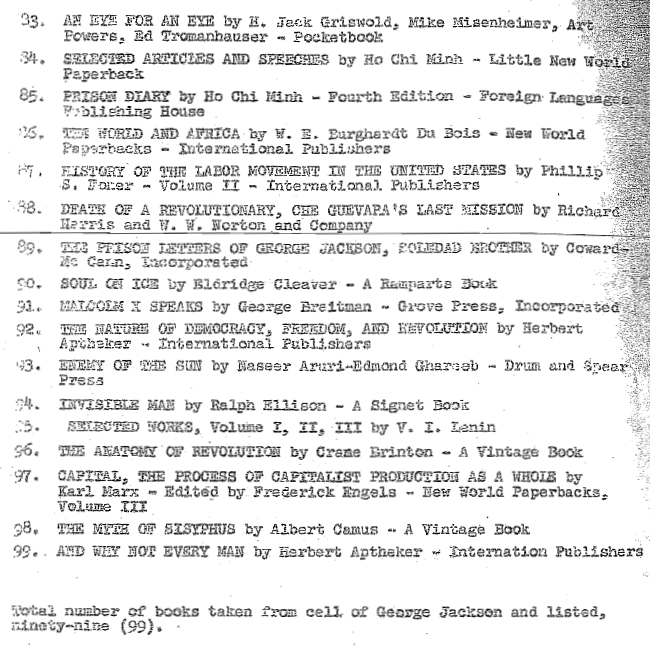
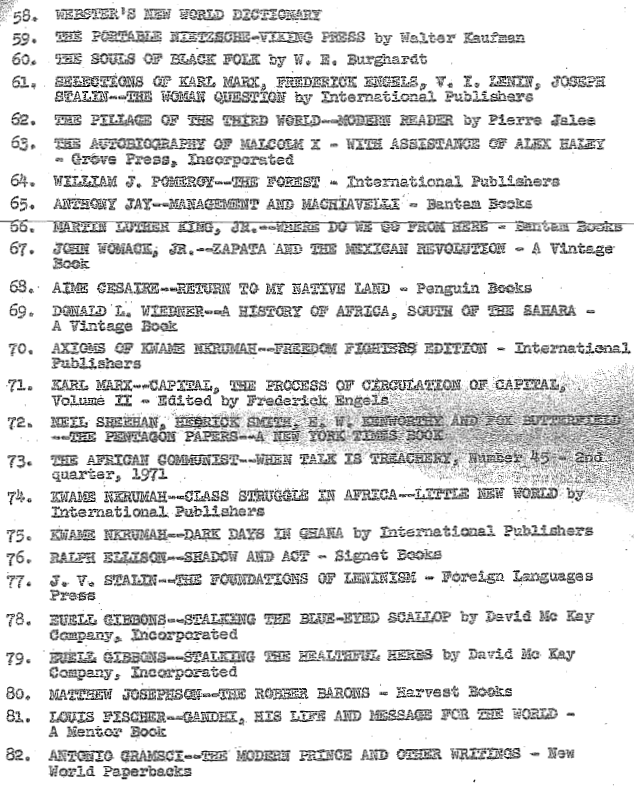
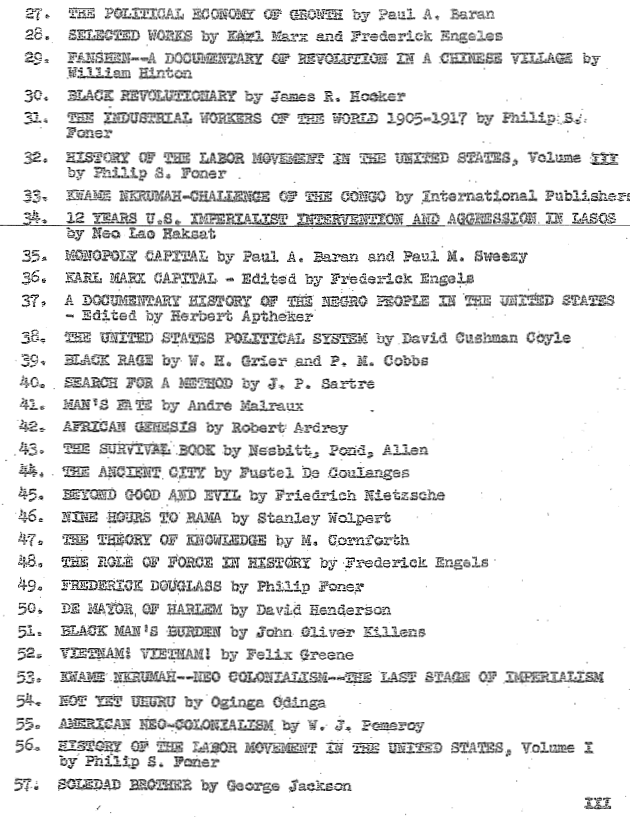
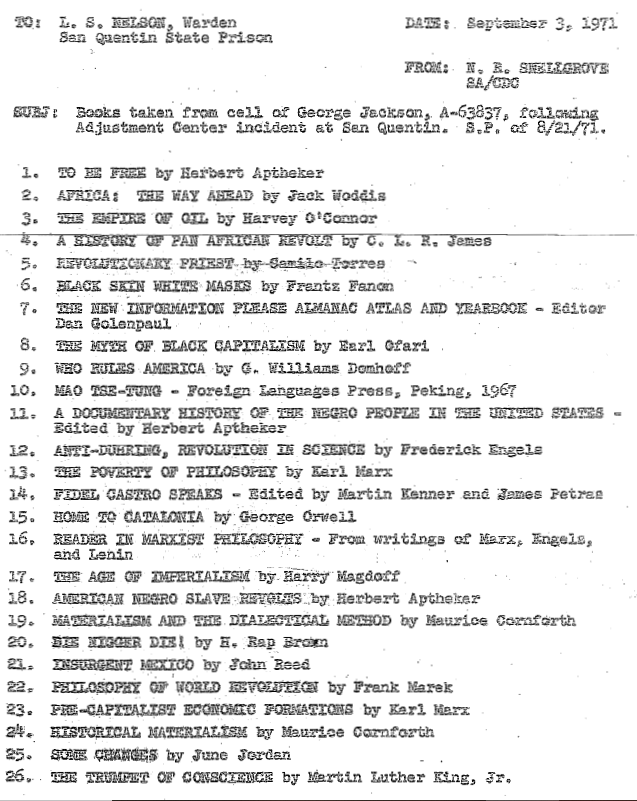
At the time of his murder in 1971 George Jackson had 99 books in his prison cell.
They included works by Marx, Engels, Fanon, Stalin, Lenin, Du Bois, Nkrumah, Ho Chi Minh, Mao, CLR James, Gramsci, Castro & Malcolm X, as well his own book, Soledad Brother.
Here's the full list:
A must read on the impossibility of export-led growth in a capitalist world order by Prabhat Patnaik: a shift to export-led growth does not per se raise the rate of growth of aggregate demand in the world economy..
https://t.co/1X8eACWQen
I wrote a bit on the recent outrage at Axios correspondent Barak Ravid, what he represents, and the impromptu division of labor in the Israeli army that leads to ex-intelligence officers being “favored” by western institutions and companies.





![MujammaHaraket's tweet photo. In the 1985–86 period, small clashes broke out between al-Kutlah Islamiyyah (Islamic Bloc) and the PFLP’s Jabhah al-’Amal al-Tulabiyyah student organization. This would subside after the beginning of the First Intifada and, in the 1990s, give way to rapprochement as the PFLP joined the Hamas-spearheaded Ten Resistance Organizations’ "fasail," a coalition of resistance factions opposed to the Madrid–Oslo process. In May 2006 (following the signing of the National Reconciliation Document), the Joint Operations Room would be formed by al-Qassam and Saraya al-Quds; approximately a year later, the PFLP’s Abu Ali Mustafa Brigades and Hamas' Qassam Brigades undertook their first joint operation: the 13 July 2007 Hawwara checkpoint operation near Nablus. The two brigades issued a joint statement, the first of several. Subsequent early Hamas–PFLP joint ventures included a 23 August 2007 operation in al-‘Ayn camp, Nablus, and a 25 August 2007 operation around ‘Ayn Bayt al-Ma’ west of Nablus, cementing the unity of fields.
Reviewing the tense 1985-86 clashes, a PFLP activist was prevented (by the Islamic University of Gaza's administration, not the Islamic Bloc) from standing for the student council. During a quarrel, this student was, according to one witness account, the target of an acid attack by an Islamic Bloc-affiliated student. So too, however, was the Islamic Bloc member Zakariyyah Sinwar; PFLP-associated students launched an acid attack on him during the height of these brawls.
Throughout this charged period, the older Sinwar brother, Yahya Sinwar, worked as a bridge between the Islamic Movement and the PFLP. (He would, incidentally, also play the same role with the Fatah movement, championing unity and reconciliation amongst Palestinian parties.)
As Jeroen Gunning recounts:
"Despite their prominence in Western discourse, the number of serious incidents seems to be limited. The two (male) former PFLP activists could only recount one incident in which nitric acid was (successfully) used against a PFLP activist while Islamists always refer to [Zakariyyah] Sinwar when discussing acid. Likewise, the case of Yusra Hamdan is famous for its unicity. Moreover, and despite the fighting, close friendships existed across party lines. Thalmas was close to some of the Islamist leaders, particularly Yahya Sinwar, then senior Kutlah leader, whose family came from the same pre-1948 village as Thalmas’s. Said Thalmas, “[Sinwar is] my personal friend - til now. I have a very good relationship with him and his family.”
(See: Jeroen Gunning, “Re-thinking Western constructs of Islamism: pluralism, democracy and the theory and praxis of the Islamic movement in the Gaza Strip”, Doctoral thesis, Durham University, Durham, England, 2000, p. 274.)](https://pbs.twimg.com/media/HIBNEt7WIAALJ_F.jpg)