@AndrewCurran_@GoldMagikarp42 Sorry to be that guy but it is permanent, not unavoidable, not saying that it won't be unavoidable, just saying that permanent has a different connotation
5/5
meanwhile, ML models attempt to predict how cells respond to genetic interventions, potentially helping us discover better combinations of transcription factors.
the final goal is learning to replicate the sequence of interventions required to turn one cell into another.
and then engineering genetic circuits into cells that:
sense their own molecular state
activate or suppress genes accordingly
adjust their activity as the cell changes
stabilize the desired identity
But also, if we eventually learn to control these processes reliably, maybe we could induce damaged heart tissue or brain tissue to regenerate.
achieving this might require much more, but possibilities like this are why the problem is so exciting.
Can we convert a bone cell into a neuron?
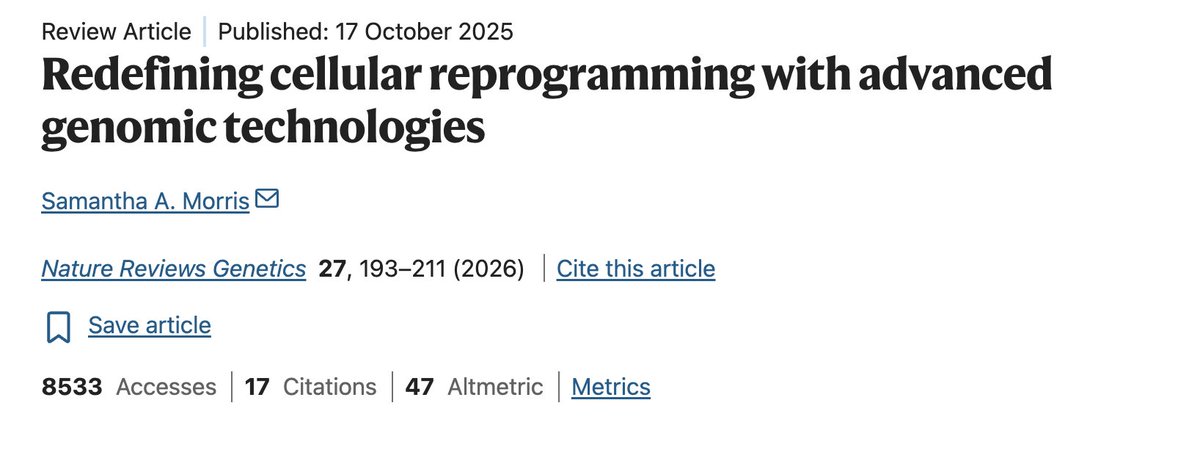
this review published in Nature explains how we can turn one type of cell into another, why this often fails, and how we might eventually learn to control the process.
here's a short summary:
4/5
we can use DNA itself as a diary.
DNA Typewriter and ENGRAM can record biological events directly into a cell's DNA.
instead of continuously observing the cell, we can later sequence its DNA to recover information about signals it experienced, and sometimes their order.
this could help us understand what actually happens along successful reprogramming trajectories.
3/5
not all cells are equally receptive to reprogramming.
some cells enter states that make them much more likely to convert successfully.
we can study these differences using single cell sequencing
but there’s a catch, sequencing typically destroys the cell we care about observing, so we can't watch the same cell change over time.
computational methods that infer possible cellular trajectories from snapshots of different cells help (e.g. Waddington-OT)
but multiple different histories can explain the same observations.
what if we could actually recover information about what a cell experienced, instead of just inferring it?
2/5
we've known since the 1950s that cellular identity isn't necessarily permanent
in 2006, Yamanaka showed that four transcription factors could turn differentiated cells back into pluripotent stem cells, capable of becoming many different cell types
we can also bypass pluripotency altogether, e.g converting , fibroblasts directly into cardiomyocyte-like cells.
but there are 3 big problems:
1. immaturity: the resulting cells don't fully function like their natural counterparts.
2. low fidelity: some cells acquire unintended identities.
3. low purity: we end up with mixtures of successfully, partially and incorrectly reprogrammed cells.
so why do some cells convert successfully while others don't?
@SyntheticBeef this is related with cost efficiency and the economic structure around a given task and not really the intelligence, so its rather a relationship of how we misprice certain tasks as intelligence becomes cheaper
I live in a student town in germany, so I constantly find this ugly second-hand aesthetic in front of me. I’ve always found it repulsive.
I tried talking with chat about why people felt so drawn to it, and it said they can see it as a way of being free from social expectations, while maybe deliberately dressing a little bit ugly—or at least that’s part of the idea.
It’s funny because I believe that while trying to escape the norm, they just became enslaved to this new norm of actively going against those rules. if anything, it just showcases whose approval you are trying to earn.
Also, there’s another point to be made, and it is that dressing actually has an externality.
You can actually make the world a prettier place by deciding, with everyone else, to dress a little bit better. Sure, on one hand it makes you more conscious of what you wear, but on the other, it really is like part of the city’s architecture and art. Why not keep it pretty?
I mean, if we are all going to pursue status in one more disguised way or another, why not at least do it beautifully?
@swhotch I built a plugin that asks me questions about the task and the outcome in order to continue thinking about the task instead of not knowing what to do. I don’t believe it’s a cure but it helps for a while
This platform is much more fucking artistic than any artsy platform made for the pretencious. if you actually stand and believe in more than the shape and the characterization of the artist, you will stay here and nowhere else.