Meaning is created in words, composed in underlying stories and narratives, and flavored with judgements.
Words, stories, and judgments can easily be deconstructed and seen to be relative to a particular time and place, culture, perspective, point of view, etc.
Gavin, spot on.
AI is bringing manufacturing back to America and reindustrializing the nation after decades of offshoring.
AI is creating demand that drives investment in our aging power grid and sustainable energy, powered by market forces, not subsidies.
AI is creating construction and manufacturing jobs across energy plants, chip fabs and data centers.
AI is creating new companies and industries. $400 billion has been invested in AI startups in the past six months alone.
Builders must partner with communities to build in their hometowns, earn trust and create local benefits.
We have an opportunity to create lasting benefits for communities across America and help America lead the next industrial revolution.
@GlobalCollapse@jiahanjimliu Exactly. Then, when the DC is completed & revenue is flowing, they'll be able to add asset-backed financing of the whole DC to pull money out of that particular project (maybe something like 70+%?) and put it to work building another.
That's serious torque on the Flywheel...
$IREN The most bullish part of today's EC was the "Funding Flywheel".
Dan said ~100% of the data center build outs can now be funded with just prepayments & GPU financing.
Plus, 100% of the portfolio is unencumbered (for future, additional asset-backed financing).
@scludweed 🙏
The flywheel has started even *before* utilizing the asset-backed financing of the DCs!
Add that on top, and they've got the flexibility and optionality to make some big (and likely surprising) moves to advance their growth.
Bullish.
Nvidia must diversify away from hyperscalers & frontier models (who build their own chips) and bolster sovereign compute via open source.
Companies can't hand over their proprietary data to be siphoned by models.
It's happening & neoclouds (like $IREN) will help them succeed.
So if the news is true, between @poolsideai and @huggingface NVIDIA just spent $20B in the past two weeks on Open Weight AI
Ironically the same amount spent on the Groq aquisition last year ($20B)
Jensen is going all in on open source 🤔
Turns out, giant AI data centers are insanely good for a city
Just look at what is happening in Memphis since SpaceXAI arrived
Memphis is quietly becoming one of the clearest examples of what happens when massive AI investment moves into a city
Since SpaceXAI came to Memphis:
• A vacant 1 million sq. ft. factory was transformed into Colossus
• Hundreds of permanent high-paying jobs are being created
• Thousands of subcontractors are working across its projects
• Tens of millions of dollars in local taxes have already been generated
• That contribution is expected to exceed $100M by next year
• NVIDIA, Dell and Supermicro expanded into the Memphis AI ecosystem
• SpaceXAI is investing $80M+ into a massive water recycling plant
• Another $55M is going into two electrical substations
• Memphis is becoming the “Digital Delta”... a serious new center for AI infrastructure
And at the same time, Memphis is getting dramatically safer
Major violent crime fell 27.6% in 2025
Then in Q1 2026, it fell another 30.5% compared with the same period a year earlier
And it’s not just the data center
SpaceXAI has cleared miles of local roads, removed thousands of pounds of debris, funded upgrades at local schools, supported youth programs and partnered on a new community center
Jobs are coming in
Massive investment is pouring in
Infrastructure is being built
Crime is falling
And Memphis is becoming part of the most important technological race in the world
Elon didn’t just bring the world’s largest AI supercomputer to Memphis. He basically turned Memphis into an AI powerhouse
Just a friendly reminder that $IREN is the only neocloud NVIDIA has contracted with to run their own compute.
NVIDIA has plenty of other investments and partners. But to me, there is no greater vote of confidence and trust than this.
Relevant fact for a "strategic partnership."
IREN and @nvidia have announced a strategic partnership to accelerate deployment of up to 5GW of next-generation AI infrastructure. The companies have also signed a $3.4bn contract under which $IREN will provide AI infrastructure cloud services for NVIDIA internal AI and research workloads.
https://t.co/MLV0KZuPOA
https://t.co/ql0JNikfJ1
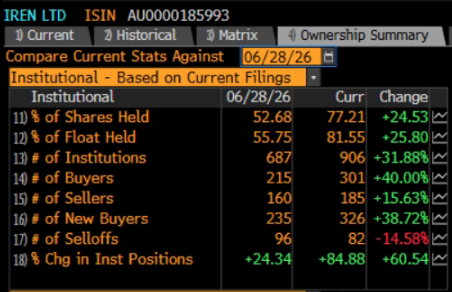
$IREN This has been a rapid transformation of the ownership base. The whales have been loading up while the price has recently been (unreasonably) low and some sold due to their impatience.
Very bullish for the next phase.
Thanks to @_Sgr_A_Star for the up to date data.
@XCapitalMgmt 3. Druck often nibbles before he takes a big bite.
Whatever the case, the fact he took a long position seems positive.
Big money has clearly been adding lately - also positive.
The chart is trending in the right direction, and I'm glad to see this ownership transformation.
@FransBakker9812 This isn't happening.
IREN isn't going to help save NBIS from their poor planning. The NBIS news is an admission they don't own enough power to do it themselves and hope to skim profits off those that do.
It'll all be more obvious once the NBIS delays start to hit in Q4/Q1.
@jiahanjimliu@SemiAnalysis_ If @SemiAnalysis_ is being PAID for this, they have to disclose this and who is paying them if they don't want to be guilty of securities violations.
Plus, now that they KNOW it is information that is no longer true, if published, they could be charged with market manipulation.
Okay, here's my shot at two bold predictions for $IREN this year @mikealfred:
1) they will not sign another hyperscaler or AI lab deal (unless it's a $MSFT expansion of the current deal).
2) their next major surprise will be a government-backed sovereign AI factory, combining NVIDIA architecture, IREN infrastructure, and Mirantis’ secure orchestration layer for public-sector, national lab, defense-adjacent, or sovereign AI workloads.
I've tried my best to connect the dots between Jensen's comments in NVIDIA's most recent earnings call, the NVIDIA & IREN partnership, the Mirantis acquisition, the market trends toward sovereign AI & open-source models, and the tremendous community research & support from folks like @PhadsEth, @FransBakker9812, @jiahanjimliu, @bitcoinbutcher1, @ilzmcfly, etc.
Over the next 5–10 years, IREN is trying to become the vertically integrated AI factory operator for the part of the market that cannot, or will not, rent its AI future entirely from the hyperscalers.
AI is becoming the brain of the enterprise (core workflows, decision systems, customer experiences, research processes, and operating models).
And there is an old saying in enterprise IT: "Don’t rent your brain."
The first phase of AI infrastructure was about getting as many GPUs online as possible. That phase rewarded whoever could access chips, power, and data center capacity quickly.
But the enduring business is about turning GPUs, power, networking, storage, orchestration, software, security, and governance into usable AI factories.
Those factories can now be built with three key puzzle pieces:
NVIDIA brings the AI factory architecture. It brings the systems, networking, software, and credibility required for enterprises and governments to trust the platform.
IREN brings the physical infrastructure: power, land, data centers, GPU deployment, and operating expertise.
Mirantis brings the cloud-native software layer: Kubernetes, OpenStack, orchestration, enterprise customers, and open-source infrastructure credibility.
Of course, the hyperscalers will remain huge. AWS, Azure, and Google are not going away. But there is a much broader market forming outside of them: enterprises, AI-native companies, governments, regulated industries, industrial companies, research labs, pharma, financial services, healthcare, energy, defense-adjacent customers, and sovereign AI buyers.
Those customers have different needs when it comes to AI.
Some need dedicated infrastructure. Some need data residency. Some need confidential computing. Some need control over networking, storage, and telemetry. Some need to avoid lock-in. Some do not want the future operating intelligence of their company running entirely inside a shared public cloud controlled by another strategic technology giant.
That is where sovereign AI breaks down into a few categories:
1) National sovereignty, where countries want domestic AI infrastructure.
2) Enterprise sovereignty, where Fortune 500 companies want control over their most important AI systems.
3) Industry sovereignty, where banks, pharma companies, healthcare organizations, industrial manufacturers, and energy companies need infrastructure built around regulation, privacy, and mission-critical operations.
4) Model sovereignty, where customers want the flexibility to use open-source models, proprietary models, fine-tuned models, and domain-specific models.
5) Infrastructure sovereignty, where customers want to avoid being trapped inside one provider’s ecosystem forever.
To serve these various customer needs, IREN can offer a vertically integrated AI factory platform with NVIDIA-grade infrastructure, industrial-scale power, enterprise cloud orchestration, and open-source flexibility.
Inference is bursty. Workloads are diverse. Hardware generations will be mixed. Models will vary. Traditional compute will be pulled into the same environment. Agents will need to call models, databases, APIs, applications, and internal systems.
The AI factory becomes a full compute platform built in anticipation of this diversity.
And, the open-source angle is critically important.
Open source reduces lock-in. That matters because the biggest enterprise and government buyers will not want their AI operating layer controlled by a closed proprietary stack. They want flexibility, standards, and optionality.
If you are building tens of billions of dollars of physical infrastructure, you do not want a proprietary software vendor sitting above you with the ability to tax the customer relationship or limit flexibility.
Open-source infrastructure gives IREN a way to say:
You can run NVIDIA-aligned AI infrastructure at scale, without locking the future of your company into a single closed ecosystem.
It also explains why NVIDIA would care.
NVIDIA’s challenge is no longer selling GPUs. Every GPU they make will get sold.
The bigger challenge is expanding NVIDIA’s AI factory architecture beyond five or six hyperscalers and into the much broader enterprise, sovereign, industrial, and AI-native market.
That go-to-market is far more complex. And explains the massive marketing & brand awareness push. IREN is pushing for >90% brand awareness for anyone involved in the AI space.
The hyperscalers are easy to identify. The rest of the world is hundreds of thousands of potential customers, each with different industry requirements, compliance needs, software environments, and deployment models.
The plan is:
1) Secure massive power.
2) Build AI-optimized data centers.
3) Deploy NVIDIA-aligned AI factory architecture.
4) Layer in Mirantis orchestration.
5) Support enterprise, sovereign, AI-native, and regulated customers.
6) Repeat. To serve thousands of customers in the middle market.
If they execute, IREN becomes something very different from what the market originally thought it owned: a vertically integrated AI factory operator for the sovereign, enterprise, and AI-native world.
That is the ambition I think they are chasing.
And if AI truly becomes the operating brain of every major company and country, infrastructure sovereignty becomes one of the most important themes of the next decade.
From DGX to DSX — NVIDIA’s Secret Weapon Is $IREN
DGX was the pivotal turning point that transformed NVIDIA from a chip company into a systems company. From the original ambition of creating a “unified data center standard,” DGX encountered resistance from the hyperscalers. They refused to adopt NVIDIA’s unified standard and instead developed their own chips, frustrating NVIDIA’s vision of becoming the dominant systems platform of the AI era. Google is perhaps the most notable example: after initially falling out of the core AI race, it rapidly recovered and mounted a full-scale counterattack, at one point nearly matching NVIDIA’s market capitalization and challenging NVIDIA’s status as the “godfather” of AI.
DGX failed to conquer the cloud giants’ strongholds. NVIDIA’s massive sales still primarily came from individual GPU chips, while its plan to establish DGX as a new systems standard combining GPUs and software did not succeed. However, strategically, DGX laid an extremely important foundation for NVIDIA. Customers could reject the complete DGX system, but they still had to remain compatible with NVIDIA’s software management stack, otherwise GPU performance could not be fully utilized. As a result, technologies such as NVLink, NVSwitch, and Base Command matured alongside the market, enabling NVIDIA to evolve from simply selling GPUs into a company with full-stack platform control capabilities, while solidifying its dominance in scientific computing and private cloud markets.
Entering the Blackwell era, the physical limits of power consumption, interconnect complexity, and liquid cooling made it impossible for the industry to continue operating independently. NVIDIA formally introduced the standardized AI factory architecture known as DSX, positioning it as the optimal path for building large-scale AI data centers.
From this point onward, DGX evolved into DSX.
In other words, it evolved from a “single-machine AI supercomputer” into a “data-center-scale AI factory standard,” completing the transition from standardizing one machine to standardizing an entire factory.
During the Blackwell generation, AI training systems pushed power consumption, interconnect complexity, and thermal management close to physical limits: single rack power draw surpassed hundreds of kilowatts, NVLink/NVSwitch topologies became dramatically more complex, and liquid cooling shifted from optional to mandatory. In theory, this generation already required a standardized architecture like DSX. However, the supply chain ecosystem was not yet mature, and no partner possessed the full engineering capability necessary to build a true “system-level AI factory.” As a result, DSX remained only a concept and reference design.
By the Vera Rubin era, NVLink 6, NVSwitch 6, and NVL72 rack systems formed a scalable, reproducible interconnect foundation, finally giving DSX the conditions necessary for practical deployment using NVIDIA’s full-stack technology. But that alone was still insufficient. To fully realize DSX, the industry also required:
High-density interconnected rack architecture capabilities
Large-scale liquid cooling expertise and construction experience
GW-scale single-site campuses with stable long-term power supply
These became the necessary conditions for constructing a flagship DSX factory.
And only one company in the world possesses all three simultaneously.
At this point, IREN enters the stage.
Beyond those three core requirements, IREN possesses several additional strategic characteristics:
Grid-based power supply.
First, grid power solves the stability problem. To become a flagship DSX standard site, power interruptions and voltage fluctuations are unacceptable. Large-scale grid infrastructure provides industrial-grade voltage stability guarantees. Second, relying on the grid offers superior cost economics. Third, it provides regulatory compliance as public infrastructure, removing the unpredictable risks often associated with behind-the-meter (BTM) power systems, which frequently carry “gray-area” or temporary characteristics and therefore lack sufficient long-term reliability.
GW-scale infrastructure.
This enables the creation of multiple DSX modular standards. Small and medium-sized data centers become trivial by comparison — deployments from 10MW to over 1GW can all be standardized. This makes IREN the ideal flagship demonstration platform. We already know there will likely be SW2 and potentially additional nearby expansion sites. The total power capacity is enormous. DSX only truly begins with Rubin, and the upgrade path beyond that will continue for many years.
Therefore, possessing ultra-large campus-scale sites within a single region is critically important. This advantage makes IREN the one unavoidable choice for NVIDIA. No other company possesses such massive strategic power infrastructure concentrated within a single region.
The long-term significance and moat of such infrastructure can hardly be overstated. Small scattered sites stitched together — even if they collectively total several GW — are simply incomparable to IREN’s grid-connected GW-scale campuses concentrated in single regions.
Green energy.
As global concern over AI energy consumption rises, future “carbon footprint” metrics will become core evaluation standards for sovereign AI procurement. IREN’s long-term commitment to renewable energy allows NVIDIA’s DSX standard to become not only “the most powerful,” but also “the greenest.” This is critically important for attracting national-level infrastructure customers.
Owned land and expansion capability.
DSX requires data centers to be constructed from the ground up, including specialized transformers, ultra-heavy rack support systems, and complex liquid cooling pipelines. Only companies with full ownership of their land can customize AI factories entirely according to NVIDIA’s blueprint without facing endless approval bottlenecks or third-party building restrictions.
Vertical integration and data center engineering expertise.
IREN is not merely a data center operator. It is one of the only vertically integrated companies in the industry that owns everything from greenfield development, site development, power procurement, to operations and maintenance. For a DSX flagship factory, NVIDIA needs a partner capable of rapidly executing its “reference designs.” IREN’s model of “designing, building, and operating everything itself” dramatically shortens the timeline from blueprint to first deployed GPU.
Liquid cooling capability.
DSX is fundamentally a liquid-cooled era architecture. Liquid cooling becomes a central requirement. IREN already possesses high-density rack deployment experience through the Horizon project. Its Chief Innovation Officer is one of the most influential and experienced engineering experts in the United States in data center liquid cooling, high-density thermal architecture, and ASHRAE standards systems. He joined IREN specifically to help establish standards.
Long-term operational data accumulation.
IREN has years of operational experience managing large-scale, high-heat-density facilities running at full load. The physical environment of Bitcoin mining is remarkably similar to AI inference: both involve 24/7 full-load operations with extreme thermal output. This long-term expertise in managing massive electrical and thermal loads is, in reality, an extremely competitive advantage within the industry.
From the analysis above, one can understand why IREN possesses such uniqueness and strategic importance in NVIDIA’s DSX ecosystem, while also inferring the likely development path of DSX itself:
DSX will likely follow a “top-down” design philosophy.
Using IREN’s massively scalable GW-scale sites and specialized engineering capabilities, NVIDIA can define a flagship standard that is “multi-scale, most advanced, most efficient, and greenest,” then deconstruct that blueprint into modular, reproducible AI factory units. In the future, whether it is a GW-scale campus or merely a company operating a single row of racks, as long as they purchase NVIDIA’s “DSX-certified package,” they could theoretically produce tokens with the same efficiency as IREN.
This strategy of “defining the upper limit, then distributing the standard downward” reflects NVIDIA’s true ambition to control the global AI infrastructure ecosystem.
IREN’s Sweetwater site — along with future surrounding expansion campuses — could become the incubation base for future AI intelligence factories. The scale of this project may become one of the largest engineering undertakings in human industrial history:
“Intelligent factories produce intelligence, and DSX defines how those factories are built and run.”
This concept has already moved beyond theoretical logic into actual execution. The reason I am able to describe this vision is because I have been observing this direction consistently for a long time. In reality, developments do appear to be moving this way.
The broader historical backdrop behind the emergence of the DSX system comes primarily from three major forces:
First, the rapid development of the AI industry has positioned DSX at the center of a major inflection point in compute infrastructure. DSX is a natural product of the industry reaching a new stage of maturity. AI is no longer confined to internal model training inside a few hyperscalers. The entire world now requires AI compute — including sovereign AI, enterprise private AI, neo-clouds, AI inference platforms, agent networks, token factories, vertical-specific models, and national AI infrastructure.
Many countries — particularly in the Middle East, Europe, and Southeast Asia — are unwilling to place core AI workloads inside the public clouds of U.S. tech giants due to data sovereignty concerns. Through DSX templates, NVIDIA can help these nations rapidly build their own “national AI factories.” Hyperscalers can no longer monopolize AI infrastructure. This has become one of the most important changes of the past two years, and it forms the foundational soil for DSX to grow.
Second, hyperscalers themselves are now constrained by power, land, permitting, transformers, and cooling systems. They are no longer in a state of unlimited expansion. AI inference also requires broader distributed deployment. In the future, there will be large numbers of regional AI factories, national AI nodes, and enterprise private clusters whose operators do not want to rely entirely on hyperscalers. Meanwhile, Google TPU, Amazon Trainium, and Microsoft Maia are all rapidly advancing. Over time, they may reduce GPU purchases, form closed ecosystems, and sell their own AI services externally — creating a strategic threat to NVIDIA. Therefore, NVIDIA must cultivate a “non-hyperscaler AI ecosystem.”
Third, by the Blackwell and Vera Rubin eras, single-rack power consumption has already reached the 100kW–200kW range. Traditional air cooling, cabling, and power topology can no longer support these systems. This means that if data centers are not built according to NVIDIA’s DSX standards — system-level liquid cooling, GB200 NVL72 architecture, and related infrastructure — they simply will not be able to run the highest-efficiency compute systems. In other words, physical laws themselves are forcing the market to adopt NVIDIA’s standards. DSX effectively becomes the “entry ticket” to the AI era.
Under this backdrop, DSX attempting to define the entire AI factory standard becomes a completely natural progression. It encompasses GPU architecture, network topology, liquid cooling standards, power design, rack standards, software orchestration, inference optimization, and token factory production pipelines — reflecting an ambition to turn AI compute into something like an “industrial iPhone operating system.”
After understanding the broader context, one can then better appreciate the deeper strategic meaning behind IREN’s acquisition of Mirantis.
To build a standardized flagship DSX factory, IREN already possesses massive GW-scale physical infrastructure, liquid cooling capability, and engineering expertise, but it still lacked the software layer needed to bridge “hardware” and “cloud services.” Mirantis perfectly fills this gap. Its deep experience in OpenStack, Kubernetes, and bare-metal management enables IREN to transform DSX into a directly usable cloud platform, allowing customers to immediately deploy AI workloads out of the box.
For NVIDIA, this acquisition enables its key partner IREN to free DSX from dependence on AWS, Google, and other cloud giant software ecosystems, establishing an independent vertically integrated stack. For IREN, the acquisition elevates it from a power and infrastructure supplier into a true “neo-cloud” platform capable of delivering sovereign AI and national-scale AI infrastructure.
Mirantis will also integrate NVLink topologies and DSX-specific features directly into software orchestration, enabling AI factories to achieve automated scheduling and token-level operational stability.
Although CRWV and NBIS also possess software with somewhat similar functionality, their stacks are largely designed for internal use and are difficult to standardize for export. Mirantis, by contrast, is inherently a cloud-native software company serving global customers. This allows IREN to transform DSX into an exportable “software-defined AI factory” template.
Its core product, k0rdent, can unify bare metal, virtual machines, and Kubernetes management while deeply optimizing for NVIDIA GPUs — a capability IREN could not realistically develop internally.
One could speculate that NVIDIA itself encouraged this acquisition (especially given how inexpensive the deal appeared, with IREN seemingly receiving extraordinary value). The ultimate objective may be to give DSX an independent software control layer outside AWS and Google while creating a sovereign AI solution deliverable globally. Mirantis upgrades IREN from a hardware host into the software brain of DSX, while giving NVIDIA a strategic ally in global AI infrastructure that is open-source-oriented, conflict-free, economically aligned, and technologically synchronized.
NVIDIA choosing not to acquire Mirantis directly — instead allowing IREN to do so — likely centers on avoiding antitrust concerns, maintaining delicate relationships with hyperscalers, and ensuring the software layer remains closely aligned with practical AI factory operations. An IREN acquisition appears as ecosystem collaboration rather than market domination.
At the same time, Mirantis software must deeply integrate with IREN’s GW-scale power, liquid cooling, and operations systems, making IREN the more efficient owner.
Financially, NVIDIA benefits through warrants tied to IREN’s growth without needing to bear integration costs itself. Through this strategy, NVIDIA effectively supports the emergence of a fully aligned DSX flagship manufacturing partner while preserving its own asset-light structure and strategic control position.
A full-scale DSX rollout would potentially:
Form the foundation for NVIDIA reaching a $10–15 trillion valuation
Become the inevitable path for NVIDIA’s vision of AI intelligence factories and operational control
Represent the most economical and efficient path for AI industry development
Solve the post–Vera Rubin scaling direction for compute growth
Become NVIDIA’s only viable method for breaking out of hyperscaler encirclement
IREN becoming the sole top-level collaborator in such a massive project could not have happened spontaneously. Planning something of this scale would likely require at least a year or more of preparation. Ever since interactions between NVIDIA and IREN began to appear unusually secretive, I have noticed multiple examples suggesting unusual behavior between the two companies — almost like two people who already know each other pretending not to in public.
Overall, they likely did not want the industry to speculate too early about their true intentions, while also minimizing regulatory attention. Even IREN, once an unusually transparent Bitcoin mining company, has become more guarded. In that sense, the limited interaction between IREN’s investor relations team and the market may actually make sense.
At this point, IREN has already completed the most difficult parts of its AI industrial expansion:
High-quality, massive-scale, long-term stable power supply, still growing further
Secured supply access to the latest GPUs
Developed engineering teams and supply chain maintenance capabilities
Obtained status as a flagship manufacturing partner for next-generation AI intelligence factories
The next inevitable step is filling IREN’s enormous power capacity with high-quality customer contracts. Unlike before, however, IREN may no longer need to build a traditional sales force or aggressively market its software capabilities. NVIDIA itself would likely help facilitate customer adoption while emphasizing the superior token-generation efficiency of the DSX system, because the economic interests of both companies are now deeply aligned.
Under the DSX standard, NVIDIA could gradually evolve from a “supplier” into a “global orchestrator.” Securing partnerships with companies like Anthropic would no longer be solely IREN’s concern. NVIDIA itself has strong incentives to push major AI companies already experimenting with TPU systems toward using more NVIDIA-based infrastructure.
Second, NVIDIA holds massive warrants in IREN. Every major contract signed by IREN potentially increases its stock price, allowing NVIDIA not only to profit from GPU sales but also from appreciation in IREN’s equity value. Jokingly speaking, one could say IREN “used warrants to buy itself a world-class salesman.”
Third, the emergence of sovereign AI has opened an entirely new market. Since IREN acquired Mirantis, the term “sovereign AI” has appeared increasingly frequently. In fact, when evaluating IREN’s sites originally, many observers already noted their suitability for sovereign AI deployments. The strategic quality of IREN’s sites is fundamentally incomparable to the fragmented infrastructure assembled by many competitors.
For NVIDIA, it needs a GW-scale “pure-blood” flagship to demonstrate to sovereign AI customers globally that NVIDIA’s DSX architecture can achieve superior token efficiency.
Sovereign AI customers may not want to hand their compute, data, models, or orchestration layers to the three major U.S. hyperscalers, but they may still accept supplier sovereignty. The distinction is subtle but important. IREN’s careful positioning and boundary management become critical here. Even the Mirantis acquisition did not overextend into hyperscaler territory; in fact, sovereign AI is already one of Mirantis’ core areas. From this perspective, NBIS may actually be poorly positioned for sovereign AI because its full-stack platform structure is precisely what sovereign AI customers are attempting to avoid.
Overall, IREN appears to be positioning itself at a point that maximizes strategic optionality and economic upside. If it attempted to define itself as a fully integrated hyperscaler-like platform, cooperation with a company at NVIDIA’s level would likely become far more difficult. This partnership with NVIDIA may sacrifice some of IREN’s historical emphasis on flexibility and optionality, but technological evolution tends to follow efficiency. The emergence of the “Magnificent Seven” itself demonstrates that antitrust frameworks increasingly must adapt to technological realities.
For IREN, the most important objective during this enormous capital expenditure cycle is rapidly establishing scale advantages. These data center assets ultimately become long-term hard assets fully owned by the company. The more infrastructure accumulated now, the greater IREN’s strategic flexibility becomes in the future. From that perspective, this is an extremely rational strategy.
As IREN gradually becomes one of the standard-setters for the next-generation compute ecosystem, it could eventually open additional monetization paths such as standardized AI factory design fees, consulting and licensing revenue, and software licensing income. Compared to its core business, these may remain relatively small, but the strategic value of occupying the top layer of the ecosystem could become nearly limitless.
Many people — especially institutions — already seem to recognize these dynamics. IREN’s stock price may not have risen dramatically yet, but its trading volume appears to reveal something unusual. The volume itself has become almost phenomenon-level behavior. Meanwhile, IREN’s $6 billion ATM facility has remained active, and immediately after earnings the company issued a $2 billion convertible bond deal, later increased to $3 billion due to overwhelming demand. The intensity of demand, favorable interest rates, and high conversion prices were genuinely surprising.
If the narrative described above is even partially correct, such investor enthusiasm becomes entirely understandable. Furthermore, the remaining $5 billion of ATM financing demand will likely be sold at significantly higher prices.
At this point, CRWV, NBIS, NSCALE, and LAMBADA increasingly appear to function as alliance members within NVIDIA’s broader ecosystem. Capital markets have seen constant fighting among supporters of the three neo-cloud stocks, especially between NBIS and IREN supporters — almost to the point of ideological warfare. But IREN may ultimately represent NVIDIA’s final and most important strategic move: the piece that controls the overall board.
Importantly, IREN achieved this position through its own decisions and execution. It was not merely “chosen” or artificially supported. Yet at the same time, NVIDIA likely must publicly deny any direct support relationship — readers can think carefully about the reasons themselves.
NVIDIA’s earlier strategic investments were designed primarily to secure the GPU deployment ecosystem. As the DSX system matures, companies like CRWV, NBIS, NSCALE, and LAMBADA may increasingly become deployment and implementation partners.
Interestingly, during the earlier NBIS-versus-IREN debates, some NBIS supporters argued that the two companies did not need to be adversaries and might eventually cooperate — for example, IREN leasing power capacity to NBIS. Looking at things now, cooperation indeed seems possible, but perhaps in the opposite direction: IREN may ultimately become the holder of the standard itself, licensing intellectual property outward.
Finally, this article is ultimately just speculative corporate-strategy fiction — written mainly for entertainment purposes, not investment advice.
$IREN For a high-level company overview of Mirantis and their worldwide presence, here's an interesting short clip.
This is Kevin Kamel, VP of Product Management, from his presentation on September 11, 2025, at AI Infrastructure Field Day 3:
@bitcoinbutcher1 Thanks for sharing this, Butcher.
I hope many learn from your example; most especially from the character you displayed in the way you carried yourself during this process (and that you continue to show by being so transparent).
$IREN The importance of this can't be understated:
"...in this US$3.4 billion agreement with IREN, NVIDIA is, for the first time in its history, leasing third-party compute capacity at large scale and on a long-term basis as a customer, for use by its own AI research teams."
There is no larger long-term strategic move than this — NVIDIA joins forces with $IREN to build the flagship AI factory deployment for the DSX architecture
The market will continue to repeatedly reinterpret the deeper intent and long-term objectives behind the partnership between NVIDIA and IREN.
On May 7, 2026, IREN’s CEO reposted NVIDIA’s official announcement on X regarding the partnership between the two companies: NVIDIA and IREN Limited today announced a strategic partnership to accelerate the deployment of next-generation AI infrastructure.
NVIDIA announcement
https://t.co/WW1RJ9ERH3
At the same time, IREN also released another announcement on its own website: IREN signs a US$3.4 billion AI cloud services agreement with NVIDIA.
IREN announcement
https://t.co/f3W6yR90Mq
The two announcements, each emphasizing different aspects of the cooperation, carry extremely significant implications.
First, after careful verification, this is the first time NVIDIA has sought external compute leasing. There are three major turning points in industry development embedded in this move.
A reversal of roles: NVIDIA becomes a “major external compute customer” for the first time
In the past, NVIDIA’s relationship with infrastructure companies was almost always centered around “selling hardware” or “borrowing hyperscaler data centers for DGX Cloud.” But in this US$3.4 billion agreement with IREN, NVIDIA is, for the first time in its history, leasing third-party compute capacity at large scale and on a long-term basis as a customer, for use by its own AI research teams. This kind of “reverse leasing” is unprecedented for NVIDIA in both scale and nature.
The selective external exposure of its most core secrets: this point carries the deepest implications
For a long time, NVIDIA has insisted on keeping its most critical R&D work — chip design, driver optimization, and large-model training — inside its self-built supercomputers such as Selene and Eos, creating a closed loop of “building the shovels and mining with them itself.” But this time, outsourcing a 60MW research workload to an external data center is highly significant. It signals that compute-chip R&D is beginning to transition toward external collaboration.
The first opening of stack management: introducing Mirantis to manage NVIDIA’s internal R&D clusters
Previously, NVIDIA’s internal cluster management was handled entirely by its own engineering teams. But under this agreement, NVIDIA is for the first time allowing third-party management, bringing in Mirantis to participate in cluster orchestration and operations. This also signals a transformation in NVIDIA’s latest compute architecture R&D approach — beginning to “strengthen external collaboration” for lower-level operational work such as server cooling, restarts, and Kubernetes configuration.
As the ability of individual GPU chips to increase computing performance gradually approaches physical and engineering limits, the next phase of AI compute advancement is shifting from “single-chip performance competition” to “system-level scalability competition.” This is NVIDIA’s direction of transformation.
The primary paths for the next stage of AI compute improvement include: GPU clustering, high-speed interconnects, rack-scale computing, and data-center-level coordination. This requires GPU manufacturers (NVIDIA), data center designers/builders/operators (IREN), and supercluster operating systems (Mirantis) to jointly collaborate on development.
What they are developing is precisely the NVIDIA DSX architecture referenced in the NVIDIA-IREN partnership announcement. And IREN’s hyperscale SW site in Texas is becoming the flagship deployment location for NVIDIA’s DSX architecture. This is absolutely not a simple narrative of NVIDIA investing in a company and becoming a shareholder.
For the world’s leading company that holds the core secrets of AI compute chip R&D, this is not a trivial matter.
From NVIDIA’s perspective, there appear to be many potential partners, such as CoreWeave, Nebius, Oracle, Microsoft Azure, Amazon Web Services, and Crusoe, and NVIDIA has already invested in or partnered with these firms before. But why did it choose IREN for this most important transformation?
Because IREN possesses too many things that are uniquely its own:
Multiple GW-scale single sites with secured long-term power supply
Grid interaction capabilities
Vertical integration
Ultra-long-term site planning and abundant land supply
Green energy
Acting as its own design-and-build general contractor
Long-term accumulation of data center operational experience
Advanced design and technical capabilities
Compared with the companies above that NVIDIA has already partnered with, even if IREN temporarily lacked software capabilities, NVIDIA was still willing to wait until IREN acquired a software company before announcing this deep cooperation. Moreover, Mirantis has long been one of the three software companies that have collaborated with NVIDIA for many years. It is highly possible that NVIDIA itself played the role of connector behind IREN’s acquisition.
NVIDIA is transforming toward system-level compute scaling and building an AI factory template. In the future, the products it sells may no longer simply be GPU chips, but complete racks, clusters, or even entire AI factories.
That inevitably requires standardized data centers in order to guarantee performance, compatibility, scalability, and token efficiency.
What NVIDIA needs are facilities with massive long-term secured power supply, land, GW-scale campuses, HPC DNA, rapid construction capability, neutrality, automated scheduling capability, workload routing, GPU virtualization, fault recovery, and cluster operating systems capable of distributed training management.
At present, IREN is the only company that possesses all of these elements simultaneously.
What they are trying to build is the industrial standard for the next phase of the AI industry.
The greatest companies do not merely participate in industries — they define the standards.
From this perspective, there is no larger strategic theme than this one.
Selling compute capacity to hyperscalers, partnering with Anthropic, or developing new sovereign AI businesses are all important, but none compare with this.
The deeper meaning of last week’s announcement will require time for the market to fully interpret and understand. I believe I have already analyzed this trend relatively clearly.
This move by NVIDIA and IREN, once executed successfully, could once again widen the gap between the NVIDIA ecosystem and Google just as Google had begun catching up — and it carries major implications for the entire AI industry.