We serve at @alux_network.
Web3 Concurrent Blockchain. No Web3 will be possible without concurrency. ConcurSys brings decentralized concurrency to blockchain.
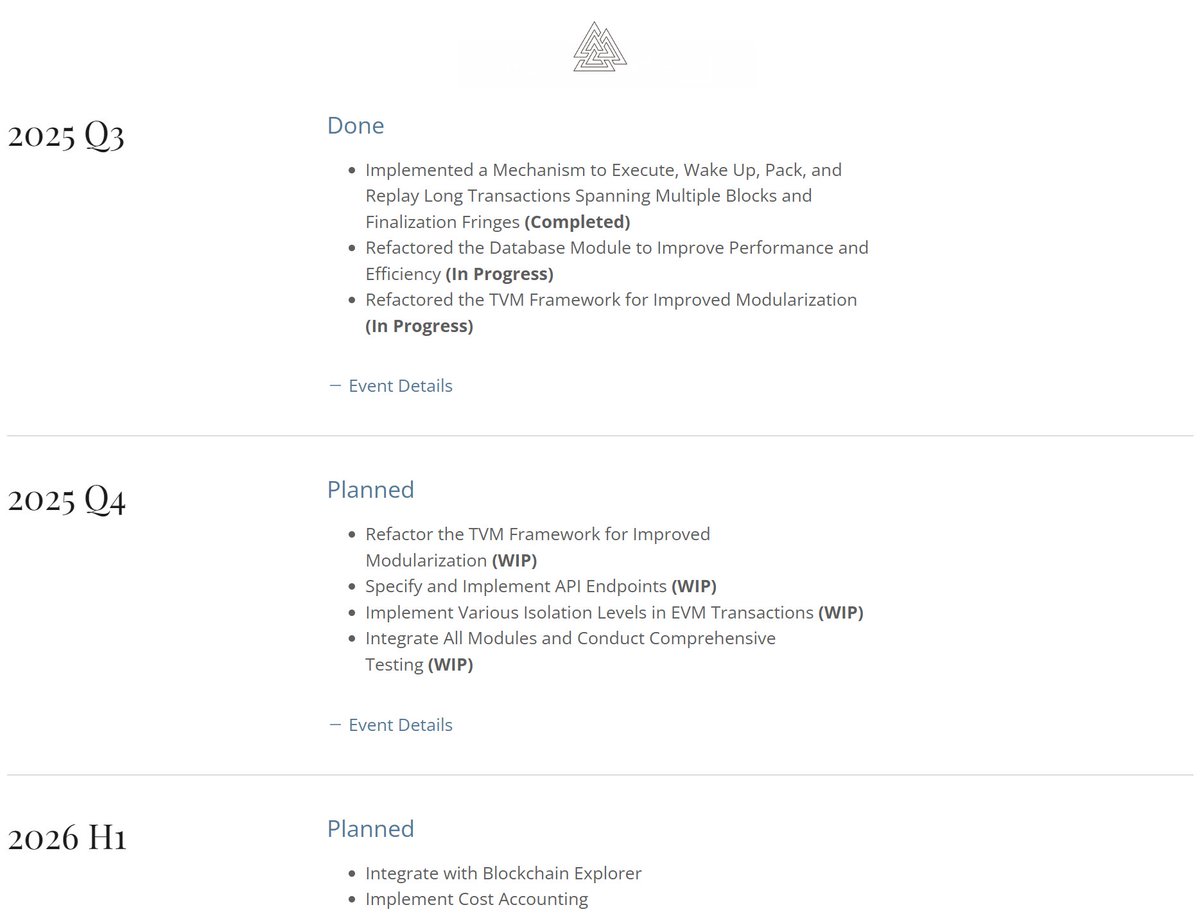
🙋🏻♂️ In Q3 2025, we focused on building a key mechanism to enable long transactions — on-chain transactions that can be temporarily suspended and later resumed, allowing execution to span multiple blocks while remaining atomically finalized.
This marks a major step toward true scalability, paving the way for the world’s first blockchain capable of actively interacting with the off-chain world, instead of relying solely on oracles.
The same mechanism will also power atomic cross-chain transactions in the upcoming sharding phase.
Meanwhile, we have continued improving code quality and modularity through multiple refactors across the TVM and database modules, as the system grows in complexity.
Next quarter, we will focus on integration and testing, moving closer to a working demo — the first blockchain capable of concurrent, on-chain long-transaction processing. Stay tuned! 👉🏻 https://t.co/noR1RNzfCq
#Web3 #Concurrent #Composite #Blockchain $ALUX
🧑🏭 In Q2 2025, we completed a critical enhancement to our TupleSpace Virtual Machine (TVM): the introduction of simple behavioral channel types. The TVM bytecode standard now enforces three channel types—Single-Owner, Affine, and Linear—enabling significantly faster execution and a much smaller replay log, all while maintaining replay consistency.
🦿 Our Weaklink feature in BlockGit has also passed full testing. Unique to ALUX’s protocol, Weaklink decouples a block’s two roles: contributing to consensus state and to virtual machine state. This separation is vital to achieving ALUX’s vision of supporting on-chain long transactions and atomic cross-shard transactions.
🤖 As we integrate all modules toward a working demo, we have introduced a more advanced test framework. Using Rust’s proptest crate, we built a system that generates millions of random Tolang programs to test TVM execution under various concurrent schedules. Each test ensures state consistency between play and replay across hundreds of execution paths.
🫶 Looking ahead to Q3, we remain focused on delivering a demo showcasing a blockchain capable of processing long-running transactions on-chain. Stay tuned! 👉🏻 https://t.co/Ta7xA4GpyX
#Web3 #Concurrent #Composite #Blockchain $ALUX
As part of a recent upgrade to our TupleSpace Virtual Machine (TVM), ALUX has introduced new behavioral channel types to enhance performance and predictability:
※ Single-Owner: A name (channel) is exclusively owned by one process at any time.
※ Affine: A name may be used at most once.
※ Linear: A name must be used exactly once.
These constraints are enforced at runtime by our bytecode VM, enabling more efficient execution paths.
Why it matters: ALUX is building a Pi/Rho calculus-based VM designed for composable, long-running concurrent transactions on-chain. To scale without compromising performance, we’ve introduced a class of channel types that unlock key optimizations.
For example, Single-Owner channels support lock-free access and can be used to hold sequential VM sandboxes like the EVM. Affine and Linear channels ensure deterministic usage, reducing the overhead of recording extra information for validator replay.
This is where formal theory meets practical engineering—ALUX brings it to life.
$ALUX #Web3 #Blockchain #Concurrent #EVM
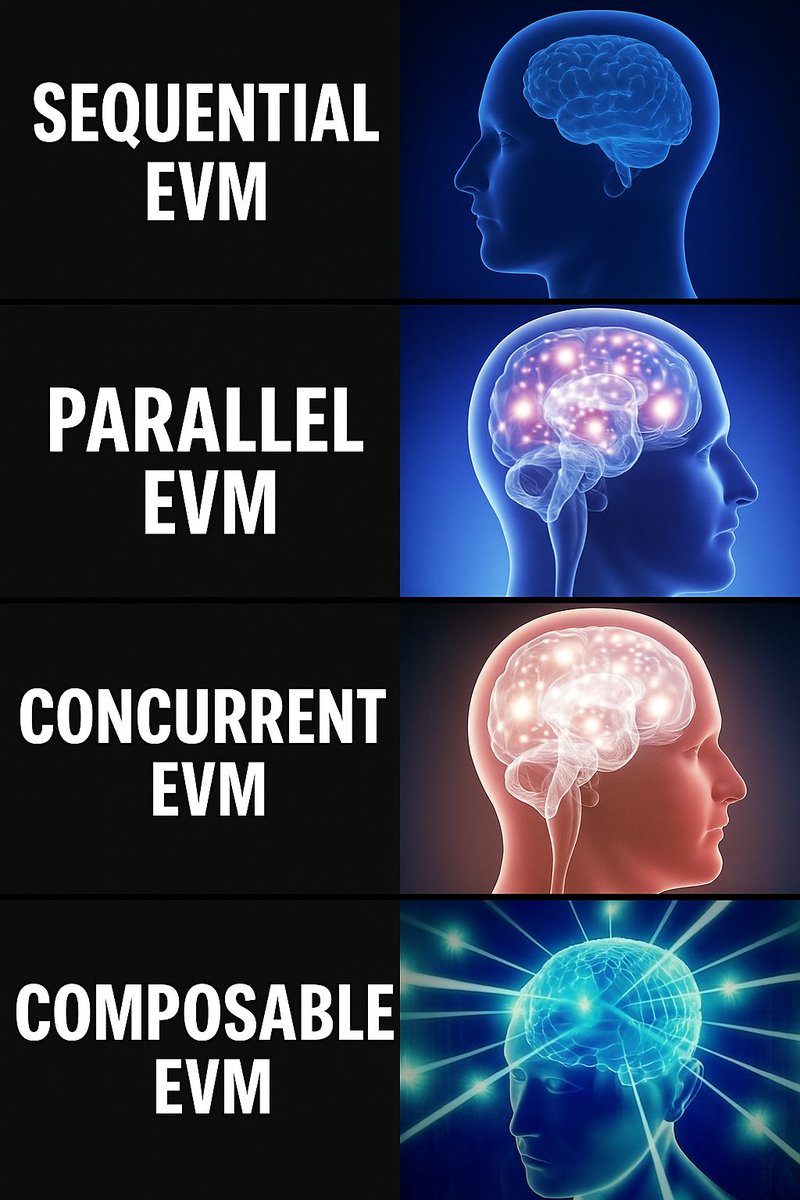
The evolution of the Ethereum Virtual Machine (EVM) can be understood across four distinct levels:
Level 1: Sequential EVM (e.g., Ethereum)
* Transactions are processed sequentially, one after another.
Level 2: Parallel EVM (e.g., Sei, Aptos, Monad)
* Enables parallel transaction processing for improved throughput.
* Limitations: Depends on trusted oracles (such as Chainlink) to interact with the external world.
Level 3: Concurrent EVM (ALUX – Single-Shard Stage)
* Supports asynchronous, long-running transactions that can be temporarily suspended and resumed.
* Enables direct, active communication with the external world—without relying on intermediaries.
Level 4: Composable EVM (ALUX – Multi-Shard Stage)
* Allows transactions to run across multiple shards while preserving atomicity.
* Unifies shards into a single, logically cohesive virtual EVM.
* The only approach to achieve horizontal scalability without compromising usability.
$ALUX #Web3 #Blockchain #Concurrent #EVM
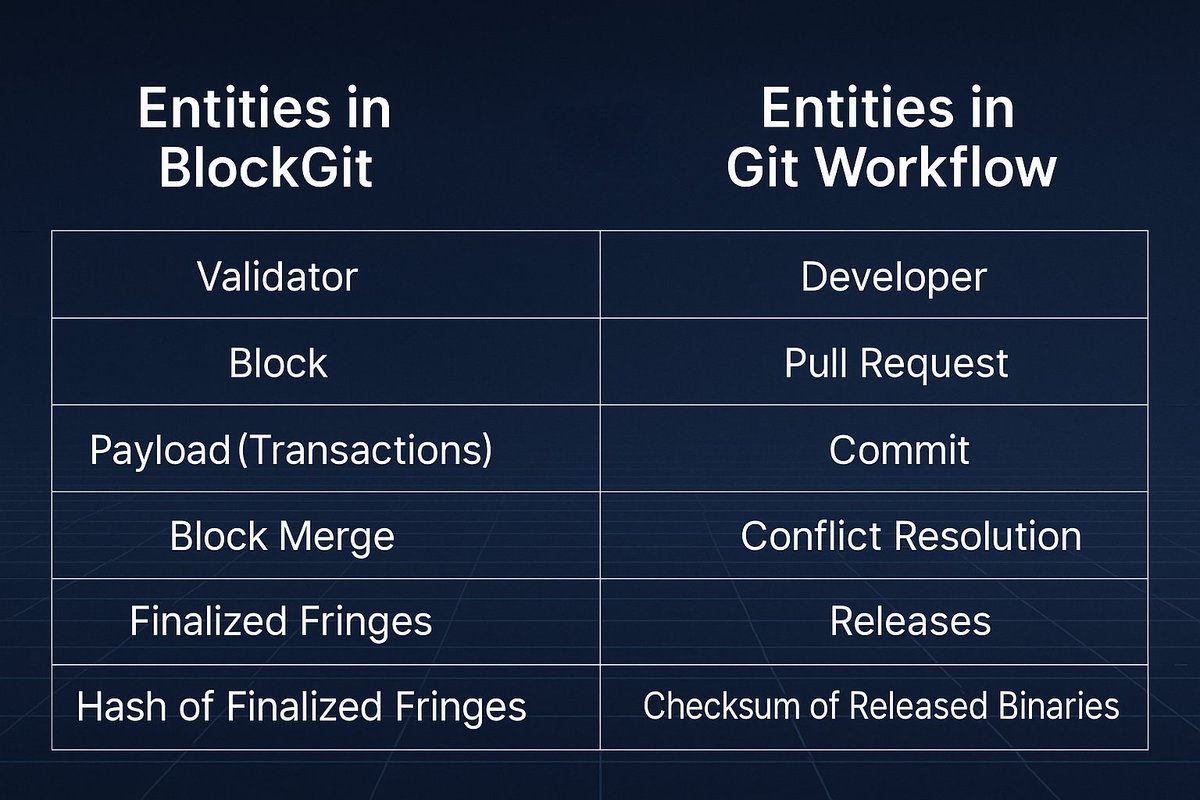
To enable concurrent long-running transactions on-chain, ALUX introduces a novel consensus protocol: BlockGit.
Inspired by Git, BlockGit treats the blockchain like a shared repo. Validators act like devs, each proposing blocks (PRs) while independently forming consistent "release schedules."
One unique feature of BlockGit is the decoupling of consensus from state transitions via weak links. A block can reference other blocks purely for consensus purposes—without endorsing their state transitions.
In Git terms: if block B is weak linked by block A, it’s like PR A acknowledges PR B but isn’t rebased on it.
#Blockchain #weaklink #BlockGit #Web3 #Concurrent
🙋♂️ In Q1 2025, we upgraded to an event-driven framework, enabling concurrent transaction execution, block production, replay, and consensus.
Our BlockGit protocol is now more stable with Weaklink, a first-of-its-kind feature that decouples consensus state from the VM state.
Next in Q2: full module integration & a demo of on-chain long-running transactions! Stay tuned! 👉🏻 https://t.co/Ta7xA4GpyX
#Web3 #Concurrent #Composite #Blockchain $ALUX
🧑🔬 We've just updated our roadmap! In 2024, we made history by integrating EVM with TVM, enabling concurrent on-chain EVM execution for the first time. We also introduced the innovative BlockGit consensus protocol, complete with a tested block-merge algorithm for conflict resolution. In 2025, we’ll take it to the next level—demonstrating a blockchain capable of handling concurrent, long-running EVM transactions. Stay tuned! 👉🏻 https://t.co/Ta7xA4GpyX
#Web3 #Concurrent #Composite #Blockchain $ALUX
👨💻 ALUX's consensus protocol, BlockGit, works like a decentralized GitHub: each node is a developer, and every block is a pull request. The whole blockchain operates GitHub-style. $ALUX #Blockchain#Web3
[#Parallel]: Can only process short transactions of the same type simultaneously.
[#Concurrent]: Can simultaneously process different types of short and long transactions.
[#Composable]: Supports multiple systems working together to complete the same task.
$ALUX is concurrent and composable!
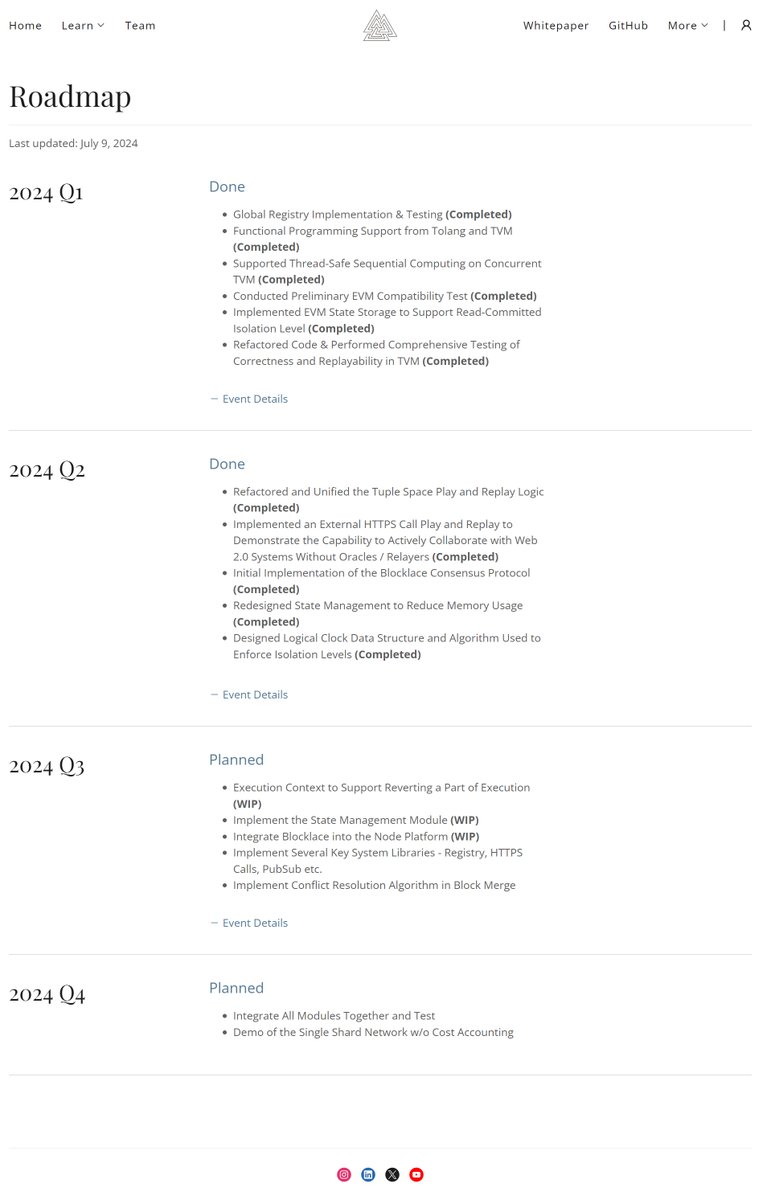
In Q1 2024, ALUX completed the implementation and testing of the Global Registry, functional programming support from Tolang and TVM, thread-safe sequential computing on concurrent TVM, preliminary EVM compatibility tests, EVM state storage implementation to support read-committed isolation levels, and refactored the code, performing comprehensive correctness and replayability testing in TVM.
In Q2 2024, ALUX refactored and unified the tuple space play and replay logic, implemented external HTTPS call play and replay to demonstrate the capability to actively collaborate with Web 2.0 systems without oracles/relayers, completed the initial implementation of the Blocklace consensus protocol, redesigned state management to reduce memory usage, and designed the logical clock data structure and algorithm to enforce isolation levels.
In Q3 2024, ALUX plans to support the execution context to revert parts of the execution, implement the state management module, integrate Blocklace into the node platform, implement several key system libraries (e.g., registry, HTTPS calls, PubSub), and implement the conflict resolution algorithm in block merge.
In Q4 2024, ALUX plans to integrate all modules together for testing and demonstrate the single shard network without cost accounting.
For more detailed progress, visit the project website: https://t.co/Ta7xA4GpyX
🚀 Exciting update on our roadmap! Check out: https://t.co/9zEpeYg6G0
🌟 Highlights include integrating functional programming and EVM support into a Pi calculus-based VM and language.
🔜 Next up: introducing a concurrent (not parallel) and async EVM runtime. #Web3#Blockchain
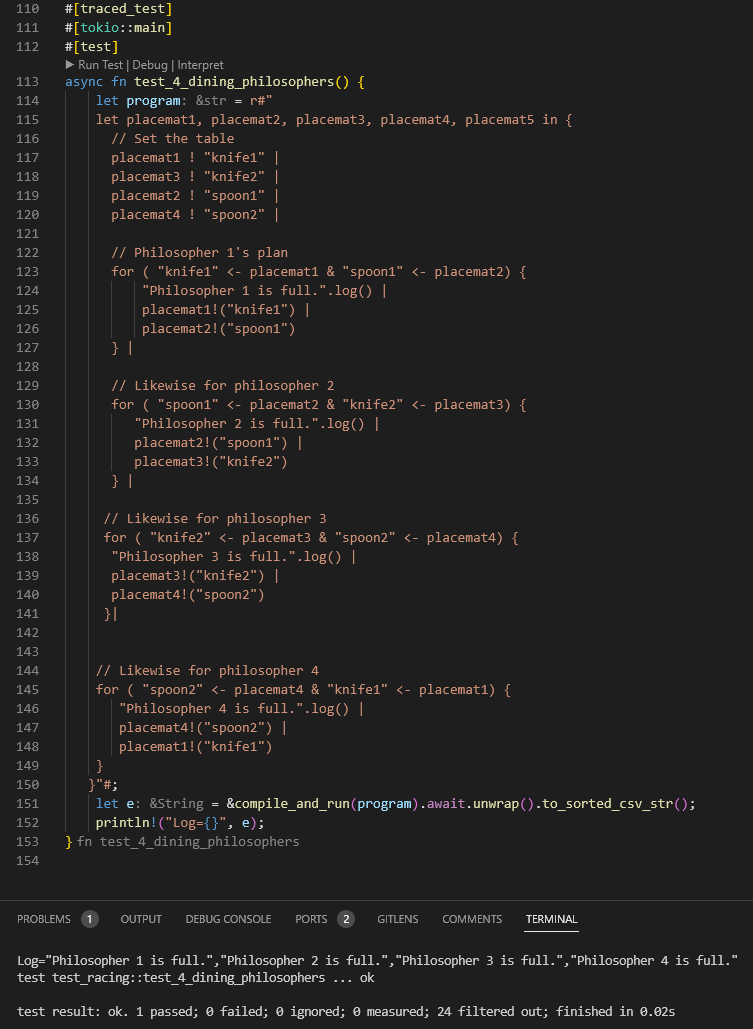
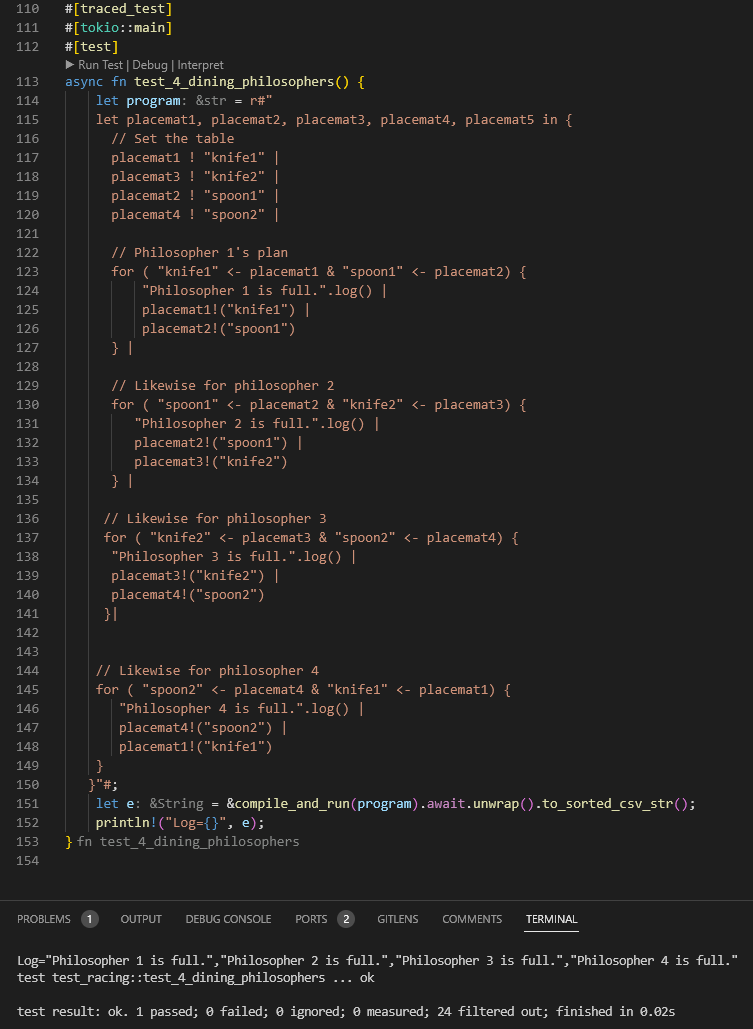
We just solved the Dining Philosophers Problem and ran code tests. #ALUX
Log="Philosopher 1 is full.","Philosopher 2 is full.","Philosopher 3 is full.","Philosopher 4 is full."
Four dining philosophers problem coded in ToLang (Tuplespace Operation Language), compiled into TVM bytecode executable and run on TVM (Tuplespace Virtual Machine). All philosophers are fed! @alux_network@rhovision
Our ongoing Development Stand-up, headed by talented programmers and algorithmic experts, is a hive of passionate effort. Each team member, deeply vested in the project and aligned in vision, fuels our innovative progress. #ALUX#blockchain









![alux_network's tweet photo. [#Parallel]: Can only process short transactions of the same type simultaneously.
[#Concurrent]: Can simultaneously process different types of short and long transactions.
[#Composable]: Supports multiple systems working together to complete the same task.
$ALUX is concurrent and composable!](https://pbs.twimg.com/media/GUKCZYKakAAve5a.jpg)