128 double quantum dots, the building blocks that become qubits, tuned automatically across a single silicon chip.
64 devices. No human in the loop.
A future quantum computer needs millions of qubits. Automation isn't optional. It's the only path.
https://t.co/JO35v3FcgS
Most QPUs sit isolated in labs. A researcher submits a job, waits, inspects, repeats. All manual.
Coda Node closes that loop. Bring your own quantum hardware into an intelligent workflow.
@nvidia's Ising models for quantum calibration and error correction are live in our Control API.
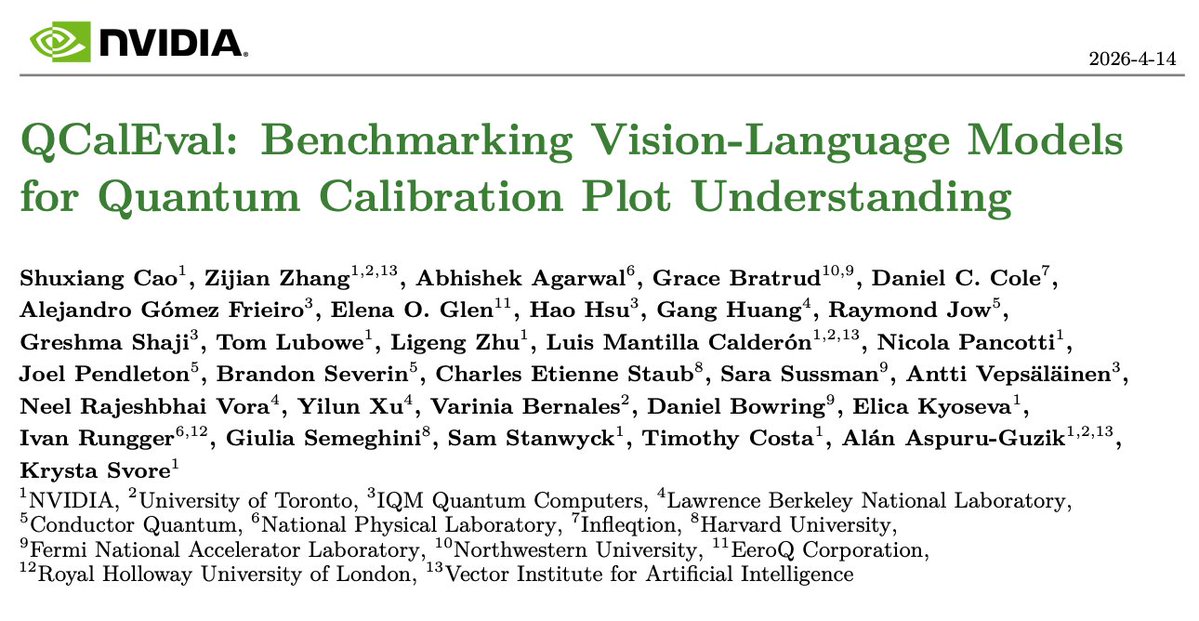
Ising Calibration 1 is a 35B-parameter vision-language model that reads quantum calibration plots and tells you what the experiment shows and what to do next. It scores 74.7 zero-shot on QCalEval, ahead of GPT-5.4, Gemini 3.1 Pro, and Claude Opus 4.6.
Ising Decoding ships in two variants for surface-code QEC: a fast model (0.9M params) for low-latency decoding, and an accurate model (1.8M params) that beats correlated PyMatching up to distance-13. Both deliver 2.5x speedup and 3x accuracy over the prior state of the art.
Calibration: https://t.co/LWbZgWyAJD
Decoder: https://t.co/aQO7EyH8Pa
We're proud to have collaborated with @nvidia and @QCHardware on the release of NVIDIA Ising Calibration, the first open Vision Language Model for quantum calibration.
Together with EeroQ, we used it to build a working proof of concept for an autonomous quantum computing lab. 🧵
Using EeroQ's electron-on-helium chip, NVIDIA Ising, and our Control software, we built a proof of concept autonomous quantum lab. From a plain-English prompt, the setup ran multiple iterations of a real experiment, recording results on real hardware.
This is where quantum is headed.
Today we’re announcing Coda model context protocol.
AI agents can now use quantum computers.
One tool for quantum transpilation, simulation, and execution incl. @IBM Qiskit and @NVIDIA CUDA-Q.
Learn how to get started below
https://t.co/Qc9ySFSrso
At EeroQ ( @QCHardware ) we’ve integrated AI into our R&D workflow to accelerate development of our electrons-on-helium qubit technology and streamline complex device tuning. Excited to be "building something quantum" with the folks at @conductorquant !
https://t.co/ccQpHZ3ztk
New in Coda: an AI-powered circuit editor, MCP for quantum in AI apps, support for 10,000+ qubit algorithms, and a partnership with @nvidia at MIT’s iQuHACK.
Everyone’s talking about the future. We’re building it.
NVIDIA cuQuantum and CUDA-Q are making #quantumcomputing more accessible through GPU-accelerated quantum simulations.
Check out how @conductorquant's Coda is enabling the next generation of developers to convert ideas into quantum circuits by harnessing these simulations. ➡️ https://t.co/bmMTzXMTDo
Coda lets beginners, domain experts, and engineers describe problems in natural language and run them on real quantum processors, without writing low-level quantum code.
Announcing Coda: natural language quantum computing
Tell Coda what you want to do. It builds the quantum program and runs it on real quantum hardware.
Live on @rigetti, @IonQ_Inc, and @meetIQM quantum computers with simulations via @IBM@qiskit and @nvidia cuQuantum + CUDA-Q.
Coda is now open for sign-ups.
It’s the first AI platform that can create and run quantum algorithms on real quantum computers. We’re putting quantum computing on everyone’s desk and accelerating the path to real-world impact.
Sign up now: https://t.co/9uRQkQuC2Y
The biggest myth about quantum ML? That it'll replace AI.
Think of it as a turbo, not a replacement.
Specialized acceleration > wholesale replacement.
twelve days of coda
Day 5: "What is QML?"
@conductorquant