🚨 Another major scandal is coming out of NVIDIA.
And this one has nothing to do with Jensen Huang's affairs.
According to a Wall Street Journal report, Nvidia was offering billions in financial guarantees to AI companies that could not afford its chips, so they could keep buying them.
Some of these deals were being pushed by Jensen's own son-in-law, Nico Caprez, who became a vice president in January. His team was telling small cloud companies and data center builders that Nvidia could arrange credit support for them within a couple of weeks.
The goal was simple: turn them into long term buyers of Nvidia GPUs.
And the size of Nvidia's commitments has exploded. Its own filing shows $530 BILLION in commitments and guarantees, up from $184 billion just one quarter earlier.
Inside the company, CFO Colette Kress was raising concerns. She kept asking how these guarantees were priced and what Nvidia was really getting back.
In an August meeting, Jensen cut her off and called her "a deer in the headlights."
She was also the one who cut Nvidia's guarantee on OpenAI's Ohio data center from $250 billion to $105 billion.
Now Jensen is gone, and the CFO who questioned these deals is running Nvidia.
To understand why this is a big deal, you need to understand the AI funding loop.
Here is how it works:
1. Nvidia puts money into an AI company, or guarantees its loans and leases.
2. That company uses the money and credit to build a data center.
3. The data center is filled with Nvidia GPUs.
4. Nvidia reports those GPU sales as revenue.
5. If the company cannot rent out all its computing power, Nvidia agrees to buy the unused part.
SO NVIDIA IS THE INVESTOR, THE LENDER, THE SUPPLIER AND THE BACKUP CUSTOMER, ALL IN THE SAME DEAL.
The money goes out of Nvidia and comes back to Nvidia as sales.
CoreWeave is the clearest example. Nvidia owns a stake in it, sells it chips, and agreed to buy up to $6.3 billion of its unused computing capacity through 2032.
OpenAI is the biggest. Nvidia is guaranteeing up to $105 billion for its Ohio data center, supplying all the chips inside it, and invested $1.5 billion in the company building it.
Nvidia's own filing for the quarter ending July 26 shows where the money is tied up:
• Supply commitments for memory and chip wafers: $279 BILLION, up from $119 billion.
• Guarantee on the OpenAI Ohio data center: up to $105 BILLION.
• Deals to buy unused cloud capacity from neoclouds: $36 BILLION.
Nvidia's actual liabilities on its balance sheet: $91 BILLION.
That means the commitments outside the balance sheet are almost 6 times bigger than the debts on it.
Nvidia does not lose this money unless something breaks. A guarantee only costs Nvidia if a customer cannot pay.
But this is where it gets uncomfortable.
The WSJ says Jensen himself had started to panic. He warned executives that the biggest cloud companies were moving to their own chips to depend less on Nvidia.
At the same time, the wafers and memory Nvidia had committed to buy were coming at him like an "avalanche."
So the biggest customers were trying to leave, Nvidia was locked into buying huge amounts of supply, and smaller customers were being kept alive with Nvidia's credit.
And things were already starting to crack:
• Nvidia paused some of its financing deals in August.
• Nearly half of the $80 billion in data center bonds issued this year were rated junk.
• Neocloud stocks crashed this week, with Nebius down over 20% and CoreWeave down 17% at the lows.
• OpenAI raised less than it wanted, at a lower valuation.
And now Kress is the one deciding whether this continues.
If she pulls back on the financing, the companies that depended on Nvidia's money will have to borrow elsewhere, in a debt market that is already nervous.
If they cannot, they stop buying chips.
And if they stop buying chips, Nvidia's revenue drops.
That is the risk of a loop. It works perfectly when money keeps flowing, and it hurts on the way down.
Holy f*ck. Anthropic CEO Dario Amodei got asked what a kid finishing high school should do right now. His answer:
"It will also eliminate jobs, and probably a large number of them"
In under 30 seconds, he names who goes first: entry-level law, entry-level finance, entry-level consulting
His own number: 50% of entry-level white-collar jobs disrupted within 1 to 5 years
Every past shift gave people time to adjust. He says this one cuts deeper and arrives faster
Prompts → Agents → Harness → Loops → The One Running the AI
His advice: learn AI. But just using it won't cut it. You need a harness that runs it for you
Start with the repos below
All of them are free:
Anthropic's plugins for legal, finance, sales, HR and data teams
https://t.co/yj4nDg5Iqm
Anthropic's analyst agents: models, memos, research notes
https://t.co/FCjDGZjMxq
Skills for Excel, Word, PowerPoint and PDF
https://t.co/Ogcb9aQh8q
An autonomous agent for financial research
https://t.co/yGVO60U9hv
Deep research agent
https://t.co/CsQ49Rzch4
Long-form research reports, written for you
https://t.co/VkS6Jifeyd
12 principles behind agents that actually work
https://t.co/1djb3yPqRn
An agent harness with batteries included
https://t.co/pxwHZtquup
Claude Agent SDK
https://t.co/hQlaZRnx6U
Memory that carries over between sessions
https://t.co/ZpkLUwgARW
Autonomous agent loop
https://t.co/4QbsNV9KIX
Let your agents use a browser
https://t.co/EDwH9qYKi2
Claude cookbooks
https://t.co/wt7es40mF4
Free 18-lesson course on agents
https://t.co/7yq9QhR9nk
Total cost: $0
AI won't take your job. Someone running a harness will
95% will keep applying to jobs AI already does. The 5% who build a harness will be the ones in charge of it
Save it and send it to someone just starting out
Then use the Harness, Loops, Graphs course below to build yours before everyone else ↓
One of my friends makes $1.2M a year as an Anthropic engineer.
I asked him how he became so good at prompting. He sent me a video that was never meant to be public: Anthropic’s core team prompting playbook.
You’ll struggle to find a better 30-minute guide to prompting than this.
I watched it last night. Halfway through, I realized I’d been using Claude completely wrong for the past two years.
Watch it. Bookmark it.
Europe has started a SURVIVAL COUNTDOWN.
Governments are now ordering citizens to STOCKPILE and prepare to survive without their help.
Water. Food. First-aid kits. Cash. Powerbanks. Radios.
Here’s how long each country wants YOU to last on your own:
UK: 3 days
Germany: up to 10 days
Sweden: 7 days
Norway: 7 days
Estonia: 7 days
Switzerland: 7 days
Taiwan: 7 days
Ireland: 3 days
Poland: 3 days
Denmark: 3 days
France: 72 hours
Belgium: 72 hours
Netherlands: 72 hours
Finland: 72 hours
Latvia: 72 hours
Lithuania: 72 hours
EU: 72 hours
They weren’t all issued at once. Some date back years.
And the reasons sound ordinary: storms, blackouts, supply disruptions, cyberattacks.
But if the reasons are so ordinary, why is everyone preparing at once?
There isn’t one shared timetable. But recent events show why these warnings are getting attention.
- Websites worldwide were taken offline as hackers made MILLIONS of attempts to exploit security flaws.
- In the UK, 3 of its 4 nuclear-armed submarines went to sea at once, the first time in 7 years.
- At their home base where Britain’s nuclear subs are stationed, ballistic shelters are now being built.
- The same day, the UK warned that the “risk of sudden escalation is high” across 15 countries.
- In the US, the Pentagon ordered major bases ready to run for 90 days without outside support.
- In the Middle East, Americans have started being pulled out as Iranian plots to kill have reached “advanced stages.”
- US officials say forces are ready to strike Iran within 96 hours of Trump's order.
- US intelligence warned Iran and the Houthis are ready to retaliate, potentially beyond the region.
- Iran is preparing for a possible ground operation inside its own territory.
- In Moscow, Iran’s FM says Russia and Iran have “never” worked so closely.
- In Israel, Netanyahu held up a map of Middle East alliances that placed Russia as "Iran-friendly".
- In Beijing, China announced it’s sending special envoys to the region to stop things from getting worse.
- Saudi, Turkish and Pakistani officials flew to Tehran for emergency de-escalation talks.
Each of these on its own could be explained.
Now look at the 2 leaders who started this war.
Netanyahu faced his first election since the Iran war began. Counting continues with no clear winner yet.
If Netanyahu wins, Trump’s endorsed ally stays in power.
If he loses, rival Eisenkot also backs attacking Iran to destroy its nuclear capability.
Either way, further strikes remain on the table.
In the US, midterms are in 6 days.
Trump says the results will have “no impact” on his Iran decisions.
Even if Democrats win Congress, the new lawmakers take office in January.
That leaves a 2-month window, right when officials say the strikes are most likely to come.
Strikes that Iran has promised to answer.
So what is coming?
No confirmed answer. Just instructions to prepare.
Is Bitcoin in trouble after Google's latest quantum computing breakthrough?
Short answer: not today. But the gap is getting smaller.
Google's new result makes one of the hardest parts of a quantum computer cheaper to build. That part is called "magic states."
Breaking Bitcoin's math needs a very large quantum computer, and these magic states are a big part of what makes it so large.
Google says the method still has to be shown at a larger scale.
In March, Google estimated the attack would need fewer than 500,000 physical qubits. Earlier estimates were in the millions.
A physical qubit makes errors all the time. To run a long program, hundreds of them are combined into one error-corrected "logical" qubit. Google's attack needs about 1,200 to 1,450 logical qubits, at roughly 400 physical qubits each.
Today, Google's Willow chip has 105 qubits. The biggest chip IBM has built has about 1,100. Even the biggest machines are roughly 450x too small.
The harder part is error correction. The most logical qubits reported so far is 96, by QuEra. The attack needs 13 to 15 times more.
IBM's roadmap targets 200 logical qubits by 2029 and 2,000 by 2033.
So if IBM hits its 2029 target, it would still be short of what the attack needs. Its 2033 target would be above it.
Google has already moved its own deadline to switch to quantum safe cryptography to 2029.
Bitcoin's proposed upgrade, BIP-360, has not been approved. Coinbase said on Oct 13 that an upgrade could take several years.
So Bitcoin is not in trouble today. No machine is close to doing this.
We now have:
1. President Trump offering $5,000 “dividend” checks to all American adults
2. Oil prices officially back above $100 per barrel
3. Total US debt above a record $40 trillion
4. Inflation above 2% for 60 consecutive months
5. One of the biggest technological revolutions in modern history
6. The Fed facing pressure to cut rates while inflation remains above target
This is your advance notice to position yourself accordingly.
🚨 THE FED IS NOW STUCK BETWEEN A SLOWING ECONOMY AND INFLATION THAT WON'T COME DOWN EASILY.
GDP grew just 1.5% in Q2, in line with expectations but well below last year's pace.
The economy is slowing.
PCE inflation came in at 3.7% in July, above the 3.6% expected and nearly double the Fed's 2% target.
But it is down from 4.1% in May, so the direction is improving even if the level is still too high.
This is the trap.
When growth slows, the normal response is to cut rates. But at 3.7% inflation, cutting makes it worse. The Fed cannot cut and staying still risks falling further behind.
The July FOMC vote was already 9 to 3. Three officials voted to hike immediately.
Markets are pricing in a 36% chance of a September hike.
On the other side, the Treasury doubled its bond buybacks and signaled it could draw from its $950 billion general account without issuing new debt.
That is significant liquidity waiting in the system.
Kevin Warsh speaks at Jackson Hole on Friday.
Whatever he signals on rates will set the tone for September and beyond.
BREAKING: 🇺🇸 A US Treasury official says the government could use its General Account at the Fed to fund bond buybacks.
The Treasury currently holds around $935 billion in that account.
Unlike the original plan, this would not require issuing new debt to fund the purchases.
Drawing it down to buy bonds would inject cash directly into the financial system.
That is effectively money printing, not just a rearrangement of existing debt.
Historically that has been bullish for assets like crypto, gold and stocks.
🩸A record-breaking BLOODBATH for crypto BEARS.
Crypto just saw the BIGGEST wipeout of BEARISH bets in history.
$2.74 BILLION in SHORTS were liquidated - 92% of the nearly $3B in positions wiped out over 24 hours.
Bitcoin shorts alone made up $1.37B, the largest BTC short liquidation .
Ethereum shorts added another $1.01B, also setting a new record.
For context, the ONLY bigger liquidation event was the Oct 10 crash...
but that was LONGS getting destroyed as the market fell.
This is the opposite.
🚨 BITCOIN IS BEING MANIPULATED, AND I HAVE PROOF
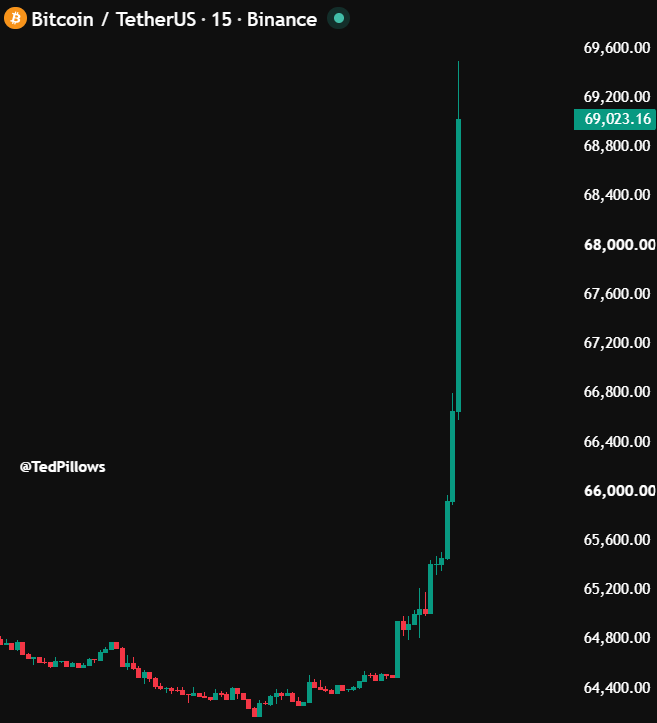
Everyone is talking about how Bitcoin went up $6,000 in 15 minutes.
Everyone’s posting about it…
But almost nobody is explaining what actually caused it.
Stop staring at the chart. Look at the flows.
Within minutes, wallets tied to Wintermute, Binance, Coinbase, and ETF-linked addresses all became active simultaneously.
Large blocks moving between exchanges.
MASSIVE market buys hitting thin order books.
Then suddenly…
THEY FLIPPED AND STARTED SELLING EVERYTHING.
Here’s what really happened:
– Liquidity was thin
– Leverage was stacked heavily on one side
– Funding rates were already stretched
So price gets pushed higher aggressively.
Why?
To trigger FOMO and, more importantly, force shorts out while pulling new longs into the market.
Once enough leverage was trapped…
They started unloading.
The data shows it clearly:
– Coordinated inflows to major exchanges
– Large market buys clustered within a narrow window
– Immediate reversal after stop levels were cleared
– Heavy selling right after liquidation zones were hit
This is how INSIDERS DUMP without crashing price.
They move the market toward liquidity, trigger liquidations, and then sell directly into the chaos they just created.
And it wouldn’t surprise me if they were running long and short positions simultaneously through separate wallets.
If you’re new to this market, understand one thing:
Bitcoin almost never moves like this because of headlines.
It moves when leverage builds up and someone with enough size decides it’s time to wipe everyone out.
Watch funding rates. Watch open interest. Watch where coins are moving, not who is posting charts.
For the record, I was the only one publicly calling the exact bottom at $16,000 three years ago and the top at $126,000 in October.
If you missed those calls, don’t worry. I’ll call the next one too.
Turn notifications on. If you’re not following yet, you’ll understand why that was a mistake later.
🚨 HERE’S WHAT ACTUALLY CAUSED BITCOIN TO EXPLODE TO $69,700.
Everyone is looking at the Bitcoin candle.
But the move started in a completely different market:
U.S. Treasury bonds.
The Treasury just DOUBLED the size of its long-term bond buyback program.
→ Old maximum: $2 BILLION per operation
→ New maximum: AT LEAST $4 BILLION
→ Targets: 10-to-20 and 20-to-30-year Treasury bonds
→ Starts September 9 through November 4
In simple words:
The Treasury is offering more support to the market for long-term U.S. government debt.
And that matters because Treasury yields are basically the return investors can get from holding government bonds.
When those yields FALL, risky assets like Bitcoin usually become more attractive.
And look what happened right after the announcement:
→ 10-year yield: -6 bps to 4.647%
→ 30-year yield: -9 bps to 5.196%
Then Bitcoin moved.
$65,400 at 10:45 AM ET
→ $67,600 at 11:26 AM ET
→ $69,700 at 11:27 AM ET
Bitcoin gained more than $2,000 in ONE MINUTE.
That move trapped traders betting against Bitcoin.
As their leveraged shorts were liquidated, they were forced out of their positions, creating even more buying.
The result:
💀 $1.59 BILLION in crypto liquidations over 24 hours
💀 $746 MILLION in Bitcoin shorts reportedly wiped out in that one-minute candle
So the chain reaction was simple:
TREASURY EXPANDS BOND BUYBACKS
↓
LONG-TERM YIELDS FALL
↓
BITCOIN PUMPS
↓
SHORTS GET LIQUIDATED
↓
FORCED BUYING SENDS BTC EVEN HIGHER
One important correction:
⚠️ This is NOT QE.
⚠️ The Fed did NOT turn on the money printer.
Treasury is buying back existing government bonds to improve liquidity in that market.
And the size is still small compared with how much debt the U.S. issues.
But the timing matters.
The bond market moved FIRST.
Bitcoin followed.
Then the short squeeze turned it into an explosion.
Everyone is showing you the green candle.
Almost nobody is talking about what happened right before it.
September 9 is now the date to watch.
It’s peak bear market.
Why? Just look at the futures volumes on the major exchanges.
And honestly, I like it. Why?
Because there’s very little interest in crypto right now. And that’s exactly when people like you and me, who are still here, can quietly accumulate before the masses come back.
Be proud of yourself for still showing up and grinding through this.
Over the coming months, I’ll help you prepare for the next bull run.
And I think the next cycle has some pretty powerful things working in its favor:
• Regulatory clarity with the CLARITY Act
• Tokenization of real-world assets
• Growing stablecoin adoption
• AI agents and the emerging AI economy
• Potential capital flows from the AI boom into crypto
Crypto is becoming increasingly connected to the broader financial system and the technology landscape.
I don’t know exactly when the next bull run will start. I don’t know how high it will go.
But I do believe the setup could be very different from the last cycle.
And I wouldn’t be surprised if the next one ends up being much bigger.
For me, the strategy is simple:
Stay patient.
Keep accumulating.
Keep learning.
And be positioned before the crowd comes back.
The hardest part of a bear market is staying consistent when nobody is paying attention.
That’s also what makes it an opportunity.
🚨 JUST IN: #Ripple CEO Brad Garlinghouse just spoke at the Wyoming Blockchain Symposium.
Here are his key statements 👇
1/9
Garlinghouse rejected the claim that crypto is anti-regulation, noting that Ripple holds 75 licenses worldwide.
He also cited the federal court conclusion that XRP, in and of itself, is not a security. #XRP
2/9
Garlinghouse said #Ripple has long positioned itself as a bridge between traditional and decentralized finance.
A strategy once criticized by crypto purists is now increasingly recognized as a strong position in a regulated financial world.
3/9
Garlinghouse said #Ripple is heading for a record year and expects to more than double revenue year over year, despite the broader crypto bear market.
He said institutional infrastructure is where the industry’s momentum is moving.
4/9
Garlinghouse said #Ripple completed $2.5B in acquisitions last year and $3B in shareholder tender offers over the past two years.
He expects larger acquisitions and further industry consolidation during the crypto winter.
5/9
Garlinghouse said Hidden Road cleared $3T in transactions last year, while GTreasury touched $13T.
Ripple acquired both as it expands its institutional prime-brokerage and treasury infrastructure.
6/9
Garlinghouse said #Ripple’s acquired platforms collectively touch approximately $16T in transactions, comparable in scale to Visa.
Moving part of that activity on-chain could improve speed, cost and certainty.
7/9
Garlinghouse said #Ripple has seen a significant shift over the past six months, with CFOs and corporate treasurers now approaching the company about adopting its technology.
8/9
Garlinghouse challenged the claim that AI itself is responsible for major corporate layoffs, arguing that organizational bloat is often the underlying issue.
He said AI helps growing businesses operate better, faster and more effectively.
9/9
Garlinghouse said agentic payments have potential, but corporate access and human accountability require substantial guardrails.
His assessment: market excitement is currently ahead of operational reality.
Liked what you just read? Follow @RippleXity and never miss the $XRP deep links others overlook.
I don’t think people understand the magnitude of the movement of coins as a result of the coldcard hack.
It was a similar event to FTX in terms of migration of coins.
Ripple's roadmap: the $XRP Ledger fully post-quantum by 2028.
NIST algorithms already running on the dev network — not a whitepaper promise.
Your DEX shouldn't be an afterthought when Q-Day comes.
https://t.co/q7HC2SareJ
Next to the Clarity act, there is nothing more important than the alliance of BlackRock, CoinBase, Circle and ETH. My biggest bets of this cycle are on $ETH, $CIRCLE and $COIN. The reasons are in the ‘Galactic Three’ report I have shared few days ago. It’s coming!
🚨 JUST IN: Most people have no idea how the $XRP Ledger actually works.
There are no miners. No stakers. No block rewards.
Around 120 validators worldwide simply agree.
When 80% of them see the same thing, a ledger closes. Every 3 to 5 seconds. Since 2012.
Nobody gets paid to do it.
That's why it's never gone down.