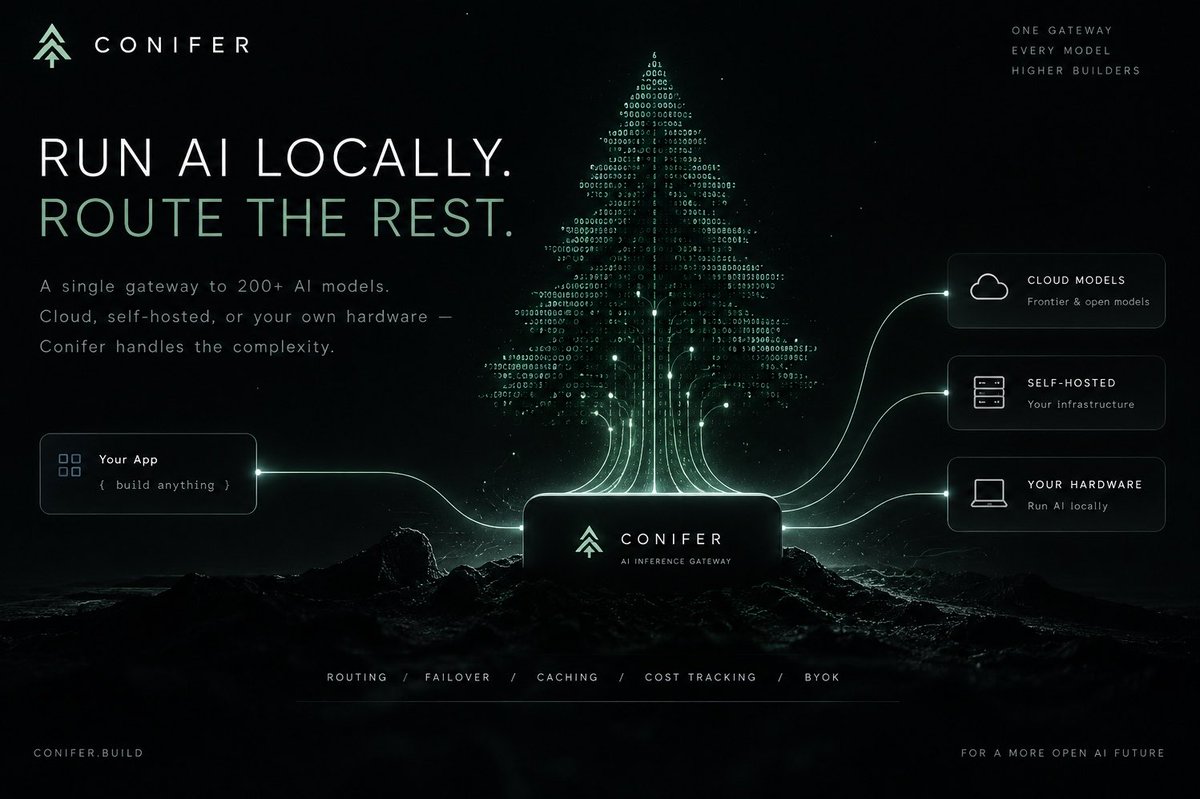
$CONIFER IS LIVE.
CA: 0x80D7796Bc9cD60C36501702828c950d1e958D8cB
The CA is out. Now the real journey begins.
Conifer represents a simple idea: AI shouldn’t be fragmented across countless models, providers, and integrations.
One gateway can connect developers to a growing AI ecosystem — making model access, routing, and infrastructure easier to manage.
From cloud models to self-hosted AI, the goal is simple:
Less complexity. More possibilities.
WHY CONIFER? WHY PAY ATTENTION?
AI is moving faster than ever.
Every week brings new models, new providers, and new capabilities. But more options also mean more complexity for developers.
That’s the problem Conifer is built around.
One gateway.
Multiple AI models.
Simpler infrastructure.
Conifer brings together model access, routing, provider flexibility, caching, and other infrastructure into one layer.
What makes the concept interesting is the direction of AI itself: as the number of models grows, the infrastructure connecting those models becomes increasingly important.
Conifer isn’t about betting on one AI model.
It’s about building around the ecosystem.
Explore the website. Understand the technology. See where the infrastructure goes next.
THE NEXT CHAPTER STARTS NOW.
The launch was only the beginning.
Conifer represents a simple vision for a complicated AI world — bringing different models and providers closer together through a unified gateway.
As AI keeps expanding, infrastructure becomes just as important as the models themselves.
This is where the journey begins:
Build the gateway.
Connect the models.
Grow the ecosystem.
No shortcuts. No finished story.
CONIFER IS JUST GETTING STARTED.
THIS IS WHERE THE CONIFER STORY GETS INTERESTING.
The AI world is becoming more connected — but also more complex.
New models.
New providers.
New capabilities.
Conifer is built around a simple concept:
CONNECT THE AI ECOSYSTEM THROUGH ONE GATEWAY.
Instead of treating every model as a separate destination, Conifer creates a unified layer for accessing and routing across AI infrastructure.
The website is live.
The CA is live.
The community is here.
Now comes the part that matters:
BUILD. GROW. EVOLVE.
Conifer is only at the beginning.
CA: 0xD12ae2461E1e90f53bC81cef4187181aca7E603F
THE GATEWAY IS OPEN. NOW THE STORY BEGINS.
AI is moving toward a world with thousands of models, providers, and tools.
The question is no longer just “Which model is the best?”
It’s:
How do we connect them all?
That’s where the Conifer vision becomes interesting.
One gateway.
Multiple models.
Routing.
Failover.
Caching.
Developer infrastructure.
The website gives a glimpse into a future where building with AI doesn’t mean managing a different integration for everything.
CONIFER IS LIVE.
The CA is out.
The infrastructure story is just beginning.
THE CA IS OUT. NOW WATCH THE BUILD.
Conifer is more than another AI narrative.
The AI ecosystem is expanding rapidly, and with every new model comes more APIs, more providers, and more infrastructure to manage.
Conifer’s vision is simple:
ONE GATEWAY.
EVERY MODEL.
LESS COMPLEXITY.
That’s what makes the website worth exploring — it’s focused on the infrastructure layer connecting developers with the rapidly growing AI ecosystem.
The token is live.
The website is live.
Now the community gets to watch the story unfold.
WHY IS CONIFER WORTH WATCHING?
The AI ecosystem is getting more fragmented every day.
Hundreds of models.
Multiple providers.
Different APIs.
Different infrastructure.
Conifer takes a much simpler approach:
ONE GATEWAY → MANY AI MODELS
The website shows a vision for AI infrastructure where developers can access, route, and work with different models through a unified layer.
That matters because as AI grows, the infrastructure connecting all these models becomes increasingly important.
Conifer isn’t trying to be just another AI app.
It’s building around the layer underneath the AI applications.
Explore the website. Understand the infrastructure.
Then watch where Conifer goes next.
THE NEXT LAYER OF AI STARTS HERE.
The CA is live.
The gateway is open.
Conifer is built around a simple idea: AI shouldn’t feel fragmented.
Different models.
Different providers.
Different infrastructure.
One gateway to bring them together.
As the AI ecosystem keeps expanding, the infrastructure connecting it all becomes just as important as the models themselves.
THE GATEWAY IS OPEN.
Conifer is now live.
AI is evolving faster than ever — new models, new providers, and new ways to build are appearing every day.
Conifer brings that growing ecosystem together through one gateway, creating a simpler path between developers and the models they want to use.
One gateway.
Every model.
One vision for a more connected AI ecosystem.
The launch is only the first step.
CONIFER IS LIVE.
A new paper just showed that a small model reading the full context can steer a big model that has been blindfolded, and get most of the full-context answer back at a fraction of the cost.
The setup that makes this surprising is speculative decoding. Normally the small model guesses the next few words, the big model checks them all in one pass, and any word it would have written itself gets kept. One pass, several words back, no quality lost. But this only works if both models read the same input. "AsymSpec: Context-Asymmetric Speculative Decoding for Agentic LLMs" breaks that rule.
The paper looks at long agent sessions, where context keeps growing from tool calls and retrievals, and the cost of carrying it scales with the size of the model reading it. Usually you would compress the context and take the quality loss on both models so they still read the same inputs. AsymSpec compresses only what the big model sees, letting the small model read everything.
So the small model still knows the exact file path and the details that got cut, data the big model can no longer see. The big model's role changes here. The small model runs twice, once on the full context and once on the compressed one, and the difference between those two runs gets added to the big model's own scores before it picks a token. Rather than seeing the full context itself, the big model gets told what the missing context would have changed. Your final output is no longer identical to what the big model would have gotten alone, since it now has both the big model's judgment and the small model's memory, so information you would have thrown away survives into the answer.
Two catches. It is not lossless the way speculative decoding is, so you trade a little quality for a much cheaper expensive step. And it does not run on a closed API since it needs raw probability scores from both models. The eval also ran greedy, always taking the single most likely next word, which is not how most deployments run.
This is still the same decision our router makes, one level up. We pick which model gets a request when it arrives, and AsymSpec picks how much context each model gets inside a single answer. Same idea at a finer grain, except it only runs the models you host, which is the part teams building on closed APIs can't copy.
What is Conifer?
Conifer is AI infrastructure built to make working with multiple AI models much simpler.
Instead of integrating different providers one by one, developers can connect through a single gateway and access a wide range of models through one API.
The flow is simple:
App → Conifer → AI Model → Response
Conifer handles the complexity behind the scenes, including model routing, provider failover, caching, and cost tracking.
The bigger idea is simple:
One gateway. Multiple models. One infrastructure layer for AI.
Conifer is building the layer that connects developers to the growing AI model ecosystem.
Conifer is an open-source runtime that makes local AI actually fast, private, and reliable.
Here's the problem we kept running into: running AI models on your own machine should be the obvious choice for anything private, your code, your documents, your data. But anyone who's tried knows the truth: the hard part isn't the model, it's everything around it. Setup. Storage. Quantization. Memory management.
Getting it to actually use your GPU properly. Splitting a model across multiple cards without it falling over. Keeping it stable when it runs for hours instead of minutes. Most people hit that wall and go back to the cloud. Which means their data leaves their machine, their costs scale forever, and their tool breaks the day someone else's servers have a bad day.
Conifer is the layer that handles all of it. It manages the model, setup, storage, quantization, and memory, and schedules the work across whatever hardware you actually have, so local inference just runs. The goal is simple: local AI that's genuinely competitive with the cloud, not a slower fallback you settle for. And we're getting there. In early benchmarks Conifer already beats llama.cpp on decode for some models (1.24x on Qwen, 1.13x on TinyLlama) and MLX on prefill (1.26x on Qwen). It's not a clean sweep yet, there are places we're still behind and tuning hard, but it's genuinely competitive, and the numbers are climbing before launch.
Conifer launches June 1st. Completely free and open source. Install it, point it at a model, and see what it does for yourself, no signup, no trial, no catch. We're opening beta access to the first 100 people on the waitlist before then. If you run models locally, or you've wanted to but the setup beats you, we'd love for you to try it and tell us what breaks.
Link for signups will be in the replies.