Perhaps it’s a bit late but really really excited to share that our work CSE on testing JIT compilers of modern production language virtual machines like JVMs has received a Best Paper Award at SOSP’23. Many many thanks to Zhendong @zhendongsu and the systems community. (1/n)
Recently, we've been working on a new paradigm for random program generation (RPG), which we call *semantic reification*.
Unlike typical syntax-first RPG, semantic reification is semantics first.
🚀 I'll be launching the Formal Methods Engineering Lab (https://t.co/9pjKYVa89h) – and I am hiring! If you’re interested in working with me, feel free to reach out.
🚀🔍🧑🏫 I am on the academic job market! My research focuses on advancing Formal Methods, Programming Languages, and Software Engineering.
Website: https://t.co/ypqj71vafu
Research Statement: https://t.co/32B5kvCDIE
🚀 Excited to introduce our OOPSLA '24 work on ET, a powerful tool for bounded validation of SMT solvers, which has uncovered 100+ correctness and performance bugs 🪳, while ensuring the absence of simple bugs in the solvers.
Preprint: https://t.co/3VSmM7Kuqi
#SPLASH2024 #SPLASH24📖
@CSatETH (@ETH_en) is hiring a tenure-track assistant professor in Theory B: Logic, SMT/SAT, decision procedures, theorem proving, semantics, type systems, etc.; please apply by 15 January 2025! More info at: https://t.co/Bn5uQjUKev
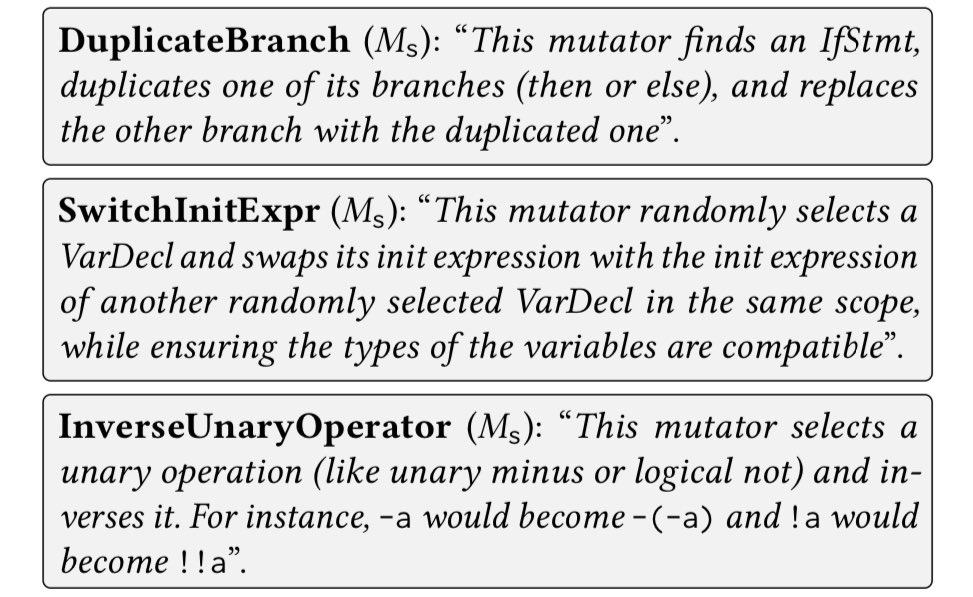
Below present some mutator examples (their names and descriptions) and the mutator ModifyFunctionReturnTypeToVoid’s code before and after fixing. More examples can be found in https://t.co/DrXapjOZsw.
Late again! But glad to share that our work “The Mutators Reloaded: Fuzzing Compilers with Large Language Model Generated Mutation Operators” was accepted by ASPLOS ’24 (will be presented in ’25):
Preprint: https://t.co/UEhMg4EYlV
Tryout: https://t.co/8UEKTGA1BJ
(1/n)
We break down the synthesis process into 3 steps: (1) Think out a name and a desc in natural language as a new mutator. (2) Generate the code for mutating a C program following a mutator’s name and desc. (3) Refine the code to validate its correctness and fix all found bugs.
Today we’re announcing Meta LLM Compiler, a family of models built on Meta Code Llama with additional code optimization and compiler capabilities. These models can emulate the compiler, predict optimal passes for code size, and disassemble code. They can be fine-tuned for new optimizations and compiler tasks.
@HuggingFace repo ➡️ https://t.co/9URAr9sn5E
Research paper ➡️ https://t.co/nIYvWHqm1D
LLM Compiler achieves state-of-the-art results on code size optimization and disassembly. This work shows that AI is learning to optimize code and can assist compiler experts in identifying opportunities to apply optimizations.
We’re releasing LLM Compiler 7B & 13B models under a permissive license for both research and commercial use in the hopes of making it easier for developers and researchers alike to leverage this in their work and carry forward new research in this space.
Finally got around to publishing the slides of my talk @offensive_con from ~two weeks ago. Sorry for the delay!
The V8 Heap Sandbox: https://t.co/2As3NlRebZ
Fantastic conference, as usual! :)