Allenes to pyrroles: congrats to Tobias Kaper (visiting Ph.D. from @UniOldenburg) and Connor Frye on this cool study incorporating allenes as partners in Ti-catalyzed [2+2+1] reactions, out now in our favorite journal @Orgmet_ACS! https://t.co/gkcfnxeQOP
Our latest out in @Orgmet_ACS: a neat rearrangement of a Ti metallacycle gave us insight into how Ti-catalyzed alkyne carboamination works! Congrats to the team: Jaekwan for leading; Evan, Dominic, and Connor for contributing key results along the way! https://t.co/beUyN1SbYG
Congrats to @janayasachs on publishing her hydroesterificative polymerization work in @MacroJrnls_ACS! You need very clean/high yielding catalysis to get high Mn polymers via step growth. This is also the 50th research article from the Tonks Group!!! https://t.co/YsobgQDppz
We are ready. 🚀
The uncrewed #Artemis I mission around the Moon will pave the way for future astronauts. The Artemis Generation is about to leave its mark.
On Aug. 29, watch history with us: https://t.co/Dx9WUCnnBS
The culmination of my graduate work thus far was published today in Nature Chemistry! A giant thank you to Ian for the support and mentorship along the way, and to Rachel D and Lexi for their contributions!
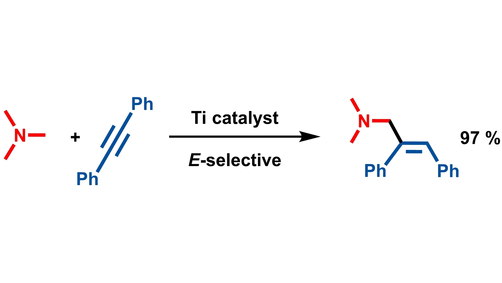
Stereoselective Synthesis of Tertiary Allylic Amines by Titanium-Catalyzed Hydroaminoalkylation of Alkynes with Tertiary Amines (Doye et al.) @kapertron#OpenAccess thanks to #ProjektDEAL https://t.co/8XQSYl9GV4
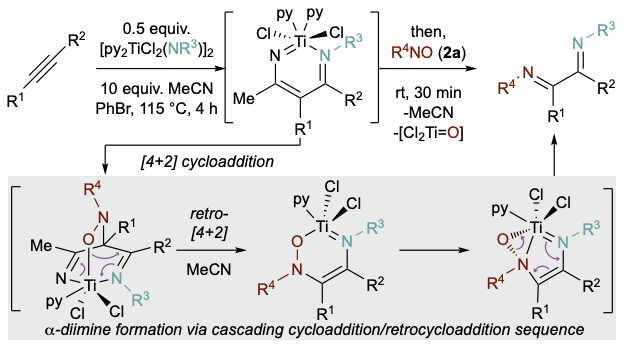
Please have a look at our paper: a simple and modular way to make unsymmetrical a-diimines that you can't make via stepwise condensation! Now on
@ChemRxiv, may it find a nice peer-reviewed home soon. 🙂 https://t.co/pQpvPs55VY
@lisarose_ltpb @CIC_ChemInst@DaltonTrans@cscinorgdiv @degruyter_phys The conversion of imido to metallacycle can be increased significantly, but at the cost of using excess alkyne and nitrile (3:3:1 stoichiometry)
Here's what I've been working on in the Tonks group at UMN! #gidw2020
P46 - Ti-Mediated Intermolecular Diamination of Alkynes via [4+2]-Cycloaddition Reactions with Trapped 2+2 Intermediates
Thanks @CIC_ChemInst@DaltonTrans@cscinorgdiv @degruyter_phys for supporting the event
@lisarose_ltpb @CIC_ChemInst@DaltonTrans@cscinorgdiv @degruyter_phys 2/2 For the second step conversion from metallacycle to diimine is usually very high. The leftover imido from the first step will react with the remaining nitroso to form azo compounds, but I don't believe this affects diimine yield.
@lisarose_ltpb @CIC_ChemInst@DaltonTrans@cscinorgdiv @degruyter_phys 1/2 For the most part, the current yields are due to limited conversion to metallacycle rather than different products being formed. A small amount (<5% usually) of pyrrole can be formed with some alkynes in the first step.
@lisarose_ltpb @CIC_ChemInst@DaltonTrans@cscinorgdiv @degruyter_phys 3/3 However, you do need stoichiometric amounts (or excess in case of terminal alkynes) to prevent pyrrole formation from a second equivalent of alkyne.
@lisarose_ltpb @CIC_ChemInst@DaltonTrans@cscinorgdiv @degruyter_phys 1/2 Thank you! Dominic and Errikos who are visiting students in our group have been helping me with synthetic and computational work. The lab shutdown gave me a lot of time to dip my toes into DFT calculations.
@lisarose_ltpb @CIC_ChemInst@DaltonTrans@cscinorgdiv @degruyter_phys 2/3 Nitrile is not consumed in the reaction ultimately since it is ejected again, if you track by NMR you can actually see nitrile get consumed to form metallacycle then come back one nitroso is added.
@LaurelSchafer 2/2 We've thrown around idea of trying to isolate a discrete titanium oxo complex with the diimine bound, but have not attempted it yet. It certainly possible that the oxo species would dimerize/oligmerize instead of being discrete, but we didn't look at that for the computations
@LaurelSchafer 1/2 Thanks! There isn't any animation in the poster itself (I tried but it looked awful due to low resolution), but the gif in the reply should be animated if working correctly.


![ianatonks's tweet photo. Allenes to pyrroles: congrats to Tobias Kaper (visiting Ph.D. from @UniOldenburg) and Connor Frye on this cool study incorporating allenes as partners in Ti-catalyzed [2+2+1] reactions, out now in our favorite journal @Orgmet_ACS! https://t.co/gkcfnxeQOP https://t.co/kuVPa3QTnr](https://pbs.twimg.com/media/FzU4puSWIAMecro.png)


![ConnorFrye42's tweet photo. Here's what I've been working on in the Tonks group at UMN! #gidw2020
P46 - Ti-Mediated Intermolecular Diamination of Alkynes via [4+2]-Cycloaddition Reactions with Trapped 2+2 Intermediates
Thanks @CIC_ChemInst @DaltonTrans @cscinorgdiv @degruyter_phys for supporting the event https://t.co/nyKrnxjz7w](https://pbs.twimg.com/media/EcfHQqhXsAABZBc.jpg)


