The 5 inputs to run it on your own business:
1. Monthly spend, counted honestly
2. Customers in year one (be conservative, 3 to 5)
3. Monthly value per customer
4. Average lifetime in months
5. Customers x value x months, divided by spend x 12
Above 2, start. Above 4, you should have started last year.
The SEO ROI model:
$1,500 a month x 12 = $18,000 in.
5 customers at $2,000 a month, staying 10 months = $20,000 each.
$100,000 out.
5.5x in year one. From a channel most people quit at month four.
New issue is live: I pitched 50 websites to get EcomBalance into ChatGPT's sources. 5 to 10 said yes.
The full 6-step process, the email, what's changed in 2026, and a free tracker.
Free to read. Link below.
@CraigRFTW Totally agree, since a niche site that’s actually about the topic helps with Google and AI at the same time, while a big generic mention barely moves either.
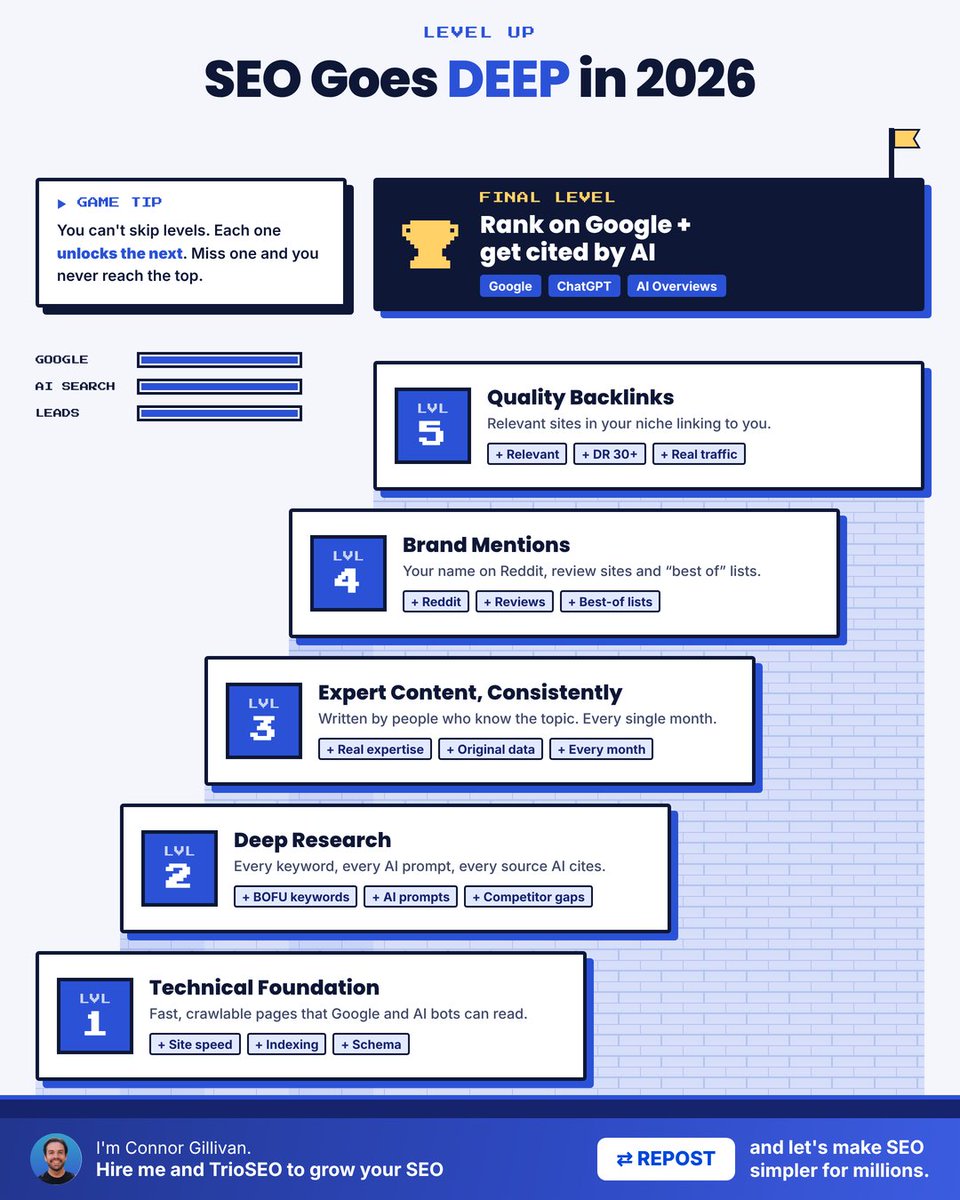
SEO goes DEEP in 2026. It's not just Google. It's all this:
Most people think SEO is one level.
Write a blog. Hope it ranks.
That worked in 2015.
Today it's more like a video game.
You have to clear every level to reach the top.
Level 1: Technical foundation
↳ Fast, crawlable pages that get indexed.
↳ Google and AI bots have to be able to read your site.
↳ Skip this and nothing else you do counts.
Level 2: Deep research
↳ Every keyword your buyers search on Google.
↳ Every prompt they type into ChatGPT.
↳ Every source AI already cites in your niche.
Level 3: Expert content, consistently
↳ Written by people who actually know the topic.
↳ Real expertise and original data, not rewritten blog posts.
↳ Published every single month. Not a burst, then silence.
Level 4: Brand mentions
↳ Your name on Reddit, review sites and "best of" lists.
↳ AI trusts what other people say about you.
↳ Most AI citations come from third-party sites, not yours.
Level 5: Quality backlinks
↳ Relevant sites in your niche linking to you.
↳ Real traffic. Real authority. Quality over quantity.
Final level: Win search
↳ Rank on Google.
↳ Get cited in ChatGPT and AI Overviews.
Every level unlocks the next.
Great content on a broken site goes nowhere.
Great content with no authority gets ignored by AI.
You can't win in "search" without all five.
Which level is your business stuck on?
♻️ Repost to help someone who thinks SEO is "just blogging."
P.S. Want help clearing all five levels? Join the 10 free articles Beta Program. Email [email protected] to see if you qualify.
The reason people still ask "is SEO worth it" in 2026:
Nobody shows them year two.
They see $1,500 a month and a wait, and they stop.
Year two is the whole point.
Most people pick keywords by search volume.
That’s usually a mistake.
I ran one Semrush prompt that proved it on my own site.
I connected Semrush to Claude.
Grabbed their content gap prompt.
Pointed it at EcomBalance, my bookkeeping company.
It found my real competitors and ran a keyword gap. Ten topics I don’t rank for:
↳ Amazon FBA, 160k searches a month
↳ eBay fees, another 150k
↳ Etsy, Shopify, balance sheets, all big
↳ Near the bottom: ecommerce CPA, barely 2k
Six months ago I’d have chased the big numbers.
But those are how-to searches. People learning, not hiring.
The 2k cluster is people looking for a bookkeeper right now.
My competitors rank 1 to 4 for “ecommerce accountant.” We’re missing.
That’s not low traffic. That’s leads going to them.
Volume gets you reach. Intent gets you clients.
Most people only chase the big number.
This used to be a full afternoon in spreadsheets.
The prompt sorted it in about a minute.
Which gap would show up for your site?
♻️ Repost to help another operator find theirs.
Try the Semrush prompt library: https://t.co/GiDgvaWZXz
P.S. I write about SEO, GEO, and building a B2B portfolio daily.
#SemrushPartner
https://t.co/GiDgvaWZXz