A criminal record reduces earnings and shifts workers across firms. Firms vary substantially—even within industry—in their propensity to hire workers with records, from @ProfHjalmarsson, Matthew J. Lindquist, Louis-Pierre Lepage, and @conradcmiller https://t.co/E3rvqr3wa6
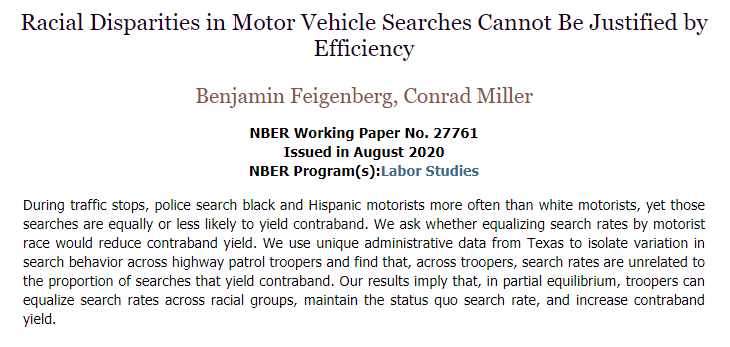
Police search low-income motorists more often but are less likely to find contraband in those searches and disparities are driven, at least in part, by class-based profiling, from Benjamin Feigenberg and @conradcmiller https://t.co/K6G8I7biKb
LAST CALL: Today is the deadline to submit your paper for the second Conference on Discrimination in the 21st Century.
Learn more about the conference organized by Marianne Bertrand, @alexoimas, @conradcmiller & @veronesi_pietro: https://t.co/cZiDaSmGqW
#EconTwitter
@jenniferdoleac@sarahlageson@NiskanenCenter From an employer’s perspective, expungement and non-prosecution seem like similar policies to me. They both remove information, in a way. Can you say more about why you see the two as fundamentally different?
Recently accepted by #QJE, “Would Eliminating Racial Disparities in Motor Vehicle Searches Have Efficiency Costs?” by Feigenberg and Miller (@conradcmiller): https://t.co/c6hc54Ni7G
Tomorrow (Thursday) at 3 PM EST, @conradcmiller (@BerkeleyHaas) will present “The Dynamics of Referral Hiring and Racial Inequality: Evidence from Brazil” at the
IDB's EconNet seminar. Our virtual seminar is open to the public! You can register here: https://t.co/vghIYO022A
@johannarickne @ianschmutte @mikekofoed@footeball45 I don't have the data access to do that, unfortunately, but may have leads for whom you can ask. I can send you more info via DM.
Thanks to @jenniferdoleac for having me on her podcast, where we discuss my paper with Ben Feigenberg, "Racial Divisions and Criminal Justice: Evidence from Southern State Courts", forthcoming at AEJ: Policy
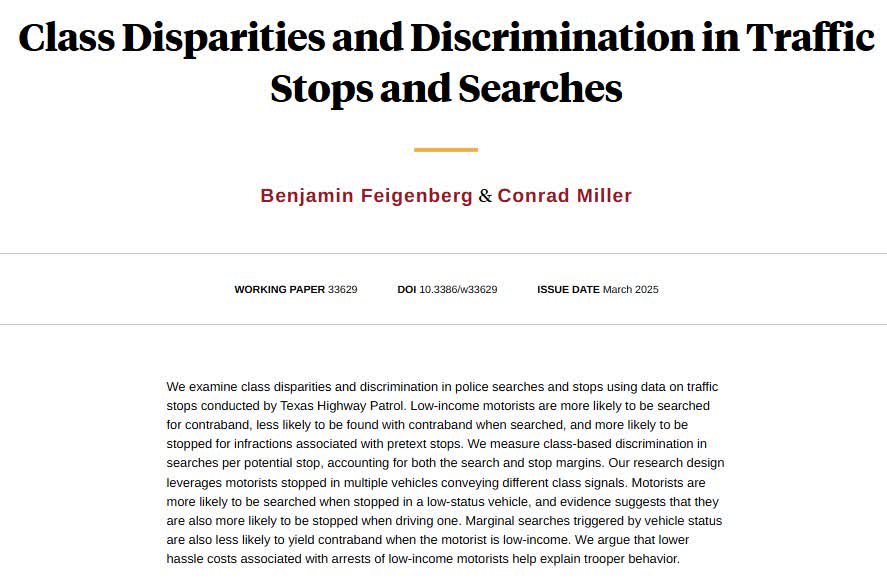
👋🏽 Excited to share research with Ben Feigenberg (@UICLAS) on racial disparities in motor vehicle searches conducted by highway patrol. TLDR: eliminating these disparities would *increase* contraband yield.
NBER: https://t.co/AvqVIUNSBD
Ungated: https://t.co/Tf8JHm75yv [1/20]
Police are more likely to search Black and Hispanic motorists for contraband during traffic stops, yet equalizing search rates across racial groups would increase contraband yield, from Benjamin Feigenberg and Conrad Miller
https://t.co/S590XOqmGD
👋🏽 Excited to share research with Ben Feigenberg (@UICLAS) on racial disparities in motor vehicle searches conducted by highway patrol. TLDR: eliminating these disparities would *increase* contraband yield.
NBER: https://t.co/AvqVIUNSBD
Ungated: https://t.co/Tf8JHm75yv [1/20]
👋🏽 Excited to share research with Ben Feigenberg (@UICLAS) on racial disparities in motor vehicle searches conducted by highway patrol. TLDR: eliminating these disparities would *increase* contraband yield.
NBER: https://t.co/AvqVIUNSBD
Ungated: https://t.co/Tf8JHm75yv [1/20]
There’s more in the paper. For example, we find that low income motorists are also more likely to be searched yet those searches are less likely to yield contraband, and that black-white disparities in search are larger in counties with higher 2016 Republican vote shares. [END]
Second, we abstract from deterrence effects. If troopers search white motorists at higher rates, perhaps white motorists would be less likely to carry contraband in the first place. We provide suggestive evidence in the paper that neither of these are first order issues. [19/20]




![conradcmiller's tweet photo. 👋🏽 Excited to share research with Ben Feigenberg (@UICLAS) on racial disparities in motor vehicle searches conducted by highway patrol. TLDR: eliminating these disparities would *increase* contraband yield.
NBER: https://t.co/AvqVIUNSBD
Ungated: https://t.co/Tf8JHm75yv [1/20] https://t.co/VxGeW96JrZ](https://pbs.twimg.com/media/Eg1s4PrVgAE7OH4.jpg)