Announcing Conscious: the easiest way to see how ethical the companies actually are.
Every company gets a clear A–F grade so you can decide in seconds whether to support them.
Already:
800+ users
550+ companies graded
7,000+ data points
Each report shows who really owns the brand, what the company is actually doing, good and bad, recent news, and better alternatives that score higher. Fully independent. No company pays to be on the platform. Every grade is backed by third-party data sources.
New companies are added daily and the database is constantly growing.
This is just the beginning. Bigger features rolling out soon, built around what people actually want when they’re trying to shop with intention.
Free to download on iOS. Link in bio.
This brand makes deodorant you buy once and refill forever. And it still hasn't sold to an evil company, unlike its rival Wild.
Fussy's refills are made from leftover sugarcane waste and break down in a home compost bin.
No aluminium. No parabens.
Two ad men launched it on Kickstarter in October 2020, taking just under £120,000.
In 2022 they pitched on Dragons' Den. Deborah Meaden and Peter Jones put in £50,000 for 2%, per The Grocer.
Then Fussy let the public buy shares. 1,225 people put in £1.1m.
B Lab audits how a company treats its workers and the planet. Fussy scored 87.7. The median is 50.9.
Wild sold the same idea. Unilever bought it in April 2025.
Ethical Consumer and The Good Shopping Guide both downgraded it.
Use the Conscious app to find ethical companies to buy from. 🔗 in bio
Etsy had one of the most tragic downfalls in ethical business.
In 2015 it went public as the biggest B Corp ever.
By 2017 an investment firm pushed the board to sell.
The CEO was gone in a day. 22% of staff were cut.
Etsy let the certification expire.
Its new CEO told the NYT: "Being good doesn't cut the mustard."
Then the 2022 fee hike sellers struck over.
Handmade labels dropped.
Shops found in illegal Israeli settlements.
If you want to find ethical alternatives to Etsy you can use the Conscious Spend app to find them...
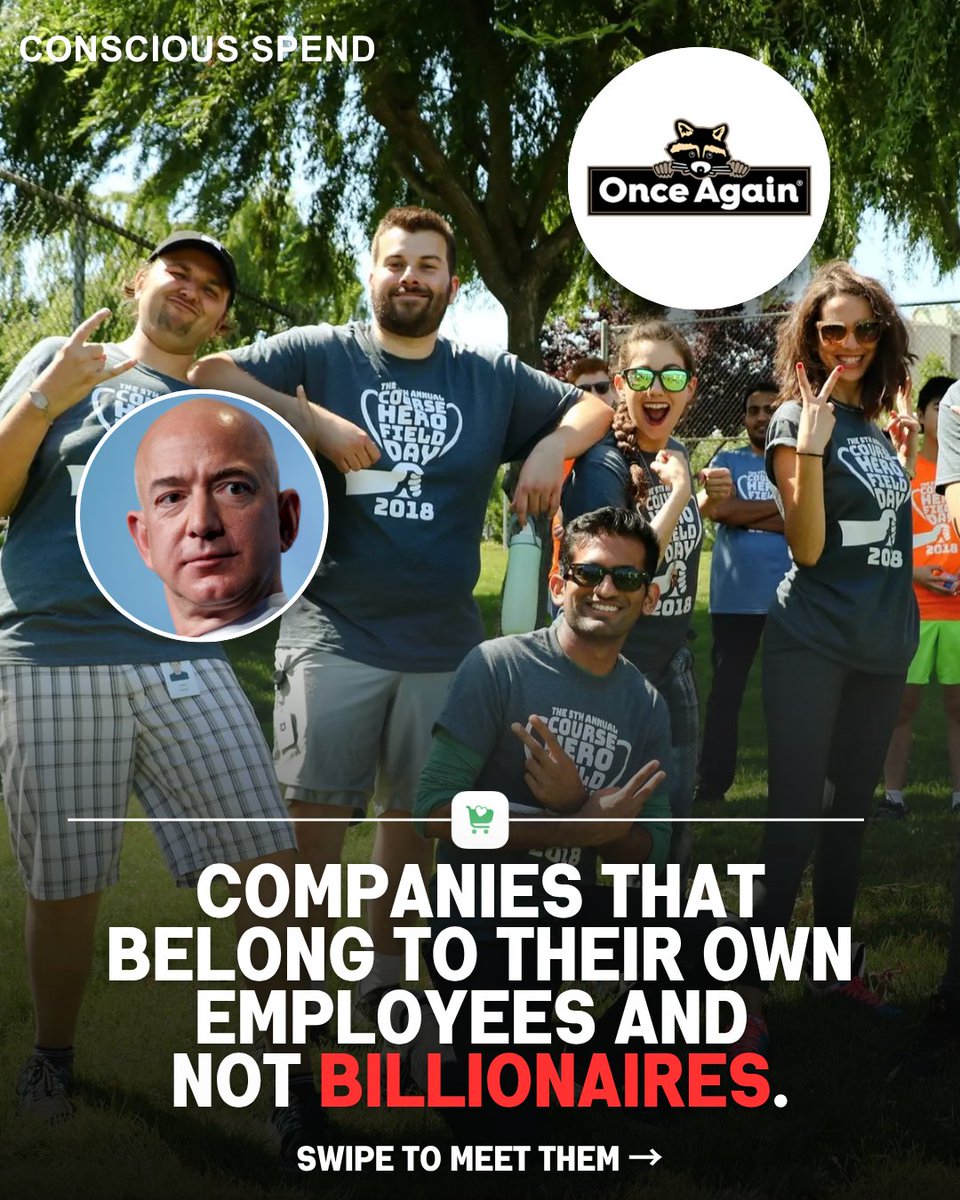
Companies owned by their own workers and not billionaires.
1. Litehouse dressings: 100% employee owned since 2014, when the founders sold the company to their staff instead of an outside buyer.
2. Once Again nut butters: 100% employee owned, one vote per person, and the workers elect the board.
3. W. W. Norton: owned entirely by its staff since the early 1960s, and still independent while the rest of publishing consolidated.
4. Alvarado Street Bakery: a worker co-op in Petaluma since 1981, where the bakers vote on their own wages and where the profits go.
CEOs at the 350 largest US companies now make about 281 times what a typical worker makes. In 1965 it was 21 times.
Roughly 6,400 US companies have an employee stock ownership plan. Each one exists because someone chose not to cash out.
You can use the Conscious app to see who actually owns a company before I spend money there. Link in bio.
Starbucks employees say a new ingredient is making them sick.
Workers have raised alarms for years, and labor judges have found the company broke the law over 400 times.
Here are 5 coffee brands people are switching to instead:
1. Counter Culture Coffee
2. Onyx Coffee Lab
3. Equal Exchange
4. Pachamama Coffee
5. Cafédirect
Most people have no idea who they're really funding. Spending is power. Check the Conscious app before your next order. Link in bio.
People are still supporting these brands accused of using child labor.
1. McDonald's
2. Tyson
3. Hyundai
4. Starbucks
5. Hershey.
Federal investigators found 305 children working illegally at McDonald's franchises. Two were 10 years old.
Hershey and other chocolate makers pledged to end child labour in cocoa in 2001, then missed 2005, 2008, 2010 and 2020.
None of it was hidden. It just never changed what anyone bought.
Use the Conscious app to find ethical companies to buy from. 🔗 in bio
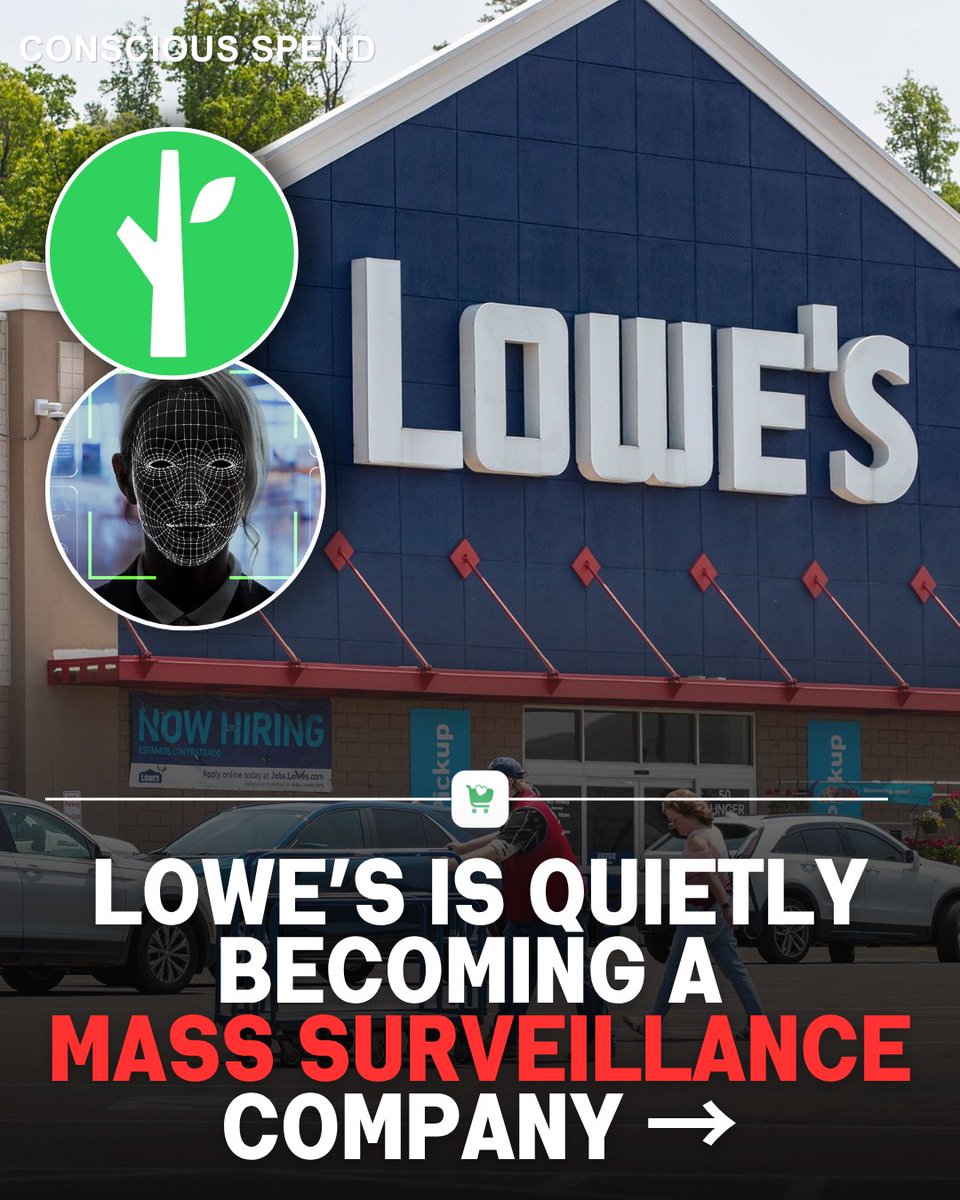
Lowe's is quietly becoming a mass surveillance company.
EFF records show one sheriff's office in Texas could tap into Flock cameras at 173 Lowe's locations nationwide.
404 Media found 4,000+ Flock lookups tied to immigration or federal requests.
Lowe's own policy says its cameras capture video and audio, and can capture race, ethnicity and disability.
In May, shareholders asked the board to report the risks. It said no.
Use the Conscious app to find ethical companies to buy from. 🔗 in bio
Ben & Jerry's parent company defunded its 40-year-old foundation and evicted the staff.
Trustees are suing. $600,000 a year in Vermont grants hangs on a judge's ruling.
here are 5 independent ice cream brands:
Straus Family Creamery — organic, founder-led
Ice Cream For Bears — founder-led
Booja-Booja — independent since 1999
Mackie's of Scotland — family farm
Taharka Brothers — employee-owned
Use the Conscious app to find ethical companies to buy from. 🔗 in bio
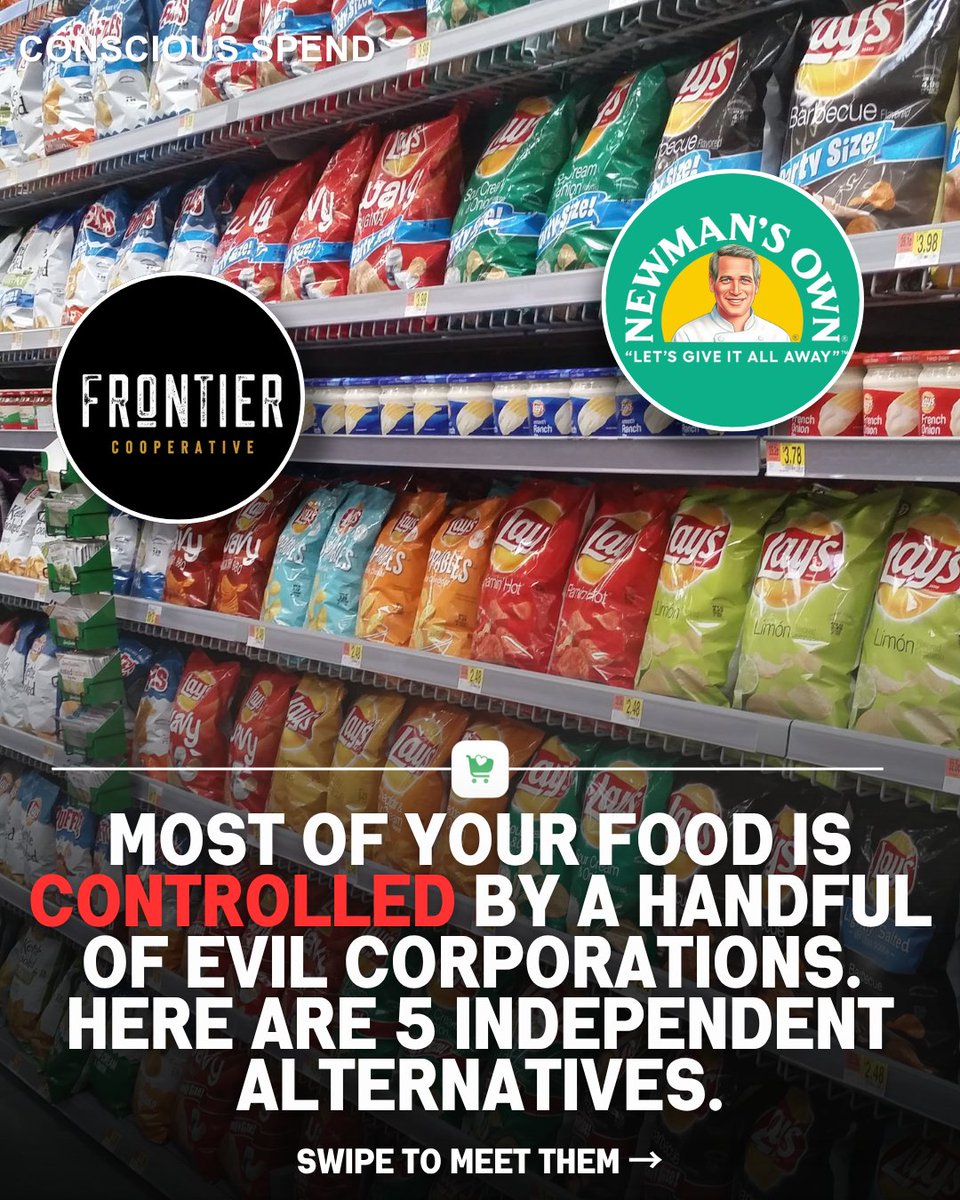
Most of your food is controlled by a handful of evil corporations.
Here are 5 independent alternatives:
Newman's Own — a foundation owns it, no shareholders
GoMacro — mother and daughter, since 2004
Rapunzel — family owned since 1974
Yeo Valley — the Mead family, since 1961
Frontier Co-op — owned by the stores that stock it
LesserEvil, Good Culture and Crofter's all sold in the last year.
Use the Conscious app to find ethical companies to buy from. 🔗 in bio
Never buy from these companies again.
1. Clorox owns Burt's Bees
2. Unilever owns Wild
3. L'Oréal owns Aesop
4. PepsiCo owns Siete
5. Nestlé owns Lily's Kitchen
Lily's Kitchen was the world's first B Corp pet food brand, per Nestlé's own release.
Siete customers say quality slipped after the $1.2B sale. PepsiCo says it is preserving the brand.
PETA lists L'Oréal as testing on animals. L'Oréal denies it.
Use the Conscious app to see who owns what you buy. 🔗 in bio
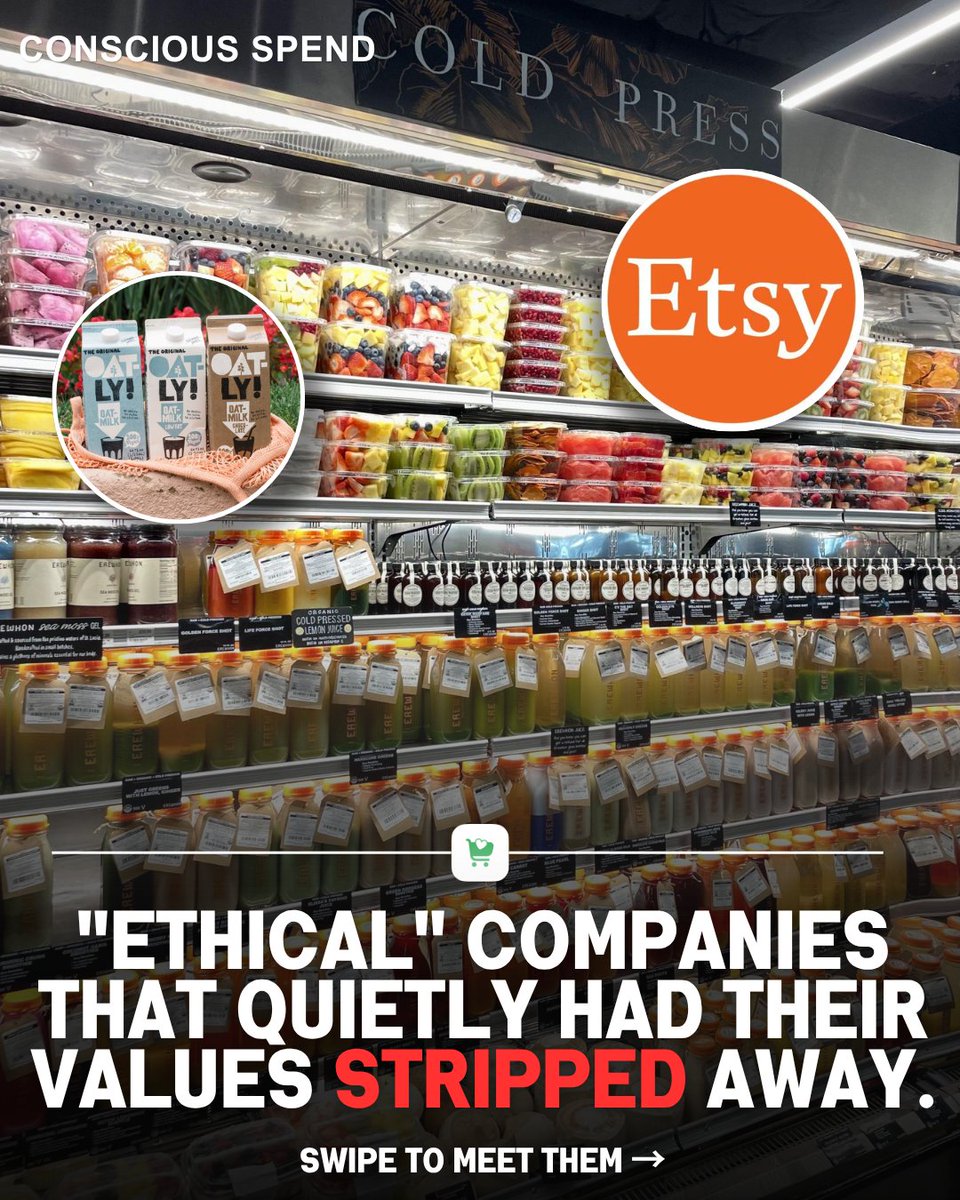
“Ethical” companies that quietly had their values stripped away:
1.Pukka — organic B Corp, lost its B Corp status under private equity
2.Etsy — early B Corp, dropped it and let in mass resellers
3.Oatly — took Blackstone money
4.Tom’s — “natural,” but Colgate owns it
5.Clif Bar — held out for decades, then sold to Oreo’s owner
Same story on repeat: bought, stripped, folded into a giant.
Use the Conscious app to see who really owns what’s in your cart. 🔗 in bio
In 2010 the world's largest food company launched a floating supermarket and sailed it into the Amazon.
The boat came weekly, carrying 300 products to 18 river towns of 800,000 people, selling pudding, cookies and candy below what local traders could charge.
In Ultra-Processed People, Chris van Tulleken writes that type 2 diabetes began appearing in children where it had been unheard of.
Nestlé pulled the boat in 2017, and private boats moved in to fill the demand.
You won't see a Nestlé boat where you live, but you will see the brands. Nestlé owns over 2,000 of them and most don't carry its name.
That's what the Conscious app is for. Search a brand, see who owns it and how they're graded. 🔗 in bio
Note: the boat had an 11-person crew and Nestlé says it included youth training.
Everlane, the "ethical" clothing brand, was sold to Shein.
5 brands people are switching to:
1. Eileen Fisher, roughly 40% employee-owned through an ESOP
2. Kotn, buying cotton direct from 5,127 family farms in Egypt
3. Girlfriend Collective, sewing through an SA8000-certified factory in Hanoi
4. Elvis & Kresse, donating half its profits to charity
5. Outerknown, FLA Accredited and publishes its factory list (Kering took a minority stake at launch)
The reason they're switching:
Puck reported the board approved a $100M sale and common stockholders got nothing, per a note to shareholders. Its owner, private equity firm L Catterton, was covering roughly $90M in debt.
Use the Conscious app to see who owns what before the next one gets sold.
5 companies that could have sold out and didn't.
1. Victorinox: the founding family gave the company away — the shares sit in foundations. 142 years, no layoffs.
2. Sierra Nevada: still 100% family-owned. After the 2018 Camp Fire it gave its relief beer recipe away free. Nearly 1,500 breweries brewed it.
3. Riverford: the founder sold most of it to his staff at about a quarter of its valuation.
4. Suma: sold to its seven employees in 1977. No bosses, no shareholders. One wage, one vote.
5. LEGO: near collapse in 2004. Forbes reported the owning family was expected to lose over $250 million. They turned down a sale and put in their own money.
Poppi took $1.95B from PepsiCo. Siete took $1.2B.
Ownership is almost never printed on the packaging.
Use the Conscious app to see who owns what you buy.
In Karur, India, workers strap cameras to their heads and fold the same towel hundreds of times a day.
They're training their replacement.
Every clip becomes training material for AI. That footage doesn't stay in India, it goes to US tech and robotics companies building humanoid robots meant to do those exact tasks.
One firm, Objectways, runs this kind of collection out of Karur, Tamil Nadu.
Workers repeat the same motion over and over so a machine can learn the pattern.
They're paid roughly 250 rupees an hour, about $2.50.
The humanoid robot market is projected in the tens of billions over the next decade.
The people teaching those robots won't see that money. And when the robots are good enough, they may not see the job either.
Use the Conscious Spend app to find ethical companies that dont do stuff like this....
Clarification: Objectways' Amazon connection is an AWS software partnership. Amazon has not been reported as a buyer of this footage.
Here are 5 ethical companies that still haven't sold to big evil corporations.
1. @DrBronner , family owned since 1948, caps exec pay at 5x its lowest-paid fully vested employee.
2. @Fairphone , Amsterdam 2013, publishes what its supply chain workers are actually paid against a living wage.
3. @Komodofashion , still run by its founder since 1988.
4. @NaturesPath , which says Kellogg and General Mills have tried to buy it. The family said no.
5. @ecosia , whose founder gave up the right to ever sell it in 2018.
Meanwhile companies like Burt's Bees went to Clorox, Aesop to L'Oréal, Kashi to Kellogg, Annie's to General Mills.
The label stays the same. The ownership doesn't.
Know who owns what you buy. Use the conscious app to see who owns any company and how ethical they are.
Most people have heard of Flock Safety. Almost no one has heard of Cognyte.
Cognyte sells a machine that fakes a cell tower. Phones nearby connect on their own, suspect or not.
The Israeli firm says it sells to governments in more than 100 countries.
Weeks before Myanmar's 2021 coup, Cognyte won a tender to sell phone intercept spyware to the country's state telecom, per Reuters.
Brazilian police allege their intelligence agency used its software to track Bolsonaro's opponents. The accused deny it.
Meta banned Cognyte from Facebook and Instagram in 2021, saying its customers targeted journalists and politicians.
Now Texas state police have $3.9 million of Cognyte gear inside four Chevy Tahoes.
See how ethical almost any company is, from food brands to surveillance firms. 🔗 in bio
Here are five companies owned by their own workers instead of billionaires.
1. King Arthur Baking. America's oldest flour company, employee-owned since 2004.
2. Bob's Red Mill. Bob Moore turned down the food giants. Worker-owned by 2020.
3. WinCo Foods. 20% of eligible pay into stock yearly. Workers pay in nothing.
4. Equal Exchange. One worker, one share, one vote.
5. Taylor Guitars. Sold to its 1,200 workers in 2021.
Use the Conscious app to find ethical companies to buy from. 🔗 in bio
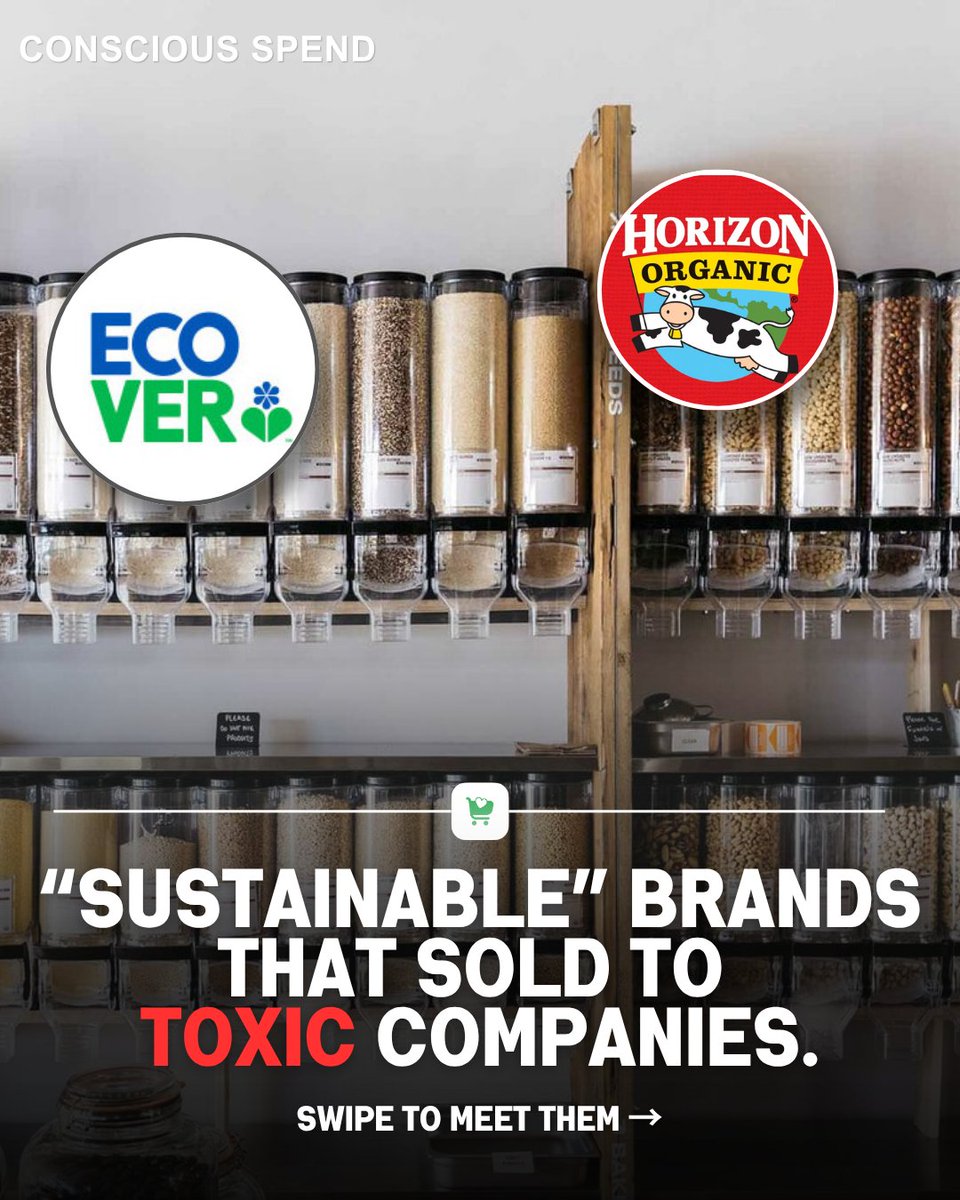
Here are 5 "sustainable" brands that sold to toxic companies.
1. Seventh Generation → Unilever, 2016
2. Horizon Organic → Danone, 2017, now private equity
3. Nest → Google, 2014
4. New Belgium → Kirin, 2019
5. Method & Ecover → SC Johnson, 2017
Every deal was legal and public, and it barely shows up on the shelf.
and sadly this is the system working as designed, because nearly 12 companies (like Nestle, Unilever, Mondelez + more) control almost everything you buy at the store...
But we can fight the system...
Use the Conscious app to find ethical companies to buy from. 🔗 in bio
So let me get this straight.
The Waze app is used in America but your data could go to Israel?
Google owns Waze, but the company you agree to terms with is Waze Mobile Ltd., incorporated in Israel.
Its terms say disputes go to a court in Tel Aviv under Israeli law.
Google never moved that to California the way it did for Maps.
Waze denies sharing data with governments.
Boycott Waze using the Conscious Spend app, where you can also find better ethical alternatives to big companies.
Big Tech is quietly moving data centers onto Native American land.
Often under NDA, before communities even hear about it.
One large data center can drink millions of gallons of water a day.
Power bills climb for the families next door.
Tribes are pushing back. The Seminole Nation passed the first data center moratorium.
The Muscogee Nation voted down a rezoning. The Yakama Nation is fighting a sacred-site project in federal court.
Advocates at Honor the Earth call it "data colonialism," and point to the companies they say are behind the push: Google, Amazon, Microsoft, Apple, Meta.
Want to avoid companies operating this way?
Use the Conscious SPend app to find ethical alternatives.