📣 Welcome to your first lesson.
Link 🔗 https://t.co/1AQmbFgpP5
Our goal for these lessons is to help you want to read a bill. Sure, understanding it is important, but you certainly won’t understand it if you don’t want to read it.
Here’s an example of how spending on a wealth redistribution program spirals 🌀 🌀 out of control.
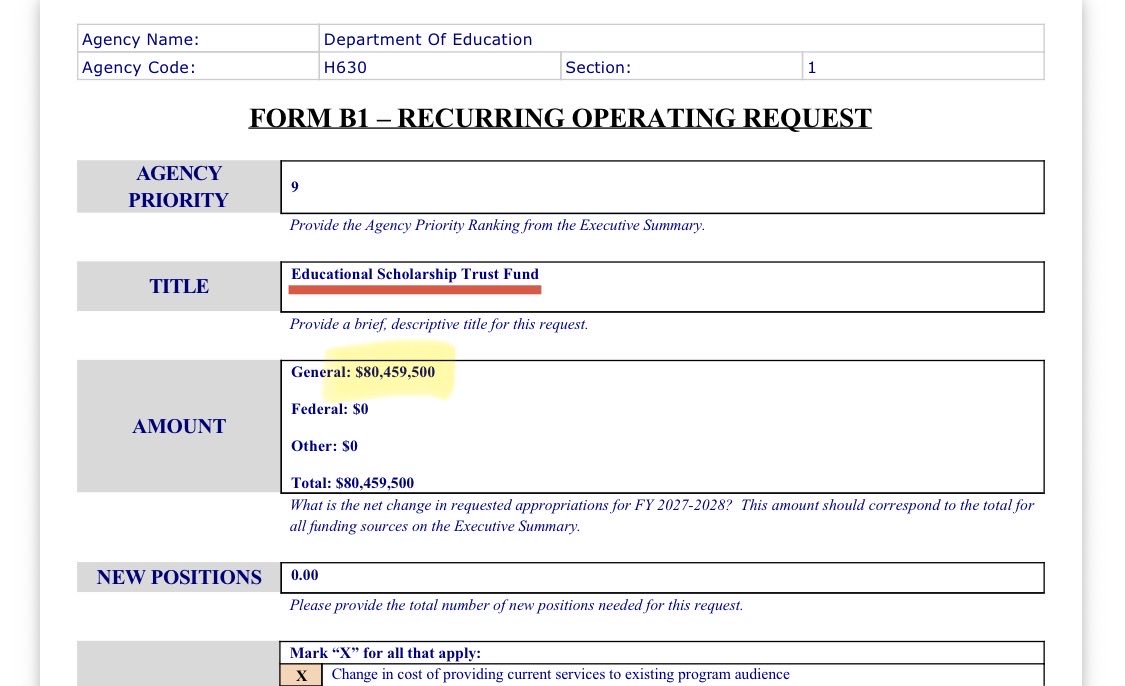
The SC Dep of Education is begging for another $80.46 million in recurring tax dollars to fund the government school choice ESTF program.
That would bring the total annual cost to taxpayers to $164 MILLION!
Yet, at the same time, senators want the citizens of SC to believe they’re working hard on tax reform to simplify the tax code and provide meaningful tax reductions.
If the state collects $90 in taxes and spends $110, where’s the other $20 coming from? 🤔
Will there ever be a day where the simple written words of the law can just be the simple written words of the law?
Or do we really need the systems in place we have today altering,skewing,manipulating, and molding them into an agenda??
We’ve been told by many of those in law that your rights are not absolute.
Now justice Thomas rights that we have absolute rights…
You’re right you’re not absolute we’re told because they can be taken from you by due process of law..
That’s fair as long as due process of law does not include enactments of legislatures who by majority make assumptions to presume guilt and deprive through arbitrary agenda….
@sccontechforum@JeanneWill41999 But it’s risky to challenge the underlying worldview by creating statutory frameworks that can eventually be used against us.
A South Carolina Citizens’ Digital Bill of Rights is a ❌ bad idea!
Why would you want to give government that kind of control? What happens when the wrong people in government get their hands on all the laws created under this legal framework?
Once you hand over that power to government, you’re giving those in power today and those who inherit it in the future the legal opportunity to abuse it.
@JeanneWill41999@sccontechforum Also, proposed legislation that includes the phrase - - Bill of Rights - - does not give it constitutional standing or make its provisions equivalent to the first ten amendments.
During recent Senate Common Sense Tax Reform Special Subcommittee hearings, the 15% property tax assessment cap under Act 388 came up for discussion, including the possibility of replacing it with a property tax levy cap.
What does this mean?
Let’s say your home is valued at $300,000. Five years later, it’s worth $450,000. Under Article X, Section 6 of the state constitution, the assessment cap generally limits the increase in the value used to calculate your property taxes to 15%, or $345,000.
For your primary residence, the 4% assessment ratio is applied to that $345,000, resulting in an assessed value of $13,800. Your property tax millage is then applied to that amount. One mill equals $1 in taxes for every $1,000 of assessed value.
What about a levy cap?
An assessment cap limits increases in the taxable value of your property. That is what we have now. A levy cap limits how much property tax revenue a government can collect overall.
For example, a county collecting $100 million in property taxes could collect up to $103 million the following year under a hypothetical 3% levy cap.
But a levy cap could cause individual homeowners to face substantial tax increases and fall within that government collection revenue range.
Either way, replacing the existing 15% assessment cap would require a constitutional amendment.
The Senate has not agreed to any specific change yet.
What do you think - - is this a good idea or not?
🇺🇸 STAY INFORMED.
🇺🇸 STAY ENGAGED.
🇺🇸 HOLD THEM ACCOUNTABLE.
What’s happening at the South Carolina Statehouse matters to every one of us.
Below is a link to the South Carolina Senate Journal Minutes from October 28, 2026.
It’s important that we stay informed about what is happening in Columbia, what legislation is being introduced, what decisions are being made, and how our elected officials are representing us.
Our responsibility as citizens doesn’t end at the ballot box.
Read the minutes. Follow the legislation. Know how your legislators are voting. Make your voice heard.
South Carolina belongs to its people, and an informed electorate is an essential part of keeping our government accountable.
🇺🇸 South Carolina First.
👇👇👇
https://t.co/UiSytjWXtk