Consort Technologies
Edge for the cutting edge.
Consort builds tools to provide alpha in emerging fields such as:
-> prediction markets, attention markets, socialfi, sentiment markets, onchain card trading, onchain sports, and more.
Founded by @ibuprod.
Find My Friends is way too basic to be an IRL social product. But i know some people absolutely love it. Wondering why. LMK.
Happy Thanksgiving BTW ���🍂🍁 :)
3 hours in a cafe can become 20 new international connections.
Back in September, we threw a coffee and hangout event in SF for @lolo_IRL.
With barely any prep time, we had ~100 people show up over the course of 3 hours.
When they arrived, we asked them to drop a pin where their home country was on the map, and connect it to SF.
We started at 9. By noon, pins had been dropped in over 20 countries.
These people were a mix of builders, creatives, founders, investors. All of them lovely, open, and happy to connect.
Now, all those people are in the Saltwater Bakeshop Circle on Lolo. An international community formed using only a few cups of coffee.
It's incredible how widespread our networks are, but we really have no idea bc nothing lets us know.
Nothing lets us know "you know 100 people in NYC, 25 people in SF, and 48 people in London."
I think if we knew those kinds of things, life would be a lot better. More social, more in-person, more alive.
My friend got 150 people to an open mic last week
His whole distribution plan was one flyer on IG.
Same week, my local dispensary threw a GTA6 release party. Free copies for customers.
How'd they get the word out? Also just IG. No event platform. No Luma, Partiful, etc.
Here's what that says about the IRL event sector:
Most people throwing events distribute through IG, Facebook groups or something similar. Huge platforms, but not built for events. They're praying the algorithm shows their story to enough people to fill the room.
The current IRL platforms have been around for at least 5+ years and still haven't cracked the mainstream. I'm starting to think they aren't the ones that go global. Maybe they're the first iterations of something much bigger.
The AOLs and MySpaces, before the Facebooks and Twitters. But now for IRL instead of online.
plans always get stuck in chats and never make it out
and in those chats, i have no idea who is actually around, and who can even come!
so i decided I'd fix this. I'm building the solution to your IRL needs :)
@lolo_IRL
Being a "founder" is exactly like being an artist.
You're hoping people love your product. You have to craft it, market it, distribute it, etc.
We did an event in SF for @lolo_IRL and I was nervous af no idea how many ppl would show up.
These were my thoughts OTW to the spot.
I’ll be testing the V2 of @lolo_IRL soon
It’s a completely different experience than V1.
User tests so far have shown very positive reactions.
My next test group is event organizers and community managers. I’ll be hitting people up to ask.
If you want to test, DM me
$500,000,000 of investment has gone into IRL event startups since 2022. Yet the people building in it barely say a word.
Where are the IRL thought leaders?
Who speaks for @eventbrite?
Who speaks for @partiful?
Who speaks for @LumaHQ?
We're not seeing much. 🦗
Live events are a $700B market, on track for $1 trillion by 2030.
The money is there:
- Fever raised more than $430M in 3 rounds since 2022, then bought DICE.
- Posh raised a $35.8M Series B this March.
- @partiful raised a $20M Series A led by @a16z.
- Timeleft raised $7M to seat strangers at dinner together.
- @222place raised a $10.1M Series A.
The demand is there. 79% of 18 to 35 year olds say they’ll go to more events this year, according to Eventbrite's own survey.
The products are growing, too. Partiful added 2 million users last year; Luma is a force in tech events.
And almost nobody is explaining the category, or sharing any insights about why it's growing.
You’ll see plenty of “I was at this event last night.” You won’t see the people building these products explain why IRL is blowing up.
Meanwhile, we're flooded with information and discussion about every other corner of tech and startups.
When the leaders don’t talk about their own industry, nobody else will either.
If you’re building in IRL and want to see more of the discussion, drop a comment so we can follow each other.
I also have a group chat on X for IRL builders, and happy to add anyone to it.
every weekend feels like the same script bc it is. you get in the group chat... "what's happening???". nothing
group chats lack all the context and tools.
you don't know where people are at. you don't have a way to organize. that's the problem.
@lolo_IRL v2 will fix it :)
Your group chat might be dead. It's really good at talking about plans... really bad at making them.
Do any of these sound familiar?
1. Forty messages. No time. No place.
2. "What's the move?" asked four times. Answered zero.
3. Someone says "I'm down"... then goes quiet.
4. It's 10:47 PM and everyone's still home.
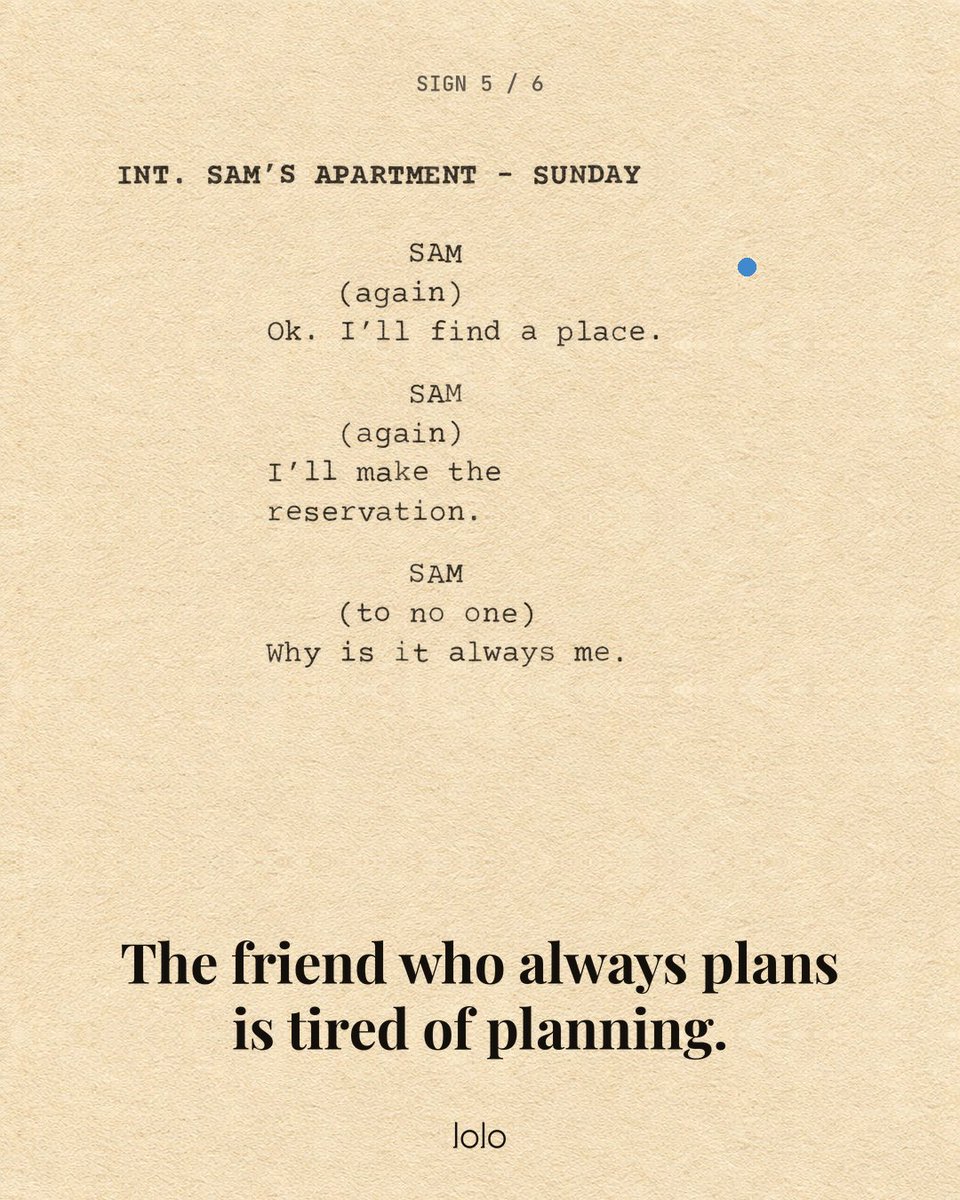
5. The one friend who always plans is tired of planning.
6. You find out the next day where everyone ended up.
Most of us have been the one typing "what's happening" into the void.
Something better is coming. Follow for the launch.
> Zero Bond has a 10,000+ person waitlist.
> SoHo House is opening 2 new locations in New York.
> 19 new members clubs have opened in NYC in the past 5 years.
Clout. Status. Everyone wants it – and they will pay.
That's why Chase, Amex, Spotify, and other huge finance + tech companies are investing billions of $$$ to own the sector.
Let me tell you more:
1. Chase Bank, in 2021, bought The Infatuation, a restaurant discovery platform, and uses its recommendations to source deals for higher-tier credit card holders.
Eating at a quality restaurant = high status social signal
2. American Express, in 2019, did a similar play with Resy, using its reservation system to give exclusive tables to Gold and Platinum card holders. In 2024, they bought Tock, another reservation platform, for $400,000,000.
Again, eating at a quality restaurant = high status social signal
3. Spotify. They're now reserving tickets for top listeners of the artist. Attention, tracked and converted into IRL value.
Being at a concert = high status social signal.
-
There's also something else at play, and it has to do with American culture, and its economy. America's average income dwarfs most other countries in the world.
Therefore, simple monetary incentives don't always work on Americans. Offering $5, $20, or even $100 for a signup bonus doesn't always convert, no matter how easy the task.
But offering an experience, like a table at a restaurant? It's relatively a fraction of the cost for the company, yet Americans will convert so much more, because status means more to the average American than cash.
To be in the room means more than it has in decades, driving the explosion of investment into IRL experiences for brands and communities.
Not everyone can be rich, but being in the room makes you seem rich, makes you feel rich. You're right there with the celebrities, the artists, the businesspeople.
Take one photo at a social club, or something like an "intimate founders dinner", post it on social media, and suddenly you're part of it – at least to people who are only seeing a picture.
It's escapism in pure form. But in a world so tumultuous, expensive, and confusing, it's fun to role play as high society.
That status, that clout, that feeling, is what drives that FOMO (no pun intended), and then drives sales for Chase, Amex, and Spotify.
Brands who create the best IRL experiences understand the modern human psyche on a deep level.
I paid all my bills in the past year only trading crypto.
But I'm not a rich trader. I only have a $10,000 portfolio.
This is how I've survived the current market conditions:
1. WAIT LONGER.
New metas and narratives for crypto emerge every few months. When they're on, play hard and run it up.
Since it's so trash right now, I've been throwing $100 here and there on random memes I like. I tried $NIO, $HUNG, and $MAX. None really worked, but at least if I lost money it wasn't a lot.
Memes are not my forte, I'm actually kind of terrible at them. My real edge is finding undervalued projects in new metas. I've done this with robinhood:0x39dbed3a2bd333467115de45665cc57f813c4571, solana:HeLp6NuQkmYB4pYWo2zYs22mESHXPQYzXbB8n4V98jwC, base:0x1bc0c42215582d5a085795f4badbac3ff36d1bcb, $ZEC and a bunch more.
The hard part is waiting and not blowing up between metas. You cannot lose your entire port or else you're just done for.
2. It probably won't bounce.
In market conditions like this, usually there is no bounce. Sometimes there's a small one and you think that was the bottom. I've been there. Sometimes, it sucks but you gotta just cut the P, mentally reset, and accept to work with what's left.
3. Avoid perps and leverage.
If your account is sub $10,000, I think onchain R/R is way better. You can get far bigger upside with comparable risk (arguably less risk) than perps. Sure, an onchain coin might rug. But if you're on anything above 5x leverage, you can get wiped out in one bad hour. They're just not worth IMO, but I've never done well w perps; some of you are surely better than me.
4. Know your own bottom, and protect it.
If you want trading to pay your bills, you have to know what your monthly bills cost. Keep at least 2-3x that amount in your port. Last thing you want is to trade away the necessary money and become desperate.
--
I only used $300 to restart my onchain portfolio this year. I'm a founder, bootstrapping my company. When I started building Lolo in February, I had some savings, but not enough to last me a year – especially considering I was living in South Florida, and now NYC.
Crypto can give great chances when the market's hot, but right now, it's way easier to lose your money.
But this is the reality of being a regular trader – not a rich one, just one who does enough to pay the bills.
And TBH, that alone is so valuable, I encourage you to get good enough at trading so you can do it too.