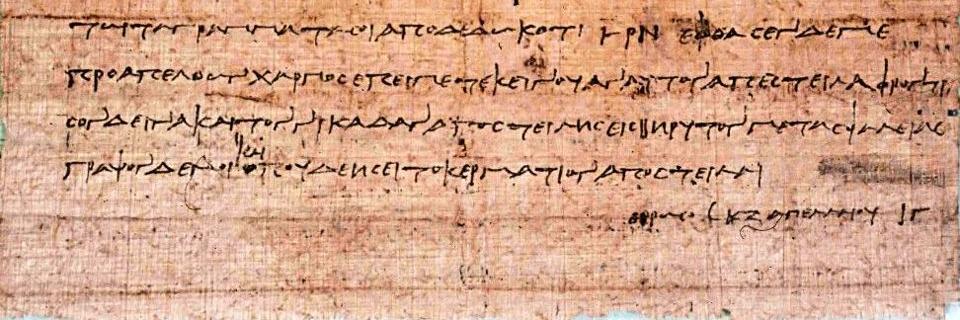
@Alyunan00 The text doesn't say that: it's ΜΗ(ΝΟΣ) ΣΕΠΤΕΜΒΡ(ΙΟΥ) ΚΔ, ΙΝΔ(ΙΚΤΙΟΝΟΣ) Η, Υ(ΠΑΤΕΙΑΣ) ΣΕΝΑΤΟΡΟΣ. Senator is the name of one of the consuls in 436. So, it's dated precisely.
@NC_Renic Ah, Greek school memories from the ...90s. 😁. Did it once with a compass only to find out that it's easier to memorize the damn notes than to inscribe them.
@mrpyrz One doesn't need t go too far back as the mosaic is late antique. In Mod. Gr. λακίζω is used in colloquial speech to denote "run away"/"chicken out". With the same meaning you can find σπάσε (lit. "break away") meaning "go away". "Let the evil-eye go away", sounds very familiar.
@AntigoneJournal Polish takes it one step further using the form Edyp and, accordingly, the adj. edypowy. I wonder why English has "tetrapod" though? Does it derive from the later adj. τετράποδος?
@Jorrit_Kelder Another question, has it been read correctly? What if Fοιναρχοι could be read as θοιναρχοι? Would it make more sense in the context of meals/feasts?
@bpthaber Worth comparing with the votive relief to Apollo Sozon from Phrygia, where again Apollo sits on a horse holding a double axe https://t.co/r50evvvX50
@theo_nash@Jorrit_Kelder@sensemolen Presumably a pre-Hellenic word based on its form, Lukab-assa. On wolves, light and mice, some ideas are discussed in: https://t.co/q6xMV5AYE4
The new Byz. Zeitrschrift 2024 vol. 117(3) is out. A long due joint piece by my colleagues M. Nowak, L. Vanderheyden and yours truly titled: 'The Greek will of Aurelius Pauchab and a Coptic inventory of household objects' https://t.co/ztakXMJffl #papyrology#Byzantium
The new "Aegyptus" vol. has just been published: https://t.co/yWCVoCUvz1 Here is my humble contribution with an edition of an undocumented papyrus from the coll. of the Law Faculty of Goethe Univ.: "Preparations for the Holy Feast: A Byzantine Letter from Frankfurt". #papyrology