A AI application is implemented as a embedded system, a mobile app or a cloud application. It consists of a data pipeline from data input to a control of a physical effect or display visual output.
A AI application is implemented as a embedded system, a mobile app or a cloud application. It consists of a data pipeline from data input to a control of a physical effect or display visual output.
Will Selfdriving cars pass a driving license test in the limits of the test zone. Planning and execution in robotics may ignore safety. Driving tests evolved over time and should be effectively used. A observer should monitor the AI.
Vision-language ➡️ vision-language-action model
By using a pre-trained VLM (e.g. PaLI-X), RT-2 enables robots to generalize to new objects & instructions
RT-2 also shows basic reasoning capabilities. (e.g. "place orange in matching bowl")
Paper+videos: https://t.co/m4U01OK9B5
The difficulty in building AI systems for audio video is the synchronization. If an AV frame is used for discriminative inference then audio needs to synch to the video frame. Video frames are easier to control. Generative AI will have similar problems.
A new smaller/more efficient #AI model is created from a existing model.
Important points for its use in applications, as the accuracy is similar but on test data are:
1. Model behaviour with real world data drifts
2. The model deterioration with time
Applicable for LLMs and MLP
Application can be built with #CNNl, #LLM or #VLM. The #AI model can not verify its output during #inference. The forward processing algorithm has no (or cannot do ) error checking for its results. This has to be done by the application software.
Training models for computer vision and using them for real applications follow different paths. The inference systems are complex and require considerable software engineering efforts. The complexity is directly proportional to the required determinism of output.
In automation, physical systems capture environmental information using sensors (audio, video). #MachineLearning#inference agents process this and output probabilities. These are used to produce motion and visual information (display,logs). #CPS#cyberphysicalsystems.
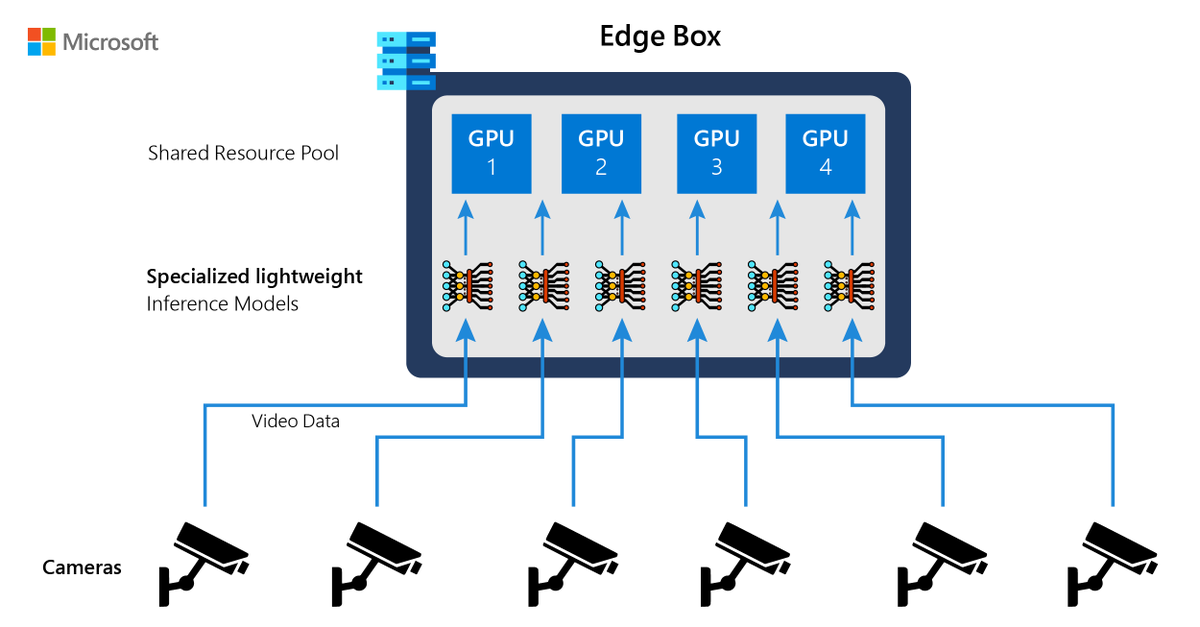
Edge computing requires minuscule compute footprints that are vulnerable to data drift—where live data diverges from training data. Learn how Ekya addresses this problem by enabling model retraining and inference to co-exist on the edge box: https://t.co/aCjm2cYn8G
The Intel engineers in the PyTorch open-source community have created an new Intel® Extension for PyTorch* which maximizes deep learning inference and training performance on Intel CPUs. Get the extension to make use of these features today:
@fanzhao_intel https://t.co/RMtyhRHeDE
Deep Learning is not yet enough to be the singular solution to most real-world automation. You need significant prior-injection, post-processing and other engineering in addition.
Hence, companies selling DL models as an API have slowly turned into consulting shops.
Shiller's advice is good in any field. Easy but sad explanation for why young people often ignore this advice : (N+1)th result in a field with N results is difficult to obtain, hence easy to publish. The 1st or 2nd result in a field are easier to obtain, but harder to publish.