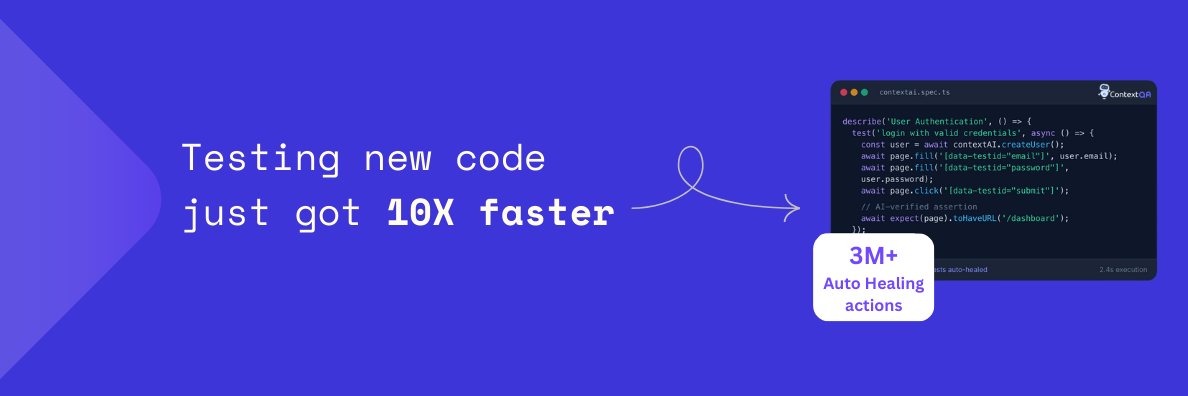
A chatbot gives you the fix. You still do the work.
An agent opens the repo, reproduces the bug, fixes the code, runs the tests and opens a PR.
Chatbot: it answers, you do the steps.
Agent: it does the steps, you review.
https://t.co/BeHAZkASvX
Build passed. Lint passed. The pull request still showed full account numbers to people who should only see the last 4 digits.
Ship ran the real flow on the QA app. 12 replays, 12 failures. The check said: not safe to merge.
You don't have to start with Selenium to get into test automation.
ContextQA Essentials on Udemy covers web, mobile on real devices, API and AI-powered testing, with self-healing tests and failure analysis. Short lessons, building from day one.
Course link below.
GTA 6 drops tomorrow. Ship dropped first.
New unlock: fast travel. Connect GitHub, Slack and Linear once, and Ship tests every PR and reports back where your team works.
Press start: https://t.co/bxVsLOPVY8
Big debate in AI coding this month.
What drives the results more: the model, or the harness around it (tools, memory, tests)?
We're curious where you land.
@IBMResearch and @kaggle gave AI agents 204 Java migrations.
About 97% compiled.
Only 63 to 76% passed their tests.
A green build says the code runs. Tests on the running app say it still works.
Which one does your pipeline check?
Stay on Provar if your suite is almost all Salesforce, stable and owned by trained authors.
Move when releases cross API, ERP and web, or locator upkeep eats your sprints.
The one test every alternative must pass:
Once AI agents write the tests, writing tests stops being the bottleneck. Deciding what to test and reviewing what agents generate becomes the job.
So should QA be central or embedded? Most teams land on a hybrid. Here is who owns what:
Meet Lavanya, our Content Strategist. In six months she took on social, YouTube, email and video, and brought AI into our marketing.
Off the clock: her own fitness content, the gym, and travel.
The Humans Behind ContextQA: https://t.co/uLvelkR1Tz
@JetBrainsHelp@intellijidea@thomaswue Thanks for the details. A fresh sandbox per test, and accepting the script only after every test passes, is a solid pattern.
AI in testing is everywhere. Practical guidance? Not so much.
ContextQA Essentials: Building and Running AI-Powered Tests is now live on Udemy.
UI, API, mobile testing + real workflows + AI-powered testing, all in one hands-on course.
Start learning → https://t.co/zcfWAqlL3t
@ChenChaim42853 Fair point. Twelve replays show the failure is repeatable, not that twelve cases are covered. Keeping those two apart, and showing a replay after the fix, is what makes the merge call easy to audit.
Build passed. Lint passed. Ship said: not safe to merge.
In this demo, a refactor quietly let Member accounts see full account numbers. Ship caught it in the deployed app, 12 of 12 replays, with evidence.
Claude Code wrote the fix. Your team still decides.
@superdapp Our take: test the deployed app on every pull request, not just the code, and keep the proof of each run so whoever merges can see exactly what was checked.