Thank you @chainlink for awarding YieldCoin the grand prize in the Chromion hackathon! We all know the entire world is going to run on Chainlink, so this is a great honor, and (was) a personal life goal.
Thank you @CyfrinUpdraft for the resources to learn invariant testing, formal verification, and the security first approach!
Thank you @concero_io for inspiring the idea, Parent-Child architecture, and custom CCIP tx types!
Thank you everyone for the support!
YieldCoin development continues alongside researching a proposal for the vLEI hackathon, Contract Level Identity (name pending review): A Decentralized Fuzzy Extractor, to address the critical need for absolute sybil-resistance by consensus - an inherent requirement for onchain identity and compliance.
Read the YieldCoin dev notes taken during the hackathon here: https://t.co/ABJjDAS4Zv
https://t.co/sbYVWRUw78 Yieldcoin v2 can optimize yield for any integrateable asset, so long as it's compatible with @chainlink CCIP and the supported strategies.
$USDC is intended to be the first instance
https://t.co/FvyQlt5o64 Known issue: settlement overwrites calculated total withdraw estimate with the actual amountOut
When an epoch closes with net withdraws, the expectedAmount is withdrawn from the strategy, and the amountOut is distributed pro-rata to withdrawers for that epoch.
Adapters revert if amountOut < expected
fwiw i see too much talk about that to be secure in ai age, you should formally verify
yes you should, to get more confidence, but its not a silver bullet.
its same as testing something, its as good as the properties you write.
https://t.co/QyGwjyqAm1 After a year of iteration, I can finally see the finish line with Yieldcoin. Audit ready by end of July - mid Aug, best effort estimates, assuming Certora and mutation testing doesn't reveal something new.
Currently working through known issues flagged by various tools and generally cleaning up the codebase, then:
- certora (🥳)
- mutation testing
- tvl impact rough simulator in workflow
- comprehensive docs (including incident response plans, threat modeling, etc)
- probably some other stuff... the proxy question lingers and the closer this codebase gets to being audit-ready, production grade infra, the more attractive they appear.
Happy with the progress.
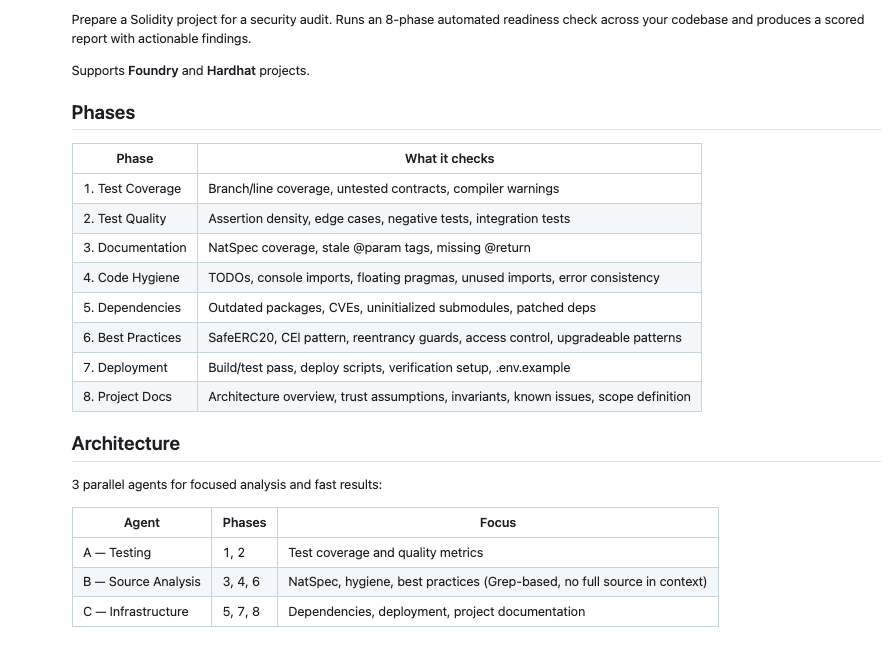
Yieldcoin v2's EVM contracts are currently scoring 91/100 in audit readiness from @CDSecurity_io audit-prep skills
havent even started gas optimizations or certora
🚨Reminder: we have a free open-source pre-audit tool for Solidity and Rust.
Run it before sending code to auditors. It checks coverage, test quality, docs, hygiene, dependencies, deployment setup, etc.
Fix the obvious before the real audit starts.
https://t.co/LZYBUCQ3A0
Reaching that point in an invariant suite when the infra doesn't need much more handling and you can just drop in assertions is one of the most satisfying parts of smart contract development
https://t.co/cXwiWcEEri
@koeppelmann Before talking about formal verification, let's talk about formal specifications. AI will eventually make formal specs accesible to developers and also make automatic formal verification feasible.
We're working on it for smart contracts and beyond.
https://t.co/qDdKzctekx Recovery mode handling is now split into failure staging and recovery to assert global properties between failures. Users can still deposit, withdraw, cancel, and claim during failures - it's just epoch and rebalance transitions that don't execute.
Codex was visibly nerfed today and claude tokens are mostly used on security scans, so a lot of this was done by hand 🫠
Progress on the Yieldcoin v2 invariant suite is going well. It's been about 2 weeks since this section of the codebase was started, although a few of those days were spent on the Go workflow and Rust relay.
Even with the help of AI, it's intense.
#1 on @ZealynxSecurity eMBA leaderboard 🥳
https://t.co/0WLESc10ID
The security module drills a lot of essential opsec related knowledge that often gets overlooked