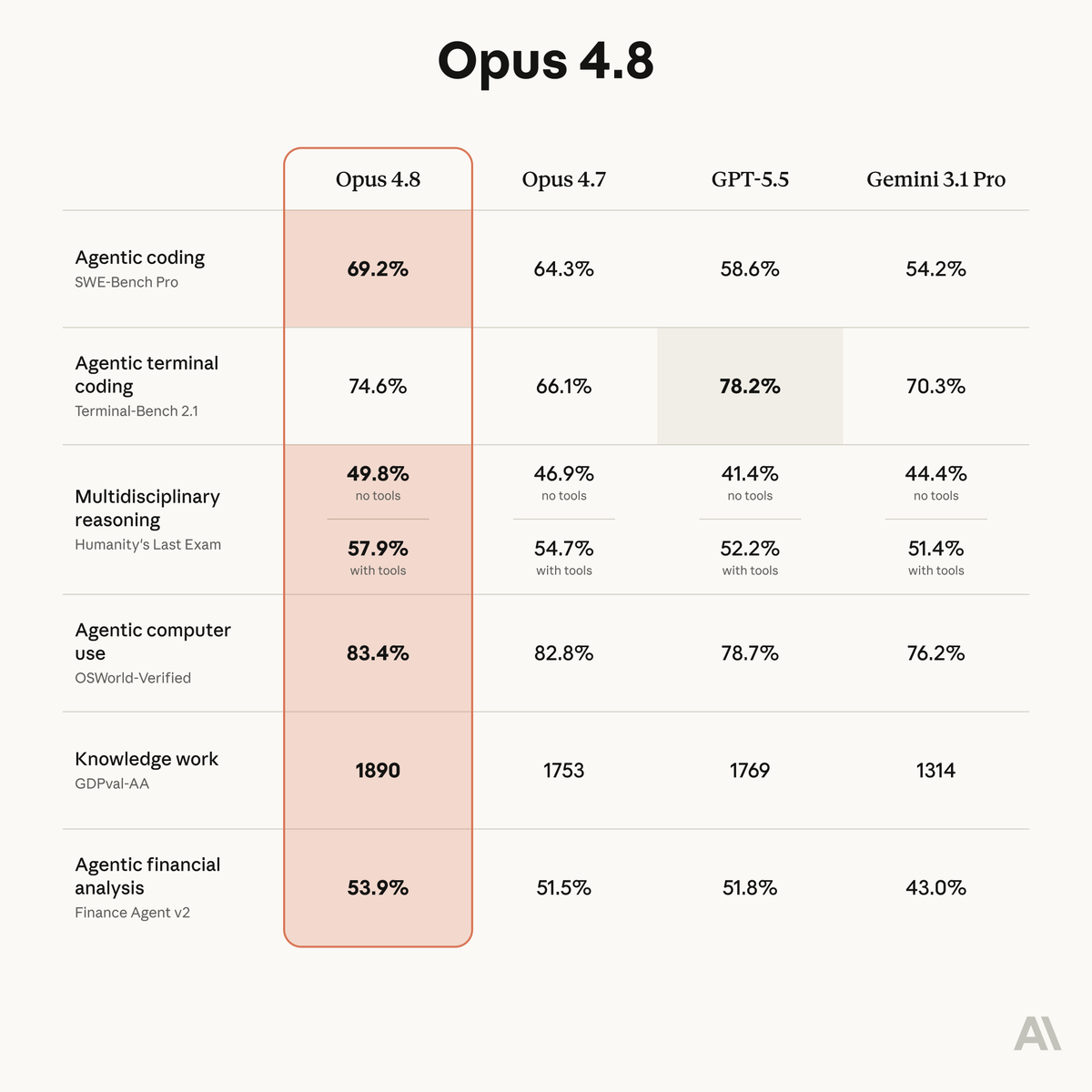
Introducing Claude Opus 4.8: it builds on Opus 4.7 with sharper judgment, more honesty about its own progress, and the ability to work independently for longer than its predecessors.
Available today at the same price.
* I don't know how to write code by myself; instead, I understand what every piece does, why it fails, and how to verify. I used agents like Amplifier.
* I will learn how to read code, not to implement it; instead, it is for auditing.
Is my approach wrong?
The Law of Leaky Abstractions (or Spolsky's Law) talks about the impossibility of having a perfect abstraction layer that is capable of ignoring the implementation details below. That's more important today with AI Agents and the commoditization of coding.
https://t.co/Z7B8USHtJT
At the start, developers translate business logic into logical instructions in some programming language to solve a domain problem.
So I tried to learn code to be able to implement things myself without relying on AI.
But I think that isn't the best approach.
How to contribute to open source :
Step 1:
>Don't overthink it.
>Open source is just people building things together.
Step 2:
>Pick one programming language you’re comfortable with.
>You don’t need to know everything.
Step 3:
> Learn basic Git & GitHub.
> Clone, branch, commit, open a PR ,that's enough.
Step 4 (important) :
>Find a project.
>I use Ossium (link in replies) to find projects by interest.
Step 5:
> Choose small, approachable repos.
>Avoid scary ones at the beginning.
Step 6:
>Set the project up locally.
>Understand how it actually works.
Step 7:
> Look for a small issue.
> Docs, bug fixes, or tiny
improvements are perfect.
Step 8:
> Fix it and open a PR.
> Don't overthink it.
Step 9:
> Learn from reviews.
> Your first merged PR builds confidence fast.
That's how open source really starts.