"...It is inconceivable that I who am so caring and loving to my friends and family could behave in such a cruel indifferent fashion...the individuals psyche suffers feom a form of spiritual stroke resulting in an emotional blackout."
@avantikatewari@veenadubal This is the typical upper class/caste mentality, how much less can I pay the worker, and how much less will they accept before retaliating? Now tech bros are using personal data to do this @gauravsabnis
Almost all the countries I've visited & lived in, transport to & from the station or airport is mainly through public transport, either bus or tram, & in some cases bicycles.
Only in SL & Maldives did I have to take a taxi to the hotel.
"On the morning Noida International Airport opened, there was no way to get there except by private vehicle or an expensive cab ride" —I read and re-read this sentence 4-5 times and then realized that we (in India) have generally been conditioned to believe that "airports = cab ride" as default transportation. This writer may be accustomed to "airports = public transport" as default to-and-fro transportation.
“In the past, family portraits centred grandparents, surrounded by their grandchildren. Today, portraits centre children, surrounded by their elders. We still have a window for cultural change: a revival of large families, siblings, and cousins. Not for all families. Not even for most. But for a meaningful minority. A gentle glide, rather than abrupt population collapse, requires full-throated embrace of a new credo: Hum do. Humare teen.”
My views:
The passage is vulnerable because it substitutes sentiment for argument.
The image of grandparents surrounded by grandchildren versus children surrounded by elders is evocative, but it is not evidence. It appeals to nostalgia for a social arrangement that many people remember selectively.
One could just as easily say:
“In the past, family portraits often concealed overcrowded homes, financial insecurity, limited educational opportunities, high maternal mortality, and lives circumscribed by necessity rather than choice.”
The existence of more siblings and cousins is not inherently a social good. What matters is whether those children have access to opportunity, health, education, and a decent quality of life.
There is also a curious elitism embedded in the argument. For affluent families, large kinship networks can be celebrated as cultural richness. For ordinary families, each additional child represents a major financial and emotional commitment. The question is not whether cousins are delightful. Of course they are. The question is who bears the cost of creating this demographic ideal.
More fundamentally, the article never really answers the central question: What problem is a third child supposed to solve in India today?
Is India suffering from a shortage of people?
We are the world’s most populous country.
Is India suffering from a shortage of young people?
We have one of the largest youth populations on earth.
Is India suffering from labour scarcity?
Millions of educated young Indians struggle to find productive employment.
Is India suffering from a shortage of demand?
Our cities, roads, trains, schools, hospitals, and public services are already under immense pressure.
The demographic challenge India faces is not primarily one of numbers. It is one of capability. We have not yet succeeded in educating, skilling, employing, housing, and providing healthcare to the vast population we already possess.
That is why the article can come across as oddly detached from contemporary India. It speaks as though population exists in a vacuum, when every additional citizen requires schools, hospitals, transport, housing, water, energy, and jobs.
The phrase “a meaningful minority” is especially revealing. A meaningful minority of whom? Urban professionals? Rural families? Working women? The article never grapples with the fact that the costs and consequences of a third child fall very unevenly across society.
And perhaps the biggest weakness is that it confuses a cultural preference with a public policy objective.
One may personally enjoy having many siblings and cousins. One may cherish memories of large extended families. But public policy cannot be built on nostalgia. It must be built on evidence.
India’s future will depend less on how many children are born than on what kind of country those children are born into.
A crowded family photograph is not a development strategy. A functioning school system is. A reliable healthcare system is. Affordable housing is. Clean air is. Walkable cities are.
Until those questions are addressed, “Hum do, humare teen” risks sounding less like demographic wisdom and more like a slogan in search of a problem.
https://t.co/psUVmJzaXA
Whenever the forced e20 mandate is questioned, NiGa's paid PR agency and IT cell bots become Vengaboys and start singing "Brazil".
To all such parrots -
Stop comparing India’s aggressive E20 roll-out to Brazil. It's a completely flawed parallel.
- Brazil started its "Biofuels" program way back in the 1970s. They spent 50+ years slowly building their entire fuel ecosystem, allowing infrastructure and automakers to mature gradually. We are compressing that timeline radically, leaving consumers to deal with sudden transitions.
- In Brazil, consumers get actual choice at the pump. They can select different blends at different, heavily incentivised price points. Crucially, ethanol is priced according to the "70% rule" - at least 30% cheaper than petrol - to offset its lower energy density. In India, consumers lack choice, and the discount on high-ethanol blends (like E85) doesn't yet cover the 20-30% drop in mileage.
- Brazilian roads are dominated by Flex-Fuel Vehicles (FFVs) capable of handling E0 to E100, a technology they mastered over two decades ago. India, however, has a massive legacy fleet of over 30 crore older vehicles built for E5/E10, which face serious risks of engine corrosion and exponential mileage drops on high blends.
- Finally, the environmental cost is vastly different. Brazil's sugarcane fields are largely rain-fed, blessed with abundant water. In contrast, India's sugarcane and grain-to-ethanol production draws heavily from highly stressed groundwater reserves, making a blind copy of the Brazilian model an ecological nightmare for our water security.
Forcing mandates without choice, true pricing parity, or technical maturity isn't following the "Brazil model" - it's ignoring it.
@PetroleumMin@HardeepSPuri@nitin_gadkari@PMOIndia
Tbh, Indians have never really been encouraged to question authority. That creates a fundamental contradiction.
We are nominally a democratic polity but most of our social institutions are deeply authoritarian in structure.
Two Indias:
1. Keralam has free High edu till postgraduate.
2. UP raises the Uni fee by 110%.
Yet, Yogi will say that States should follow the UP model.
Sigh.
Dear CM @myogiadityanath, you might be aware that Lucknow University has hiked fees by up to 110% in one stroke. Making already expensive education even more unaffordable.
And when @nsui students were protesting this harsh and unjust burden on poor and middle-class students, University has responded with expulsion and criminal cases.
@lkouniv, you are a public university. This is not how a public university should treat students fighting for affordable education. They are students fighting for fellow students. Not criminals. Listen to them. Work with them.
▪️ Roll back the fee hike immediately
▪️ Revoke the expulsion of student leaders
▪️ Withdraw all cases filed against protesting students
Stand with the students of Lucknow University in their fight for affordable education and democratic rights.
@lkouniv@CMOfficeUP@lkopolice
This is not a rant by a random genocidal lunatic. It's a public post by the national security minister of the Israeli regime.
The genocidal death cult headquartered in Tel Aviv is a threat to all of humanity. It threatens all humans. Its only interest is permanent war.
A kid, a Class 12 student, is posting about student suicides. While the govt is busy collecting MPs and MLAs like stamps.
Why doesn't the govt care? Because it only wants electoral victory. To declare a Hindu Rashtra. It has no interest in actual governance or administration.
If this is the state of the Agra metro, one can only imagine the state of the airports in UP, Bihar, MP. Ppl just don't have the money to travel in these.
Meanwhile industrial towns like Coimbatore and Salem which need transport are denied metros
Greater decentralisation is the only solution - when a city pays for its own metro project, viability studies will be undertaken more seriously.
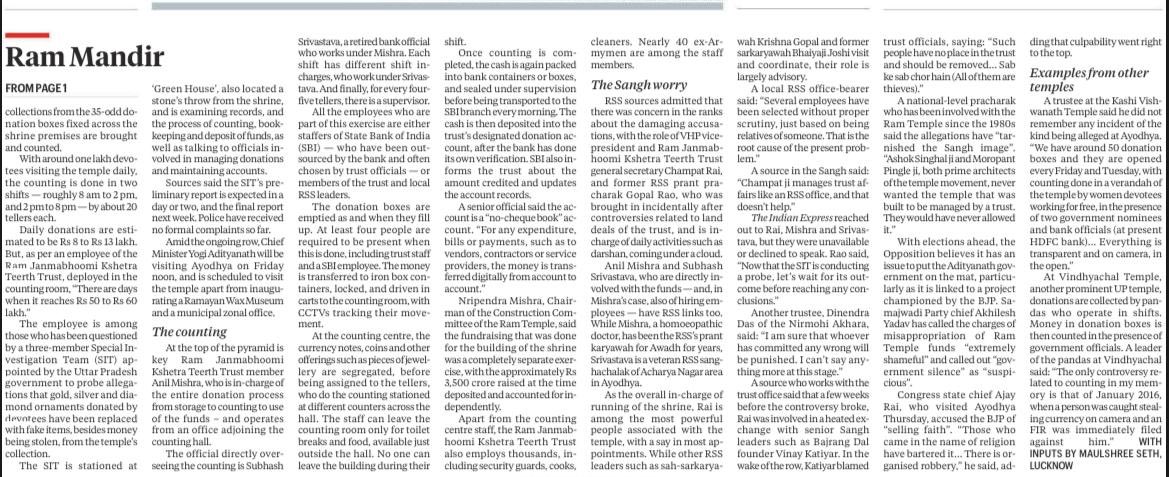
A couple of things. No mention of video recording of when the donation boxes were emptied and counted. No mention of an FIR.
Also the charge that Mr Champat ran it like a RSS office is rather weird, because it implies RSS offices are mismanaged and corrupt.